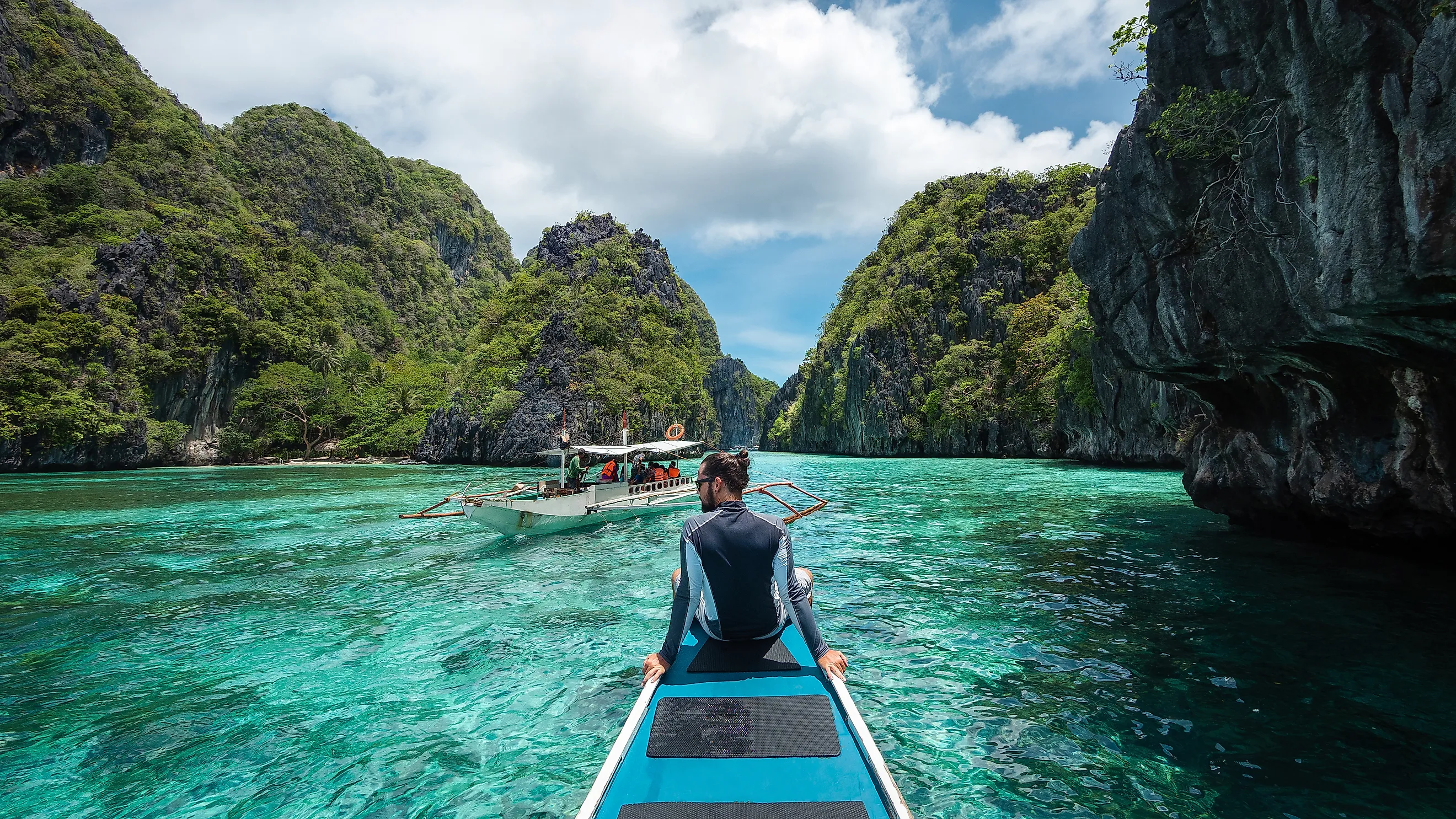
Island Hopping In The Philippines
The term island hopping is redundant in the Philippines. This archipelagic nation spans roughly 7,641 islands (the count shifts with the tides), 2,000 of which are inhabited. Stay anywhere more than a city break and you are booking shuttles, flights, ferries, and multi-day tour boats whether you planned to or not.
Those logistics are part of why Philippine tourism numbers trail its Southeast Asian neighbors. With patience and a padded transit budget, though, island hopping here rewards the effort. Come along as I work through the wild streets of Manila, the slow beaches of Palawan, the Chocolate Hills of Bohol, and a fair number of harder-to-find corners between them.
Luzon
Manila

The Philippines has several international airports, but odds are you land in the capital. Ninoy Aquino International drops you straight into the core of Luzon, the country's largest island, and one of the most densely populated cities on Earth. Metro Manila's official count is around 15 million; the UN puts the functional metro closer to 25 million. The traffic chokes, the air is heavy, the noise never stops, and a lot of people live on the street. If this is your first developing megacity, brace yourself.
Beyond the Chaos

I know what you are thinking: Why not just fly straight to a nicer island? Manila earns its time, though. Even setting aside the global perspective the rough side delivers, the calmer neighborhoods are worth a few days. Rizal Park anchors the city centre with two major museums. Intramuros, the "Walled City," still carries the 16th-century stonework from when the Spanish Empire had its sights set on Asia. Satellite districts like Makati and BGC give expats and tourists clean parks, affordable condos, and a steady supply of third-wave coffee and smoothie bars. Manila also works as a launching pad for the rest of Luzon: the mountain towns of Baguio and Sagada, the rice terraces of Banaue, the Historic City of Vigan.
Palawan
Puerto Princesa

Maxed out on Manila? The logical next move is a flight to Palawan, home to slow villages, wild beaches, and the Western tourist rallying point of El Nido. Most travelers walk out of Puerto Princesa International Airport straight into a shuttle bound for the north end of the island. Stick around in P.P. for a day or two and you get a city full of characters, an overlooked waterfront, and a stack of side quests waiting on anyone comfortable with a scooter.
A note on local transport.

Even once you arrive on your island of choice, getting around takes work. You want to skip the city centre and find the secret beach your guidebook promised? Rent a bike. Or board a Jeepney, the retrofitted army vehicle that runs slow, packs in twenty people who should be ten, and pumps a steady line of exhaust into the cabin. Or you pay too much for a taxi, assuming the driver agrees to brave the dirt road at all. I will not pretend a scooter is intuitive in urban Filipino traffic, and the highway roadkill is gut-wrenching, but no other option matches the freedom.
Port Barton

Port Barton was my favorite destination in the Philippines. A three-to-four-hour shuttle ride north of Puerto Princesa, this bohemian town breaks up the long slog to El Nido and, by a lot of measures, beats its more famous neighbor. Port Barton has the right amount of touristic infrastructure: snorkel, dive, and island-hopping tours; a steady base of like-minded travelers; a few authentic residences mixed in; some local joints with fair prices; and lesser-known beaches that you can actually reach. One has wild pigs on it.
El Nido

El Nido is a polarizing place. It sits on a small bay surrounded by sheer limestone, and the arrival itself is the kind of view that pays for the trip. Add the day tours to emerald lagoons and the multi-day excursions to islands further out (more on those in a moment), and the tourist gravity makes sense. The flip side is the development that has come with it. A lot of people now leave El Nido feeling overcharged, overcrowded, and underwhelmed.
At the risk of losing my cool-guy travel mystique, I enjoyed El Nido. I accepted in advance that it was not going to deliver the authentic portion of my Philippines trip and used the two days in the Westernised town for what it does best: bougie coffee, avocado omelets and green salads (no Jollibee here), a gym with the best view I have hit a treadmill at, and craft beer (instead of just San Miguel) on the sand.

Those two El Nido days were not consecutive. They bookended a mid-week reprieve in Bucana, a sleepy beach town 20 kilometres up the coast. The Jeepney took over two hours to cover that distance because we kept stopping for passengers and roughly 1,000 pounds of pig feed. After that came the wait for the makeshift ferry, hand-tied together after the river bridge washed out in a recent storm. That is life for rural Filipinos. It is probably the intrepid travel experience El Nido itself had in the early days. But like Pai or Bali, the trick now is to find the next undiscovered satellite town before the rest of the world does.
El Nido served one more function for my trip. It was where I booked the 3-day, 2-night boat tour that ended up being the highlight of the whole route, and the transport to my next island.
I'm On A Boat

If you book online ahead of time, you have several well-reviewed operators running multi-day excursions between El Nido and Coron (or the reverse). On the ground, hotel leaflets and tour agencies offer more. Even over Christmas, I arranged a departure for the next morning. I went with Tribe Banua and was very happy with the experience; plenty of other companies run similar itineraries at similar prices.
The going rate has nudged up since I was there, to around $400 USD. Understandable given the fuel shortage and the broader economic landscape. The way I read the bill: it covered two nights of accommodation, daily feasts of fresh fish and fruit and rice, the raw transport I would have had to buy anyway, and access to smaller and uninhabited islands I would never have reached on my own.

The trip hits at least half a dozen snorkel sites. Note: starting from El Nido, the spots get progressively better, so do not burn yourself out on day one. By day two most of my boatmates were sunbathing on deck instead of gearing up, and they missed the best coral. If you are running the trip the other way, hammer those first anchor points.
The expedition also threw in a few secluded beaches, the cliff-jumping stop, and two rustic island camps with drinks included, karaoke after dark, and wicker huts strung with bug nets. I had hoped for more contact with local communities, but the Filipino crew were friendly, and we did get a resupply at a small island village (some of the European clientele needed more cigarettes).
Coron Confusion

The El Nido excursion terminates in Coron. Not the island of Coron, the port city of the same name on the island of Busuanga. I had assumed Coron would be the chill counterweight to El Nido. It is not. The harbour and main strip run frantic, the road is barely wider than the two lanes of traffic it has to carry, and walking is more of a survival exercise than a pleasure. As is often the case in the Philippines, though, push past the commercial core and the place opens up.

The 725 steps up Mount Tapyas hand you the fresh angle on the city and the panoramic Jurassic-park view of the interior, with Mount Dalara rising in the distance (a much harder hike, but still doable). Rent a scooter and Busuanga reveals itself as a predominantly rural island. If you scuba, the underwater WWII Japanese shipwrecks rewrite your sense of Coron entirely.
Go To Bohol

The second image that lodged in my head while researching the Philippines was the Chocolate Hills at the centre of Bohol. The 1,776 pyramidal mounds look at first glance like manmade earthworks. They are not. They are uplifted and eroded coral deposits overgrown with grass, which turns brown in the dry season. To get there, take the two-hour Cebu City ferry across to Bohol, then catch a bus to one of three base towns: Sagbayan, Carmen, or Batuan.

The same three towns sit within half-day-trip range of the island's two tarsier sanctuaries. Tarsiers are tennis-ball-sized, beady-eyed primates that live on only a handful of islands across Southeast Asia. Habitat loss has gutted most subspecies, and they do not handle captivity well; the stress of being around humans (especially loud ones with camera flashes) kills them. So I went in conflicted. On the one hand, safe havens and breeding grounds for the species are exactly what they need. On the other, I was about to become part of the crowd. On the morning I visited the Bohol Tarsier Conservation Area, attendance was modest, the staff funnelled visitors through at a controlled pace, and the keepers actively shushed anyone who started chatting near the cageless nesting areas. Your own research and value system may dissuade you from going. Speaking only from a tourism perspective, the tarsiers are part of what makes Bohol unique.
Different Sides of Cebu

Rather than double back to Manila, novelty-seeking travelers can fly out of Mactan-Cebu International, just outside Cebu City on the island of Cebu. The Philippines' original capital feels like a smaller version of the current one in terms of traffic and wealth disparity. It also raises the ante on street food, mall culture, and affordable luxury accommodation.
My condo in Lahug had a rooftop pool and panoramic views: the city skyline on one side, the backdrop mountains on the other. From there I could walk to IT Park, where the Ayala Mall's Central Bloc spills out into sit-down restaurants and outdoor food courts.

Going deeper into the city, taking random turns off Pope John Paul II Avenue, I hit neighborhoods marked by strings of coloured flags. Kids zipped past on flip-flops and skateboards. Dads ran unsanctioned cockfights. Moms watched over from apparel stalls and food carts. This side of Cebu is not going to be for everyone, but it is the most honest version of everyday life in the big city.
From the centre, it is easy to forget the rest of Cebu Island is colonial coastal villages and undeveloped mountains. The periphery hands you jungle hikes, canyoning, swimming in bright blue pools under waterfalls, and an outing to swim with whale sharks. Not a bad counterbalance to Cebu City.
Salamat Po

Island hopping around the Philippines, or the sliver of it I managed to see in a single trip, left me with mixed feelings. Scrolling back through my photos, I get the full Instagram set: white beaches, karst bays, green hillscapes, shimmering seas. I also get the B-roll: rough streets, gritty neighborhoods, towns without running water or trash collection, and hubs that despite the country's modest tourism numbers have already taken on the complicated consequences of being on the global map.
These dynamics are not unique to the Philippines; they show up across Southeast Asia. They are worth flagging in case the Philippines is your first stop in the region. With a little more logistical planning than Thailand or Vietnam demands, and the same tolerance for the highs and lows you encounter in those places, you will find a few happy places across the country's 7,000-plus islands.