The National Parks With The Most Reptile Species
Cold-blooded reptiles are commonly associated with desert environments. In reality, they are among the most adaptable animals in the United States. They thrive in subtropical marshes, arid canyons, and cool mountain forests alike. That adaptability is why a few national parks are home to more reptile species than almost anywhere else in the country. Everglades National Park, the only place where alligators and crocodiles coexist, supports more than fifty on its own. Rattlesnakes and lizards crowd the desert at Saguaro and Big Bend, while different species fill the cooler Great Smoky Mountains.
Everglades National Park, Florida

Everglades National Park is a hodgepodge of reptile activity. It is the only place in the world where both alligators and crocodiles coexist. The mixture of freshwater from Lake Okeechobee and saltwater from the ocean makes the dual existence of the American alligator (Alligator mississippiensis) and the American crocodile (Crocodylus acutus) possible. Aside from these giants, there are over 50 species of reptiles found in Everglades National Park.
These reptiles include both native and invasive species. The Florida mud turtle (Kinosternon steindachneri) is harmless, while the Eastern diamondback rattlesnake (Crotalus adamanteus) has a venomous bite that can be fatal to humans. The green anole (Anolis carolinensis) reaches only about eight inches, while the invasive Burmese python (Python bivittatus), once classified as a subspecies of the Indian python, can grow over 18 feet long and has been documented preying on alligators. Such variety thrives in the Everglades because of the consistently warm subtropical climate of South Florida and the diverse wetland habitats.
Big Bend National Park, Texas

As they are ectothermic, reptiles are well adapted to the West Texas desert heat in Big Bend National Park. Keeping warm in the desert does not require much work; therefore, any energy generated is used for reproduction and finding food, instead of on temperature regulation. Between snakes, lizards, and turtles, there are 56 different species of reptiles found in the park. Even though there are only a few wet places in the park, they do support four species of turtles, some of which can be found in the desert areas of the park during the summer rainy season.
Similarly, snakes are also most active after the summer rains as their underground burrows are flooded, forcing them to seek higher ground. Lizards are as elusive as snakes, often heard scuttling through vegetation rather than seen. However, the Chihuahuan greater earless lizard (Cophosaurus texanus scitulus) has one of the largest ranges in the park, occupying the Rio Grande floodplain and the foothills of the Chisos Mountains. These lizards are extremely tolerant of heat, often seen basking on roads at night. However, they generally only live up to three years because they struggle to keep warm during winter dormancy.
Saguaro National Park, Arizona

Venomous reptiles abound across the Sonoran Desert of Saguaro National Park. Rattlesnakes are the usual suspects associated with the desert, and in Saguaro that is no exception. There are six different species of rattlesnake in the park, and they are found at all elevations, across the desert floor and up into the pine forests of the Rincon Mountains. The park is also home to the Sonoran coral snake (Micruroides euryxanthus), an elapid whose neurotoxic venom is often compared in potency to a cobra's. Its small mouth and low venom yield, however, make bites to humans rare and seldom serious.
Aside from venomous snakes, Saguaro is also home to one of only two venomous lizards in North America, the Gila monster (Heloderma suspectum). They often inhabit rocky lowlands, desert scrub and grasslands, and rocky canyons. However, in Saguaro, they have been recorded as high as 7,000 feet in elevation. Despite a healthy population living in the park, they are among the rarest reptiles to encounter in the Sonoran Desert. But the same could be said for all 50 species of reptiles found in the park. Reptiles are rarely seen in the park except during the summer monsoon.
Grand Canyon National Park, Arizona

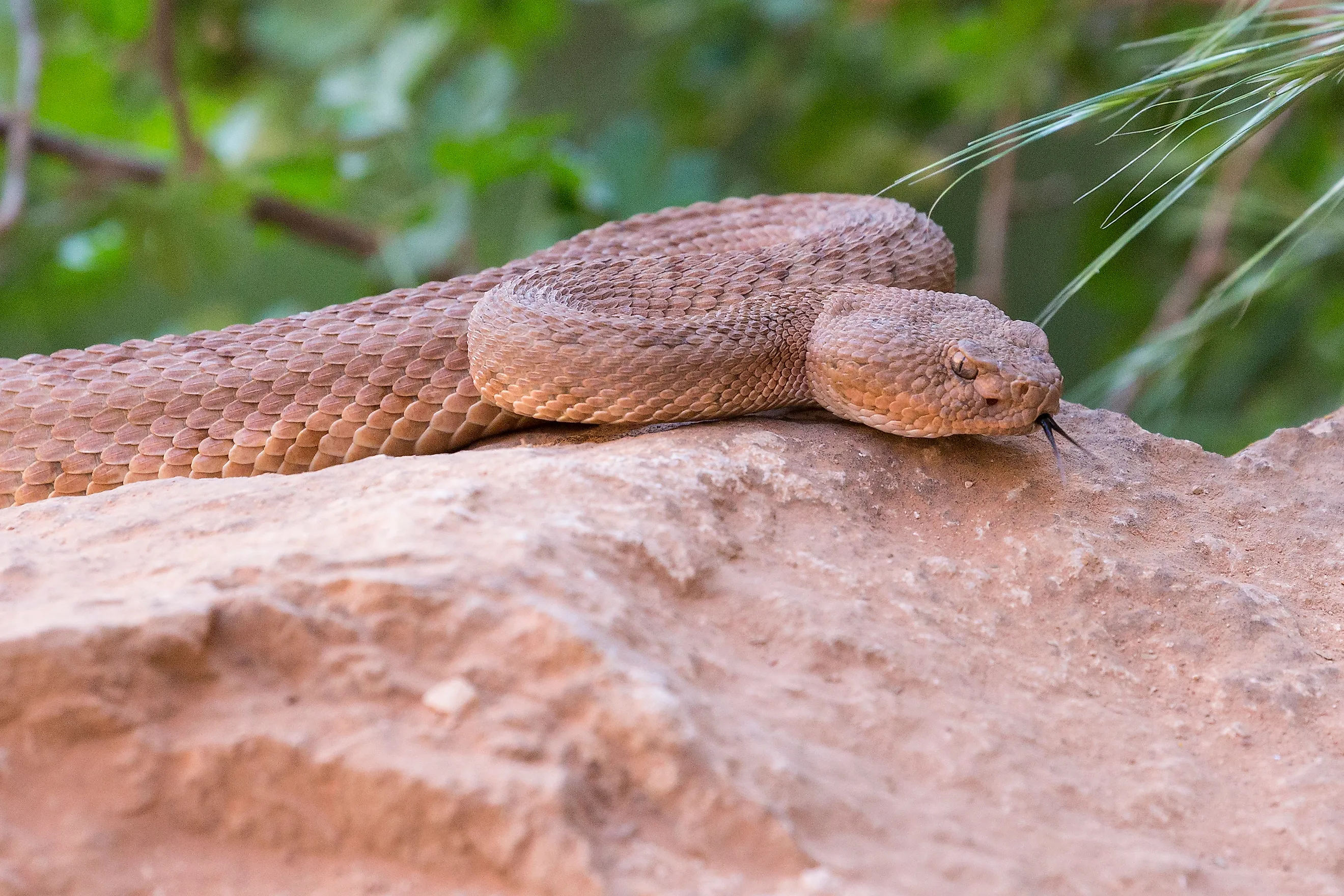
Grand Canyon National Park shares a similarity with Saguaro National Park: they are both home to six species of rattlesnakes and the Gila monster. Grand Canyon National Park stands apart because it has a reptile found almost nowhere else on Earth. The Grand Canyon rattlesnake (Crotalus oreganus abyssus) lives below the rim, where its pink coloration helps it blend into the varied rock layers.
But reptiles inhabit every area of the park. There are 41 different species that are found between the pine forests on the rim and the Colorado River below the rim. The collared lizard (Crotaphytus collaris) is commonly seen, while the desert tortoise (Gopherus agassizii) remains elusive. Reptiles play many important roles in the ecosystem of Grand Canyon National Park. Many are preyed upon by raptors and mammals, while lizards and snakes control insect and rodent populations, respectively.
Great Smoky Mountains National Park, North Carolina and Tennessee

Reptiles are incredibly versatile. They are not limited to the desert heat of Arizona and subtropical climate of Florida. They are also found in abundance in the uplands of Great Smoky Mountains National Park. Snakes rule supreme in the Smokies. Out of the 40 species of reptiles found in the park, 23 of them are snakes. Several of these snakes are common and harmless, like the northern water snake (Nerodia sipedon), the northern black racer (Coluber constrictor), and the eastern garter snake (Thamnophis sirtalis).
While there are venomous snakes, the northern copperhead (Agkistrodon contortrix) and timber rattlesnake (Crotalus horridus) are characteristically shy, opting to remain hidden amongst the leaf litter. While there are nine species of lizards in the park, one of them resembles a snake. The eastern slender glass lizard (Ophisaurus attenuatus longicaudus) has no limbs whatsoever, yet it is distinguishable as a lizard because it possesses moveable eyelids and external ear openings, which snakes lack.
Remarkable Reptile Diversity
Reptiles exist in almost every corner of the United States, in almost every climate and habitat. That diversity turns up in national parks across the country. Everglades is the only place where alligators and crocodiles coexist. Grand Canyon has its own endemic species of rattlesnake. The Smokies even have a lizard that looks like a snake.