Gila Monster
Two facts about the Gila monster do most of the work in selling this lizard to a general audience. First, its venom is the reason Ozempic exists. The blockbuster GLP-1 drugs that reshaped diabetes care and the global weight-loss conversation began with a peptide isolated from Gila monster saliva in the 1990s. Second, in February 2024, a 34-year-old man in Lakewood, Colorado died after being bitten by a juvenile pet Gila monster only 12 inches long. According to the autopsy, complications of the venom were the official cause of death. It was the first confirmed human death from a Gila monster bite in nearly a century. Both facts run counter to the lizard's reputation as a sluggish, harmless, prehistoric-looking oddity of the southwestern desert.
What It Is

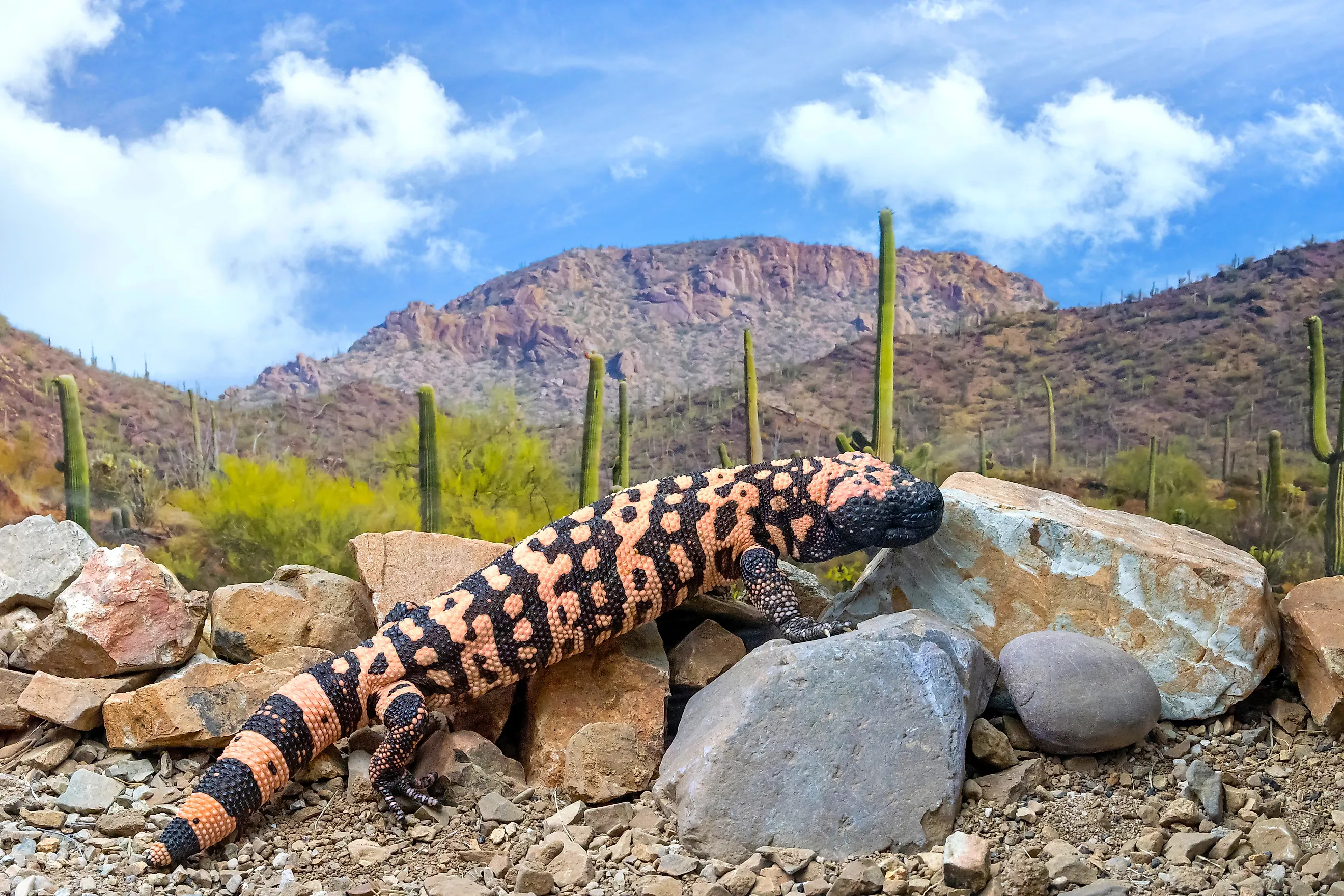
The Gila monster (Heloderma suspectum) is the largest lizard native to the United States and one of only two venomous lizards on the continent. The other is the beaded lizard, found further south in Mexico and Central America. The Gila monster takes its name from the Gila River Basin in Arizona and New Mexico, where the species was once abundant. It also lives in the southern tip of Nevada, southwestern Utah, the southeastern corner of California, and across northwestern Mexico, with significant populations in the Mexican state of Sonora.
An adult Gila monster grows up to about 22 inches long and weighs between 3 and 5 pounds. The body is covered in beady scales called osteoderms, the head is broad and rounded, and the tail is short and thick (the tail stores fat for lean periods). The signature color pattern is black with bright orange, yellow, pink, or salmon markings. In the wild, the patterns help the lizard disappear into dappled desert shrubs. Gila monsters can live more than 20 years in the wild and 30 years or more in captivity. Their ancestors in the family Helodermatidae date back tens of millions of years, into the late Cretaceous, which is why field guides often call them living fossils.
Mostly Underground

Gila monsters spend roughly 95 percent of their lives underground. They live in burrows, dens, and caliche caves cut into desert scrub and semi-desert grasslands across three of North America's deserts: the Sonoran, the Chihuahuan, and the Mojave. Two subspecies divide the range. The reticulated Gila monster lives across the Sonoran Desert, northwestern Sinaloa, and the southern reaches of Arizona and New Mexico. The banded Gila monster occupies western and northwestern Arizona, with smaller populations stretching into California, Nevada, and Utah.
The lizards emerge mostly between March and June, usually in the early morning or late afternoon. In the hottest months, they may surface only after dark. They become noticeably more active during summer rainstorms. Outside this brief active window, the rest of the year is spent below ground, where temperatures stay stable and humidity is higher than at the surface. The hidden lifestyle is the main reason Gila monsters are notoriously hard to study and even harder to spot in the field.
What It Eats

Gila monsters are carnivores with a strong preference for eggs and newborn mammals. When eggs are scarce they will take young rabbits, kangaroo rats, ground-nesting birds, smaller lizards, and frogs. Centipedes, worms, carrion, and the occasional insect round out the diet. They locate food using a forked tongue that picks up chemical scents from the environment, the same mechanism snakes use. They will climb cacti and shrubs to reach bird and reptile eggs, and they regularly dig into ground nests to do the same.
The headline detail about Gila monster feeding is the volume. In a single meal, an adult can consume up to one-third of its own body weight. The fat is stored in the tail and used over the months they spend underground waiting out the hot summer or cold winter. An adult Gila monster may eat only five to ten substantial meals in an entire year.
The Bite

Gila monster venom is delivered through grooved teeth in the lower jaw, not through hollow fangs like a viper. When a Gila monster bites, it clamps down and chews, working the venom into the wound. The bite can be held for several minutes, and once locked on, the lizard can be very difficult to dislodge. The venom contains a complex mix of toxins that produce intense local pain, swelling, weakness, low blood pressure, and nausea. There is no antivenom.
Despite the unpleasantness, deaths in humans are extraordinarily rare. The 2024 Colorado case is widely reported as the first confirmed fatality in modern times; the previous reported death was in 1930. Christopher Ward, the man who died, owned two Gila monsters illegally. The juvenile that bit him latched on for about four minutes. The Jefferson County coroner ruled his death an accident, listing complications of envenomation as the cause and noting an enlarged heart and fatty liver as contributing factors. Wild Gila monsters are not known to be aggressive toward people. The species is sluggish in disposition and slow in metabolism, and bites typically occur only when a lizard is stepped on, picked up, or cornered.
From Lizard Spit To Ozempic

In the 1990s, an endocrinologist named John Eng at a Department of Veterans Affairs hospital in the Bronx began studying Gila monster saliva. He was looking for hormone-like peptides, partly because Gila monsters can survive long stretches without eating and were thought to manage blood sugar in unusual ways. Eng identified a peptide he named exendin-4. It closely resembled human GLP-1, a hormone the gut releases after meals to help control blood sugar and appetite. The crucial difference was durability: human GLP-1 breaks down in the bloodstream within minutes, while exendin-4 lasts for hours.
That stability turned out to matter enormously. A small biotech called Amylin Pharmaceuticals licensed Eng's work and developed a synthetic version of exendin-4 called exenatide. The Food and Drug Administration approved it in 2005 under the brand name Byetta, the first GLP-1 receptor agonist on the market. Patients experienced steady blood sugar control along with sustained weight loss, which started a cascade of further research. Semaglutide, the active ingredient in Ozempic and Wegovy, is not chemically derived from exendin-4, but it would not exist without it. Semaglutide is a synthetic analogue of human GLP-1, refined for once-weekly dosing, and it was developed because Byetta proved that the GLP-1 pathway worked as a therapy. The Gila monster's contribution was the proof of concept.
The Mystery Of Reproduction

Mating runs from late April into early June. Males wrestle each other for access to females, sometimes for hours, with the larger and stronger lizard typically winning. After mating, the female digs a shallow nest in late July and lays a clutch of two to twelve leathery eggs (most clutches are in the four-to-eight range). What happens next is one of the genuinely odd things about this species. The eggs do not hatch quickly. They spend the winter underground and hatch the following spring, roughly 120 to 150 days later, after waiting out the cold months in the same shallow chamber where they were laid.
The hatchlings emerge as roughly six-inch miniature versions of their parents and are entirely on their own from that moment. There is no parental care. Juvenile Gila monsters are almost never seen in the wild, in part because they are tiny and well camouflaged, and in part because they appear to live almost entirely underground. As a result, scientists know far less about the first few years of a Gila monster's life than they do about the adults.
Myths Worth Killing

The Gila monster has attracted more than its share of folklore. The most persistent myth is that the lizard's breath is poisonous and can kill a person at close range. It cannot. Gila monsters do not project venom, and their breath is no more toxic than any other animal's. Another common claim is that they will leap at humans and chase them down to bite. Anyone who has actually watched a Gila monster move will recognize the absurdity. The lizards are heavy, slow, and famously lethargic. They bite when stepped on or cornered, and almost never otherwise.
An older folk belief held that Gila monsters lacked an excretory system and that their waste fermented inside their bodies to become venom. This is biologically impossible. Gila monsters have a digestive system like any other reptile, and their venom is produced by specialized glands in the lower jaw. The myths trace back to the lizard's prehistoric appearance and the genuine pain its bite produces, both of which made it easy to imagine something more sinister than the actual animal.
Pressures On The Species

The IUCN Red List classifies the Gila monster as near threatened. Habitat loss is the largest single pressure: urbanization, agriculture, road and canal construction, and overgrazing have steadily fragmented the desert scrub the species depends on. Highways and concrete-lined irrigation canals are particularly damaging because they prevent dispersing animals from reaching new territory. The illegal pet trade is also a meaningful threat. Gila monsters are striking and long-lived, which makes them attractive to collectors, and poaching from the wild is consistent enough to register in population surveys.
Gila monsters have actually had legal protection longer than most American wildlife. In 1952, Arizona made the species the first venomous animal anywhere in the world to receive legal protection. They are now protected throughout their US range, and international trade is regulated under Appendix II of CITES. Even so, the long-term outlook is uncertain. Climate models project that warming and drying across the Southwest will continue to shrink suitable Gila monster habitat over the coming decades, and the species' slow reproduction and limited dispersal make it a hard one to recover quickly once populations decline.
The Lizard Behind The Drug
The Gila monster is one of the more consequential animals in modern medicine, even though most people who have heard of it picture a slow-moving curiosity rather than the source of a major pharmaceutical breakthrough. Both pictures are accurate. It is a slow desert predator that spends most of its life underground, eats rarely, breeds rarely, and rarely meets humans at all. It is also the animal that gave researchers the first working blueprint for a class of drugs now used by millions of people. Both versions of the lizard deserve a place in how we think about it.