The National Parks With The Most Rattlesnakes
Rattlesnakes inhabit almost every corner of the contiguous United States. They are absent from Alaska, Hawaii, Maine, and Rhode Island. The highest diversity of species is found in Arizona, California, and Texas. The Southwest contains optimal rattlesnake habitat, including the tracts of Sonoran Desert in Saguaro National Park and the rocky canyons of Guadalupe Mountains National Park. These preserved landscapes provide warm temperatures, rocky outcrops for protection, and an abundance of prey items that together create ideal conditions for rattlesnakes.
Joshua Tree National Park, California

There are seven species of rattlesnake in California. Six of them are found in Joshua Tree National Park. One of the species is represented by two subspecies, bringing the total number of different forms of rattlesnakes in the park to seven. With nearly 800,000 acres of desert landscape, temperatures exceeding 100 degrees Fahrenheit, and an abundance of prey items like kangaroo rats and side-blotched lizards, Joshua Tree National Park is ideal rattlesnake habitat.

Rattlesnakes are not confined to a single corner of the park, but are prevalent throughout all three ecosystems, the Mojave Desert, the Colorado Desert, and a third high-elevation ecosystem composed of pinyon pine and juniper trees. The Western diamondback rattlesnake (Crotalus atrox) is restricted to the Colorado Desert, which is part of the Sonoran Desert ecoregion, while the Mojave rattlesnake (Crotalus scutulatus) reaches the southernmost extent of its range in the park. The Southwestern speckled rattlesnake (Crotalus pyrrhus) is the most adaptable species in the park, occupying the widest variety of habitats.
Saguaro National Park, Arizona

Saguaro National Park is known for its forests of Giant Saguaro cacti, but it is also home to six species of rattlesnake. The park is in the most biodiverse desert in the United States, the Sonoran Desert. The driving factors of this diversity are the amount of water and the elevation differences between the desert floor and the Rincon and Tucson Mountains. The Rincon Mountains reach an elevation of 8,666 feet, making it suitable habitat for black bears, white-tailed deer, and even rattlesnakes.

The Arizona black rattlesnake (Crotalus cerberus) reaches the southern extent of their range in the Rincon Mountains. They prefer elevations higher than 4,500 feet and, because of this, are rarely seen in the park. The Western diamondback rattlesnake is the most common rattlesnake in the park, living in a variety of arid and semi-arid habitats. Other species like the tiger rattlesnake (Crotalus tigris), the sidewinder (Crotalus cerastes), and the black-tailed rattlesnake (Crotalus molossus) are limited to the desert floor areas of the park.
Grand Canyon National Park, Arizona

Grand Canyon National Park is home to a species of rattlesnake found nowhere else, the Grand Canyon rattlesnake (Crotalus oreganus abyssus). It is commonly observed primarily below the rim. Its pink coloration allows it to camouflage itself into the varied rock layers of the Grand Canyon. Although nine species of rattlesnake are found in the vicinity of the Grand Canyon, only five species occupy the boundaries of the park, one of which, the Western rattlesnake (Crotalus oreganus), is represented by two subspecies, bringing the total forms of rattlesnakes in the park to six.

Rattlesnakes are primarily observed below the rim, within the canyon, with the exception of the prairie rattlesnake (Crotalus viridis), which is common above the Echo Cliffs region to Havasu Canyon. It has never been documented below the rim. The other species of rattlesnake in the park are predominantly found below the rim, near springs, streams, and the Colorado River.
Guadalupe Mountains National Park, Texas

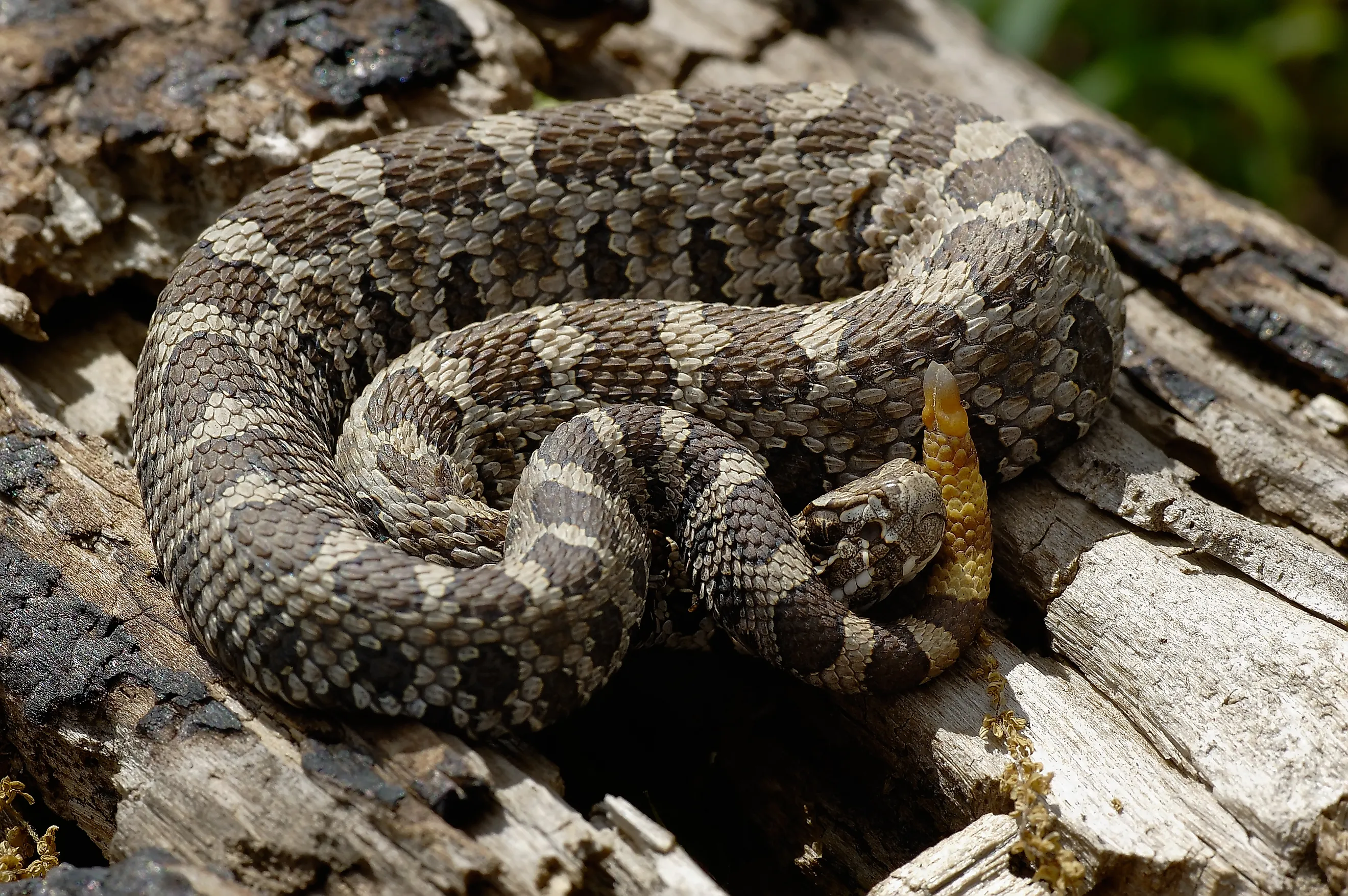
Texas is home to members of all four groups of venomous snakes in the United States, rattlesnakes, copperheads, cottonmouths, and coral snakes. For hikers keen to access over 80 miles of trails, rattlesnakes are the only venomous snake they need to look out for in Guadalupe Mountains National Park. Rattlesnakes are easily identifiable by the signature rattle at the end of their tail and their flat, triangular heads.

Five species inhabit the park, many of which reside in the rocky canyons, like the rock rattlesnake (Crotalus lepidus) and the black-tailed rattlesnake. The park contains the four highest peaks of Texas. Rock rattlesnakes inhabit mountainous areas, whereas the Western diamondback rattlesnake, which is also found in the park, spends the majority of its life on the desert floor. Of the millions of hikers that have frequented the park since it was established over 40 years ago, not a single one has been bitten by a rattlesnake.
Big Bend National Park, Texas

With the largest preserved tracts of the Chihuahuan Desert, remote Chisos Mountains, and canyons carved by the Rio Grande, Big Bend National Park is rattlesnake country. There are four species of rattlesnake that both live in and are widely distributed throughout the park. Western diamondback rattlesnakes are the most common species, found between the Rio Grande floodplain and the foothills of the Chisos Mountains, up to a maximum elevation of 4,500 feet. The Mojave rattlesnake is also found throughout the park between the Rio Grande floodplain and around 4,000 feet in elevation, although they are the least often encountered rattlesnakes.

While the black-tailed rattlesnake prefers canyons and rocky outcrops and is generally most common in the Chisos Mountains and foothills, they are found throughout the whole park. Rock rattlesnakes are also most common in the Chisos Mountains and foothills. They spend much of their life in rocky outcrops and talus slopes. They rely on protective coloration to avoid detection and are rare to rattle.
Will You See a Rattlesnake in a National Park?
Rattlesnakes may have a vast range across the United States, found in 46 states. But that does not make them hard to avoid. Even in places like Joshua Tree National Park, which stands out for its variety of species, humans and rattlesnakes can coexist without incident. Their presence is a reminder that these reptiles have adapted to survive even the harshest conditions, whether remote mountainous landscapes or the extreme temperatures of the desert.