The Quietest Place In The Lower 48
The quietest place in the contiguous United States is marked by a small red stone sitting on a mossy log. That is the entire infrastructure. No plaque, no boardwalk, no gift shop. A pebble, in a rainforest, roughly 300 feet off a trail, in a park that covers nearly a million acres.
It is called One Square Inch of Silence, and the name is not a figure of speech. The acoustic ecologist Gordon Hempton designated exactly one square inch on Earth Day in 2005, on the theory that if you can keep a single inch free of human noise, you have to keep several hundred square miles around it quiet too, because sound does not respect boundaries. It is the most ambitious thing anyone has ever done with a rock.
A Pebble, Three Miles In

The spot sits in the Hoh Rain Forest in Olympic National Park, 3.2 miles along the Hoh River Trail from the visitor center, just above Mount Tom Creek Meadows. From there you leave the trail and follow an elk path about 91 metres into the trees, and somewhere in that moss is a red stone roughly the size of a plum.
Hempton did not choose the location on a map. He walked up the trail until he could no longer hear the visitor center, then kept going, then followed a route the Roosevelt elk had made, and stopped where the silence held. The stone itself was a gift from a Quileute tribal elder.
Finding it without directions is close to impossible, which is arguably the point. The Hoh covers a 24-mile valley and every square foot of it is covered in moss that looks like every other square foot covered in moss.
Twenty-Seven Decibels, Outdoors

Readings at the site run between 24 and 27 decibels depending on the season. To put that in context, Hempton measured Benaroya Hall in Seattle, a purpose-built concert hall with the audience and orchestra removed, and got 27 as well.
So the quietest room in Seattle and a patch of dirt in a rainforest are acoustically equivalent, except one of them cost $120 million and the other one is wet.
A normal speaking voice runs about 60 decibels. Traffic on a highway clears 70. Decibels are logarithmic, so the gap between 27 and 60 is not a third again as loud, it is something closer to ten times. The forest is not quiet by a little.
Why The Rainiest Forest Is Also The Quietest

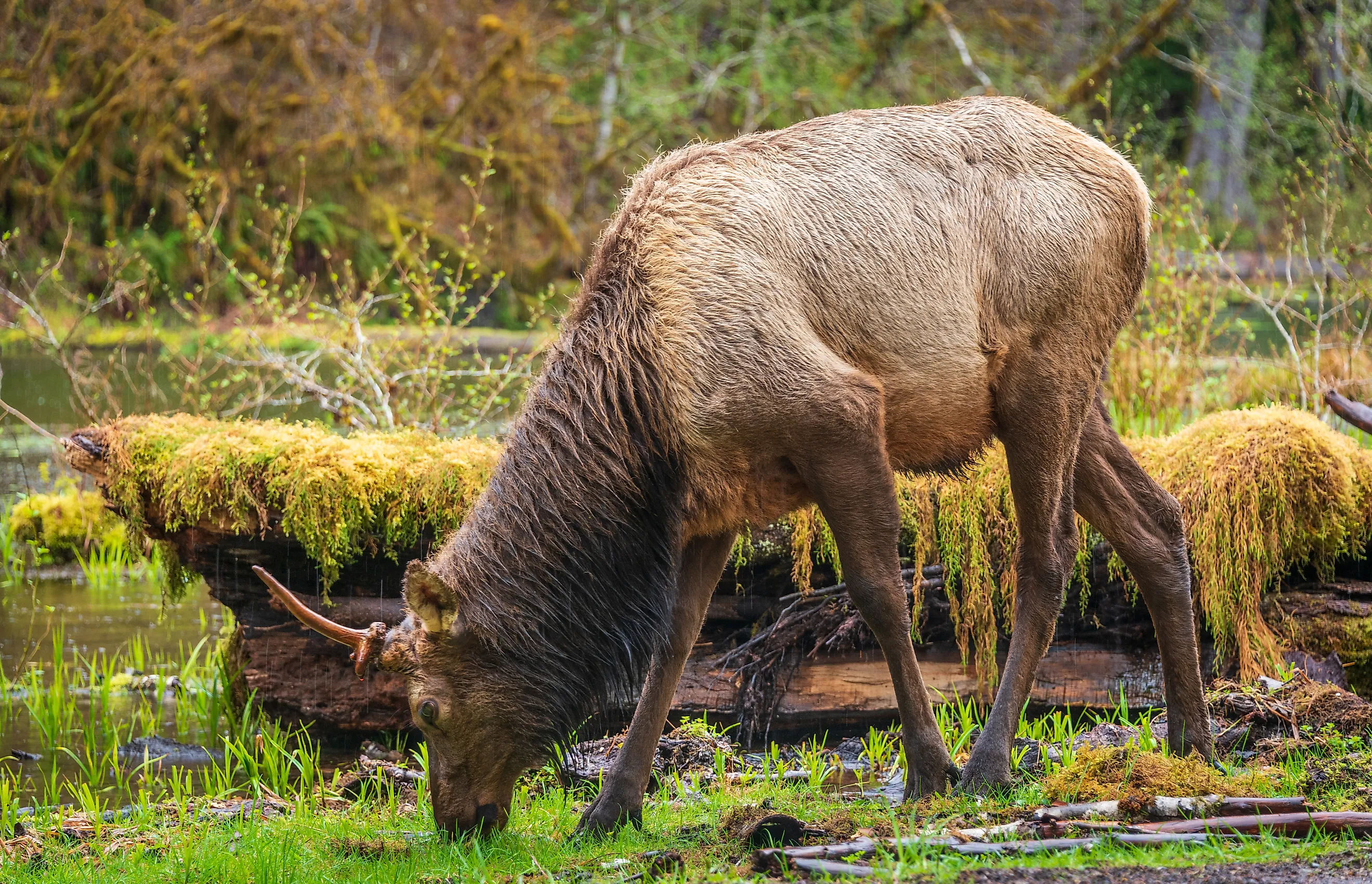
This seems backwards. The Hoh takes between 140 and 170 inches of rain a year, which is somewhere around twelve to fourteen feet, and is the largest temperate rainforest in the mainland United States. You would expect a constant racket.
What actually happens is that all that water grows the thing that makes the place quiet. Moss hangs off every surface in sheets, the forest floor is deep and soft, and the understory is dense. Soft, irregular, porous material absorbs sound rather than bouncing it, which is precisely what the foam panels in a recording studio are for. The Hoh has simply been doing it for several thousand years without a budget.
The valley walls help too, screening out whatever noise does make it this far inland. Washington's Olympic Peninsula is a dead end surrounded on three sides by water, with the Pacific to the west, which keeps the roads few and the traffic distant.
The Man Who Lost His Hearing, Then Did This

Hempton spent 18 months deaf before his hearing returned in 2005. He marked One Square Inch of Silence within months of getting it back, which tells you roughly everything about his priorities.
An Emmy-winning sound recordist by trade, he has spent decades documenting natural soundscapes in Hawaii, Sri Lanka, and dozens of places in between, and calls Olympic "the listener's Yosemite." He has also been known to write to airlines whose flight paths cross the Hoh, politely informing them that they have intruded on a square inch of protected silence. Several have altered their routes.
His numbers on how rare this is are the genuinely alarming part. In 1984, he found 21 places in Washington state alone where you could sit for 15 minutes without hearing a human-made sound. By 2007 there were three. He now estimates fewer than ten such places remain in the entire country.
What Is Actually Threatening It

Not hikers. Not logging, which stopped inside the park a long time ago. The threat comes from directly overhead, in the form of commercial airliners and Navy training flights, and there is no fence that helps with that.
Hempton has lobbied for legislation creating a protected airspace in a radius around the park, and the One Square Inch project's own website now describes the site as "once arguably the quietest place in the United States," which is a quietly devastating bit of past tense from the people who created it.
The Park Service still rates sections of Olympic as exceptionally quiet, and Hempton has recorded noise-free audio in other parts of the park, including from inside hollowed-out Sitka spruce logs on the beaches. The silence has moved around. It has not entirely gone.
Going There Yourself

Check the road first. The Upper Hoh Road washed out in December 2024 and stayed shut for well over a year, reopening in May 2026 after Jefferson County completed repairs with $623,000 in emergency state funding. It is the only way in.
From the Hoh Rain Forest Visitor Center, the walk is 3.2 miles on a flat, well-maintained trail and takes most people around two hours. If you cannot find the stone, it does not especially matter. The whole surrounding valley is within a decibel or two of the same reading, which was the entire argument in the first place.
Go on a weekday, go early, and give it fifteen minutes before deciding anything. Most visitors report that the quiet is uncomfortable at first and then stops being uncomfortable quite suddenly, which is a reasonable description of what silence does to people who have not had any in a while.