The US Reservoirs Closest to Dead Pool
A reservoir reaches "dead pool" when its water drops so low that none can flow downstream through the dam's outlets, cutting off water deliveries and hydropower at once. Impoundment reservoirs, the human-made lakes formed by damming a river, supply drinking water, irrigate crops, and generate electricity across the United States, so a reservoir approaching that threshold is a regional emergency, not a local one. After a multi-decade drought in the Southwest, three major reservoirs now sit closer to dead pool than any others in the country. The three below are ranked from most severe to least severe, measured by how little usable margin each has left above its dead pool or minimum operating level as of July 2026.
Elephant Butte Reservoir

Elephant Butte Reservoir is the largest reservoir in New Mexico, sitting on the Rio Grande. Created by the US Reclamation Service (today the Bureau of Reclamation), the 301-foot-high (92 m) concrete Elephant Butte Dam was completed in 1916 to provide flood control, ensure year-round irrigation for farmers in New Mexico and Texas, and help fulfill a 1906 water treaty with Mexico. When it began filling in 1915, Elephant Butte was the largest human-made reservoir in the world.

As of mid-July 2026, Elephant Butte is nearly empty. The reservoir held only about 2% to 3% of its capacity, with water managers warning it could bottom out near 2% by late August. That makes it a different case from Lake Powell and Lake Mead below. Rather than hovering just above a fixed dead pool elevation, it is simply running out of usable water. For the farms and towns downstream, the effect is much the same. When there is almost nothing left to release, it hardly matters whether the shortage is called dead pool or an empty account.
The consequences reach across the region. Elephant Butte irrigates hundreds of thousands of acres of farmland in New Mexico and Texas and supplies part of El Paso's water. A near-empty reservoir strains those deliveries and makes it harder for the states to meet their obligations under the 1938 Rio Grande Compact, the agreement that apportions the river among Colorado, New Mexico, and Texas.
Lake Powell

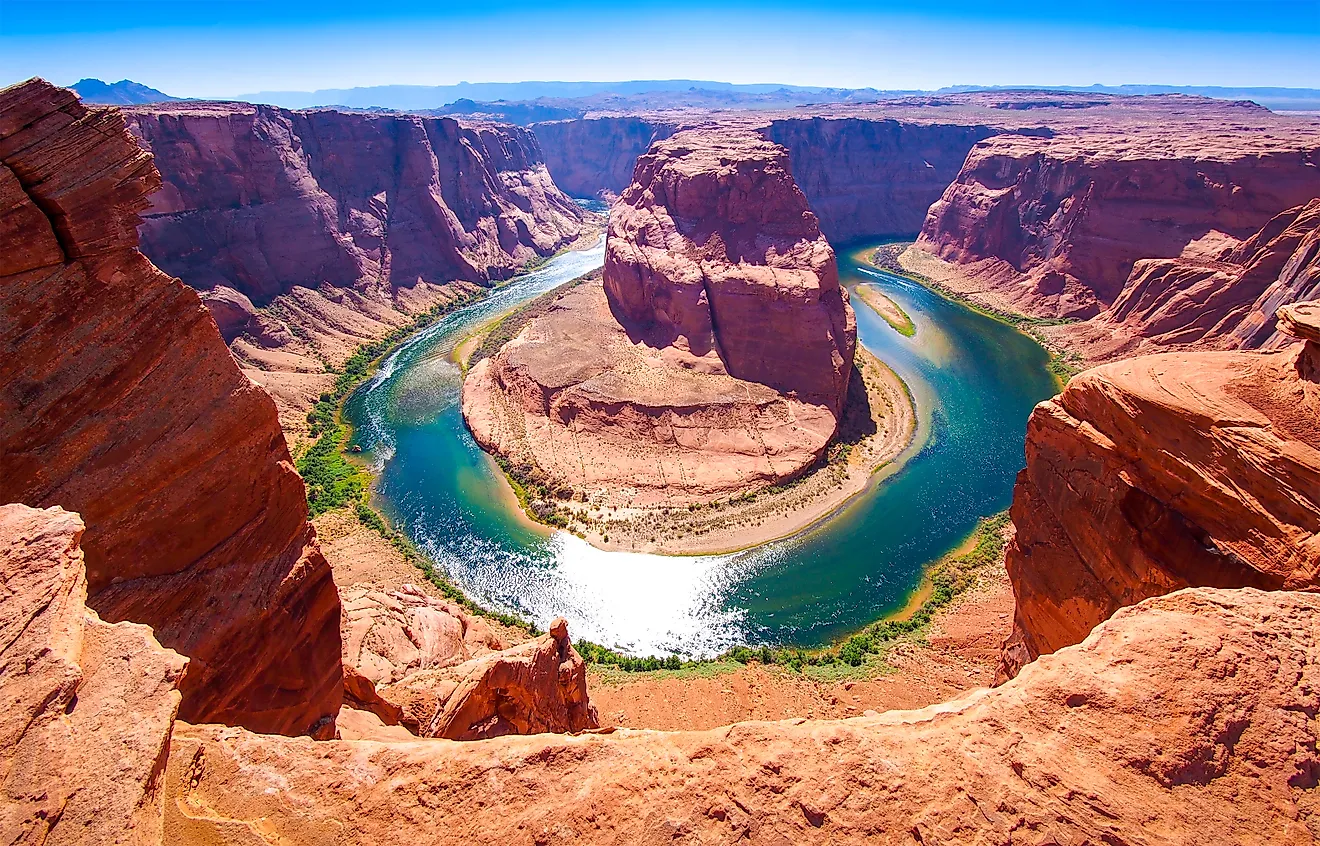
The second-largest reservoir in the US, Lake Powell, straddles the border of Arizona and Utah. It was created in the early 1960s by the Glen Canyon Dam, a 710-foot-high (216 m) concrete arch dam across the Colorado River. When the dam's gates closed in 1963, the river backed up and flooded Glen Canyon. It took 17 years for the water to reach the reservoir's full-pool mark of 3,700 feet (1,128 m) above sea level, which it hit in 1980.
As of mid-July 2026, Lake Powell's surface measured about 3,524.3 feet (1,074 m) above sea level, roughly 27% of capacity. Two thresholds matter here, and they are easy to confuse. Minimum power pool, the level below which Glen Canyon Dam can no longer spin its turbines, sits at 3,490 feet (1,064 m), leaving the reservoir only about 34 feet above the point where hydropower stops. True dead pool, where water can no longer pass the dam by gravity at all, is far lower, at 3,370 feet (1,027 m). Lake Powell held about 5.52 million acre-feet of live storage in mid-July and had been losing roughly 4,800 acre-feet per day since June 1.

Trouble at Lake Powell reaches all seven Colorado River Basin states (Colorado, Utah, Wyoming, New Mexico, Arizona, California, and Nevada). The reservoir works like a hydrological bank account for the Upper Basin (Colorado, New Mexico, Utah, and Wyoming), collecting snowmelt that these states can release downstream to the Lower Basin (Arizona, California, and Nevada) without drawing down their own local supplies.
A collapse at Lake Powell would also create a legal crisis. The Colorado River Compact of 1922 requires the Upper Basin states to deliver a minimum volume of water downstream over each ten-year period. If Lake Powell reached dead pool, Glen Canyon Dam could no longer pass water to the Lower Basin and Mexico, and the framework known as the Law of the River would begin to break down.
Lake Mead

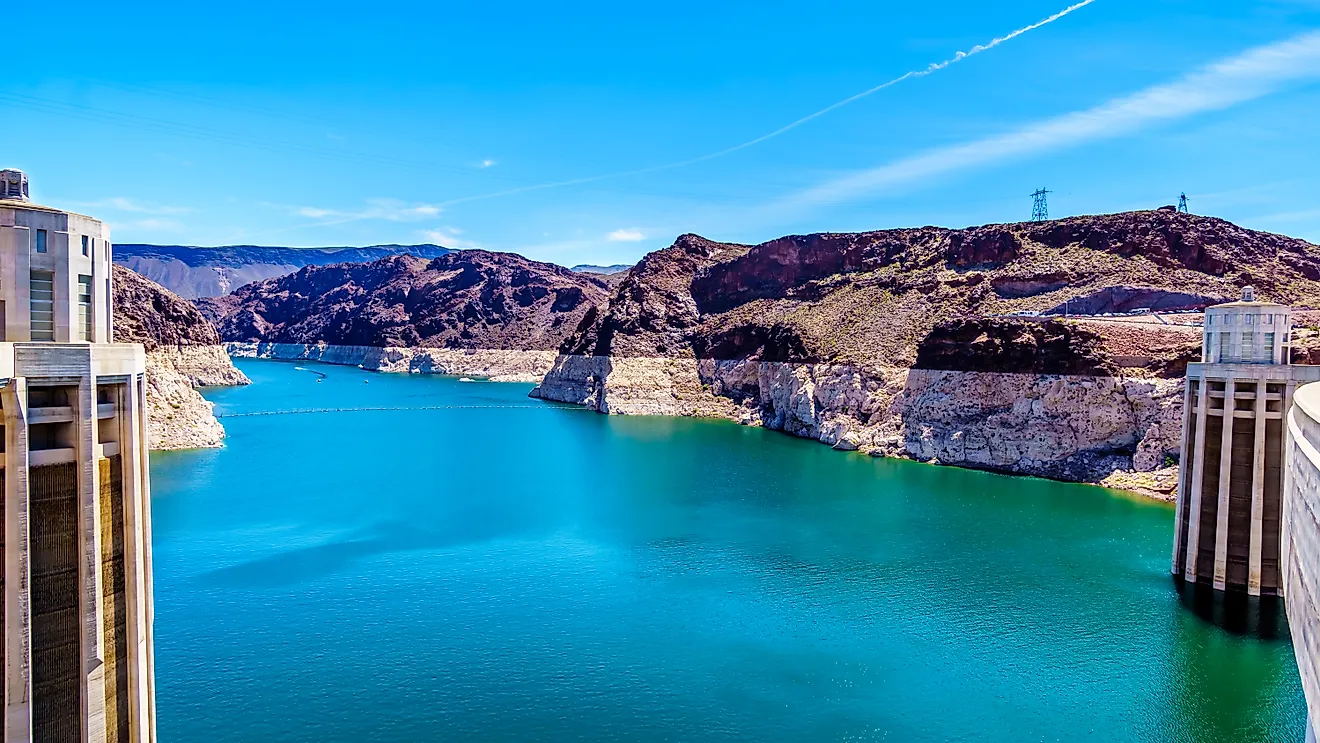
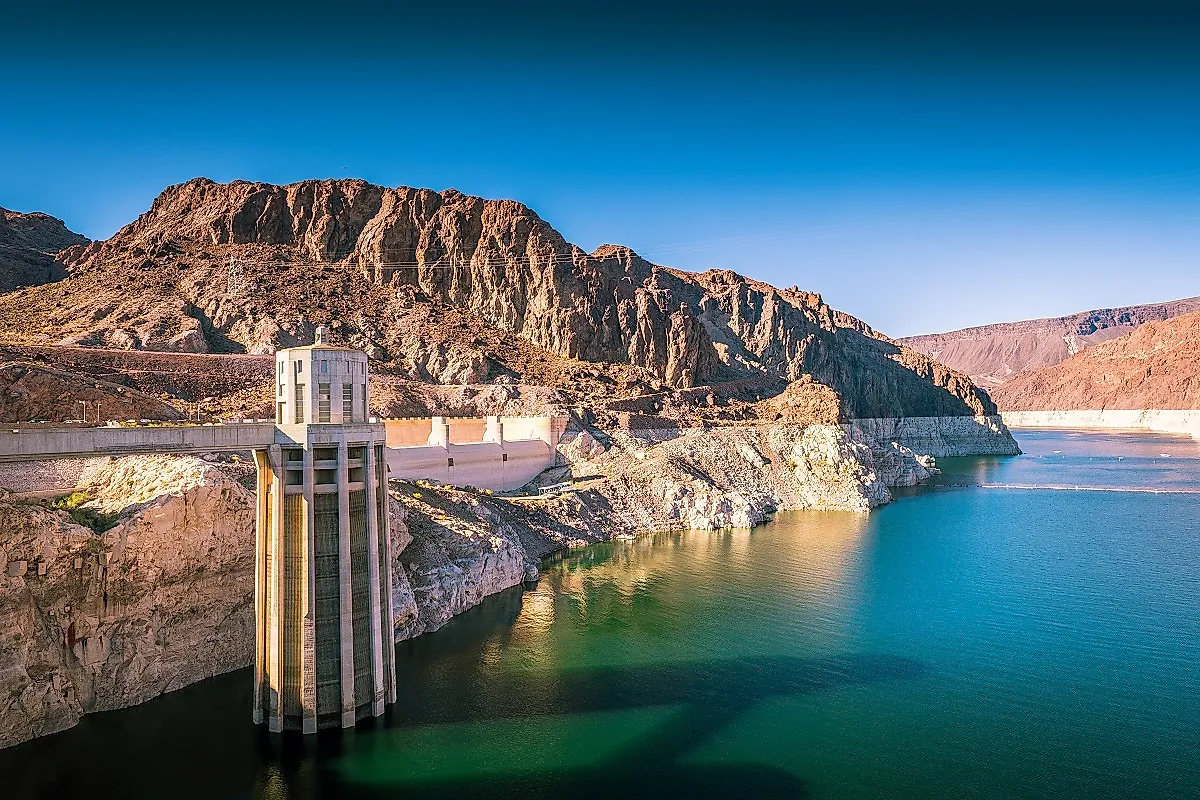
Lake Mead, about 30 miles (48 km) southeast of Las Vegas, Nevada, is the largest human-made reservoir in the US by capacity. It was built between 1931 and 1935 by the Bureau of Reclamation, which raised the 726-foot-high (221 m) concrete Hoover Dam across the Colorado River and diverted the river through tunnels blasted into the canyon walls. Once the dam was finished and the tunnels sealed in 1936, the river pooled behind it at the edge of the Mojave Desert to form Lake Mead.

As of mid-July 2026, Lake Mead sat at about 1,042.8 feet (317.8 m) above sea level and roughly 27% of capacity, within a couple of feet of the all-time low it set in 2022. Its dead pool elevation at Hoover Dam is 895 feet (273 m), leaving a cushion of about 147 feet. That sounds comfortable next to Lake Powell, but the trajectory is not: the Bureau of Reclamation projects Lake Mead could fall to about 1,015.77 feet (309.6 m) by July 2027 and a record 1,011.74 feet (308.4 m) by May 2028. Hoover Dam's hydropower is the nearer pressure point, since generation falters well before dead pool. Lake Mead is currently held up in part by federal management that has cut releases from Lake Powell to keep the Lower Basin from failing first.
The Colorado River network delivers water to about 40 million residents across the western US and sustains more than 5 million acres of agriculture, yet the system is badly depleted. Lake Mead, which California, Arizona, and Nevada rely on directly, held roughly 7 million acre-feet in storage in mid-July 2026. Continued declines could trigger legal violations, including breaches of the 1928 Boulder Canyon Project Act and the 1944 US-Mexico Water Treaty.
The Outlook For These US Reservoirs
The declines at Elephant Butte, Lake Powell, and Lake Mead show that the Southwest's water crisis is a present reality rather than a distant risk, and the three systems are linked: propping up one often means drawing down another. Temporary federal measures, such as holding back upstream releases to buy time for the reservoirs below, cannot outpace a drying climate indefinitely. The durable fixes on the table are the harder ones, rewriting the federal operating rules that expire at the end of 2026 and committing to permanent, aggressive water conservation across all seven basin states.