The Creatures That Live Deeper Than The Titanic
The Titanic lies about 12,500 feet below in the North Atlantic Ocean. It's icy depths surrounded in a darkness so deep that sunlight never reaches it.
While that sounds like the bottom of the world, the wreck is not even halfway to the deepest part of the ocean. Cephalopods, fish, amphipods, echinoderms, and even Casper, the friendly ghost-octopus, all live below the Titanic. Here's a bit of life from far, far below.
Where The Titanic Rests

Pressure at the Titanic site climbs to about 380 atmospheres, using the National Oceanic and Atmospheric Administration's (NOAA) rule of one added atmosphere for every 33 feet of descent. NOAA lists the wreck at 12,467 feet (3,800 meters), about 325 nautical miles southeast of Newfoundland in international waters.
The wreck rests within the midnight, or bathypelagic, zone, the layer between 3,300 and 13,100 feet (1,000 meters to 4,000 meters) where sunlight never arrives.
Life Below the Wreck

The midnight zone ends about 600 feet beneath the Titanic, at 13,100 feet (4,000 meters), and the abyssal zone takes over from there down to 19,685 feet (6,000 meters).
Deep-sea marine fish known as grenadiers, or rattails, of the genus Coryphaenoides range through both layers. The abyssal grenadier (Coryphaenoides armatus) lives between 920 to about 17,000 feet (280 to 5,180 meters), a band that brackets the wreck site. Across both the Atlantic and Pacific oceans, baited cameras and trawls have recorded this species as deep as 16,995 feet (5,180 meters). Adults typically measure eight to 16 inches, though some reach up to about three feet.
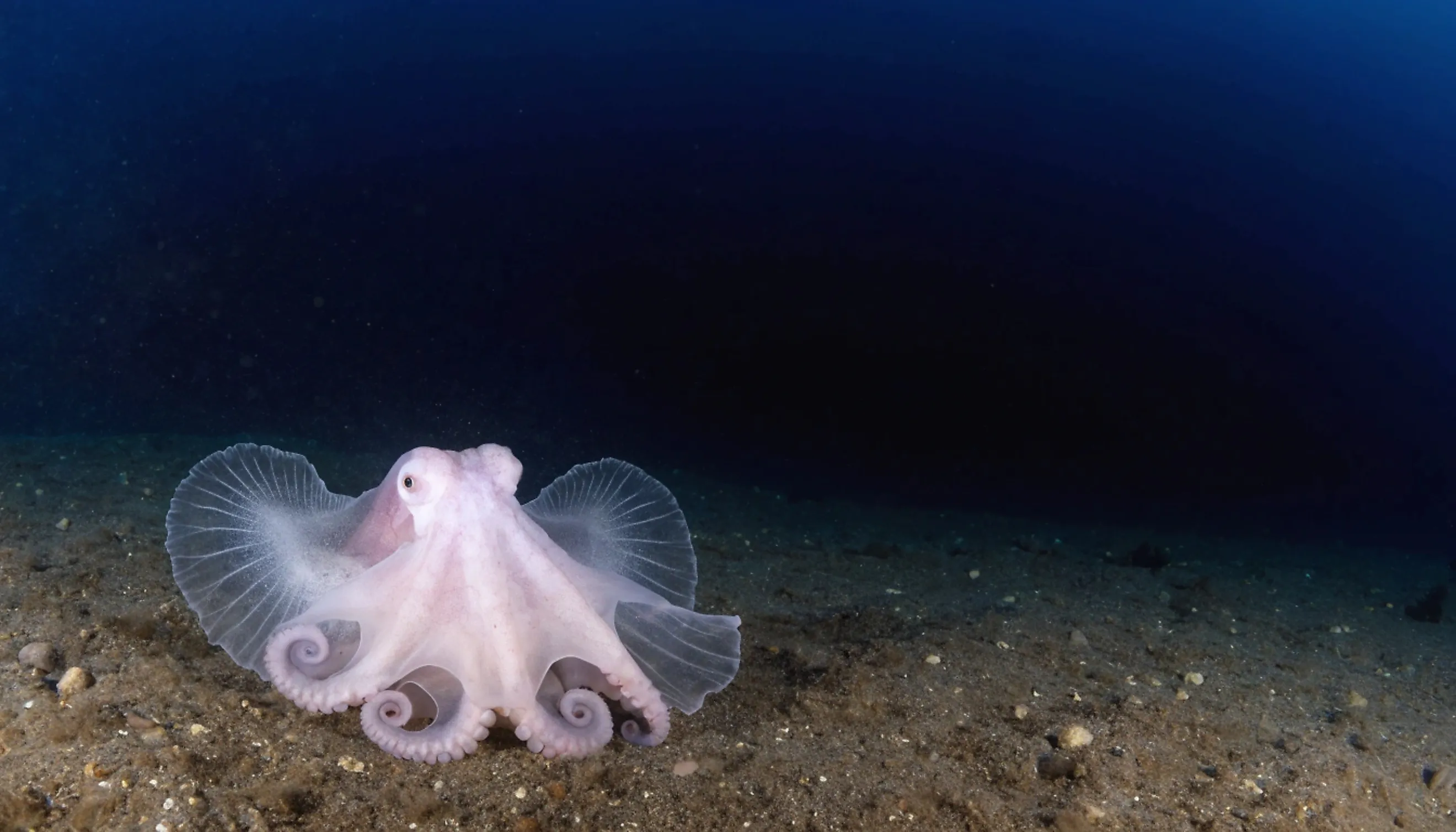
In 2016 off the coast of Hawaii, NOAA's remotely operated vehicle, Deep Discoverer, found a pale octopus resting on a flat rock at 14,075 feet (4,290 meters). Nicknamed Casper, the animal lacks pigment cells that most octopuses use for camouflage. It holds the depth record for finless octopuses and still has no scientific name. Water at that depth runs cold enough that researchers suspect the octopus's eggs may take years to develop.
An Octopus in the Hadal Zone

Below 19,685 feet (6,000 meters), the ocean enters the hadal zone, and the first cephalopod proven to live there appeared on camera in April 2019. A baited camera in the Java trench of the Indian Ocean filmed a dumbo octopus (Grimpoteuthis) foraging at 22,825 feet (6,957 meters), under nearly 700 atmospheres of pressure. This pressure load is almost double that of where the Titanic rests.
Researchers, including NOAA scientist Michael Vecchione, published the sighting on May 26, 2020, in Marine Biology. It extended the confirmed previous depth record for cephalopods by 5,945 feet (1,812 meters).
Fish in the Ocean's Trenches
Far south of the wreck that is the Titanic, the Atlantic floor drops into the Puerto Rico Trench. A cusk eel (Abyssobrotula galatheae) was recorded there at 26,132 feet (7,965 meters), more than twice the depth of the ship. The Pacific holds even deeper records. The Mariana snailfish (Pseudoliparis swirei) first turned up during the 2014 HADES expedition, and researchers described it in 2017 from 37 individuals collected between an astonishing 22,631 and 26,135 feet (6,898 and 7,966 meters). Cameras later filmed the species at 26,831 feet (8,178 meters), where pressure tops 800 atmospheres. Footage shows the fish feeding on amphipods near the trench floor.
The deepest confirmed fish sighting came in August 2022, when researchers filmed a snailfish at 27,349 feet (8,336 meters) in Japan's Izu-Ogasawara Trench. Fish vanished from the footage beyond that depth.
Sea Slugs, Urchins, and Sea Cucumbers (Oh my!)

In Monterey Bay, California, researchers at the Monterey Bay Aquarium Research Institute (MBARI) first spotted a glowing, transparent sea slug (mollusk) at 8,576 feet in 2000. Researchers have since recorded the species, Bathydevius caudactylus, 150 times in a range from 3,320 to 13,153 feet (1,012 to 4,010 meters) between Oregon and Southern California. This roughly 5.5-inch long nudibranch is the first known sea slug known to live in open, deep water, where it paddles with a fringed tail and uses a hooded mouth to catch tiny crustaceans, like mysid shrimp.
Farther down, echinoderms turn up deep within Pacific and Indian Ocean trenches. The sea urchin, Pourtalesia heptneri, was recovered from 24,081 feet (7,340 meters) in the Banda Trench off Indonesia. According to Guinness World Records, the sea cucumber, Prototrochus bruuni, is the deepest echinoderm after being hauled up from 35,203 feet (10,730 meters) in the Tonga Trench in 1977.
Scavengers on the Trench Floor
At some of the most extreme depths on the trench floors, amphipods (crustaceans without a hard upper shell) thrive. In the Mariana Trench, baited traps in 2014 recovered the amphipod Eurythenes plasticus between 19,718 and 22,799 feet (6,010 to 6,949 meters). It was famously named after the plastic pollution found in its body.
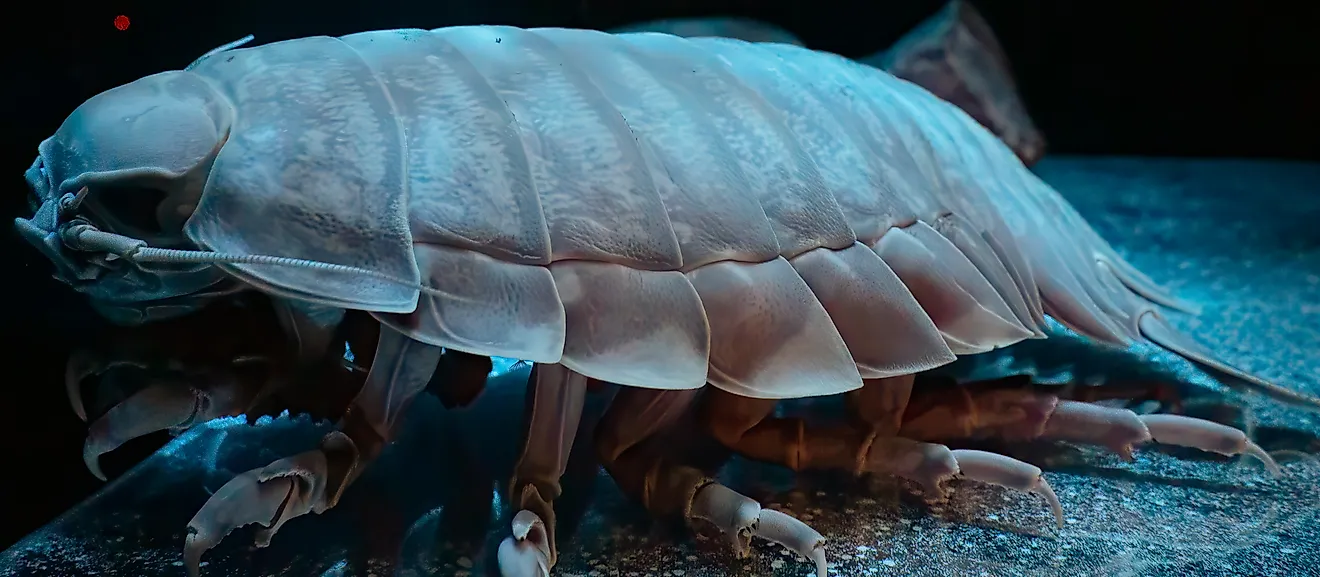
The supergiant amphipod Alicella gigantea grows larger still, reaching about 13 inches (33 centimeters). Cameras filmed this species feeding at 23,274 feet (7,094 meters) in the Mariana Trench, and researchers recorded and recovered individuals between 20,554 and 22,966 feet (6,265 and 7,000 meters) in the Kermadec Trench of the South Pacific.
The deepest of the three lives in Challenger Deep, the deepest known place in the ocean, measuring 35,876 feet (10,935 meters) with pressure exceeding 1,000 atmospheres. A free-fall sampler that Japanese researchers lowered into the trench on July 10th, 2009, trapped the amphipod Hirondellea gigas in baited traps at 35,751 feet (10,897 meters). This animal carries a cellulase enzyme that digests tiny bits of sunken wood buried in the trench floor.
From the Wreck to the Trenches

Measured against the Titanic's 12,500-foot (3,810-meter) resting place, life extends for about triple that distance. A range of fish, crustaceans, and invertebrates have evolved to thrive within the crushing pressures, cold temperatures, and nutrient-scarce environments of the deep-ocean zones that plummet far beneath the Titanic wreckage.
Rattails and the Casper octopus inhabit the abyssal layer just beneath the wreck. The dumbo octopus crosses into the hadal zone below 19,685 feet (6,000 meters), and snailfish reach 27,349 feet (8,336 meters) before the fish record ends. Select species of invertebrates can exist beyond 35,000 feet (10,668 meters), over four miles (6.4 kilometers) beyond the Titanic's final resting place.