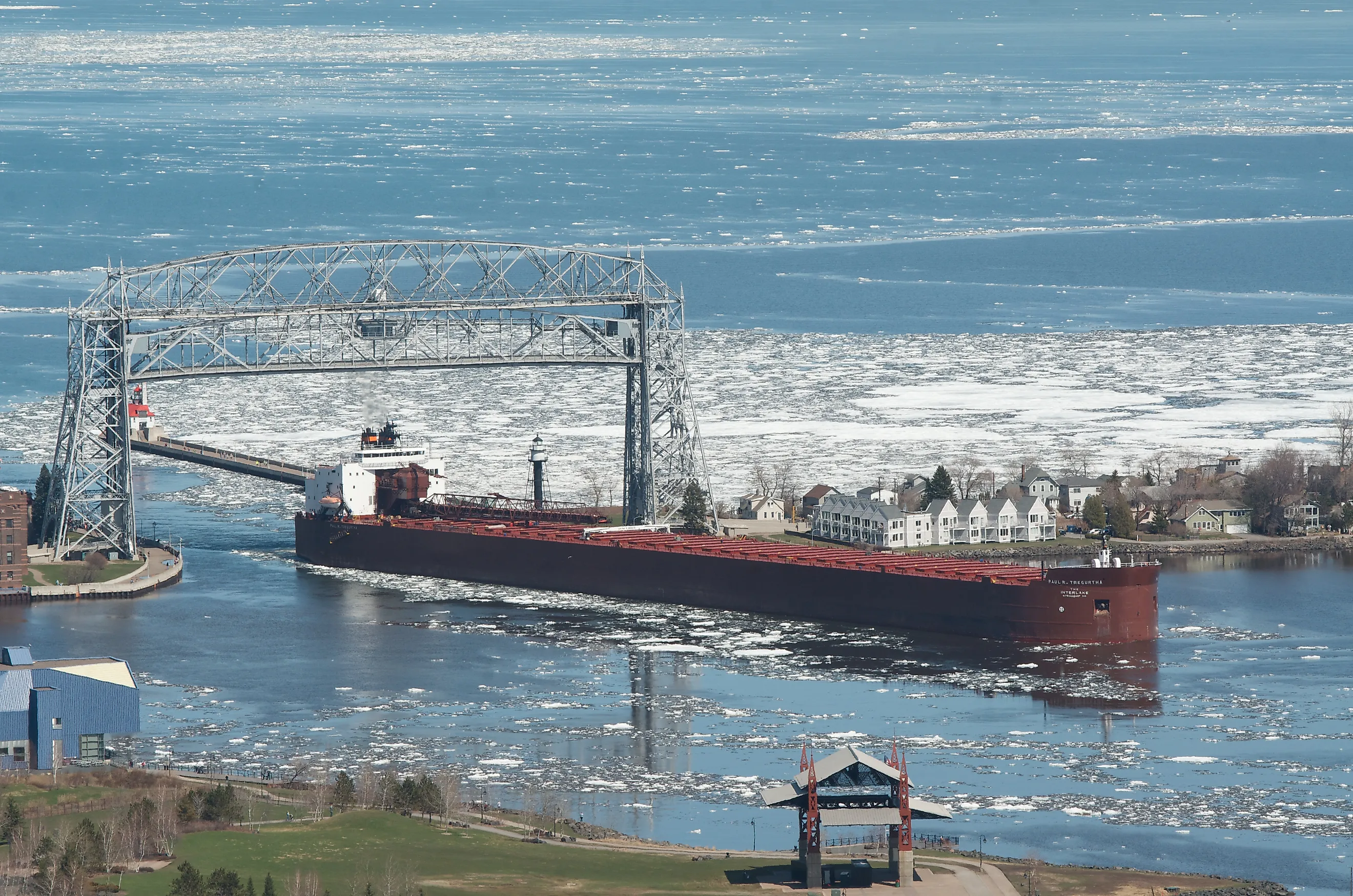
How A Great Lakes Freighter Compares To The Biggest Ocean Container Ship
The biggest freighter on the Great Lakes and the biggest container ship on the ocean are each about as large as their routes permit, and those two limits sit roughly 300 feet apart. The Paul R. Tregurtha, Interlake Steamship's 1,013.5-foot flagship, was built in Ohio to fit through a single lock at Sault Ste. Marie, Michigan, and to float in the shallow rivers between Lake Superior and the lower lakes. MSC Irina, which holds the world record at 24,346 twenty-foot containers, was built in China for the trade between Asia and Europe, and it measures 1,312 feet long and nearly twice the Tregurtha's width. Parked side by side, the longest ship on the Great Lakes would look almost slender. The water each vessel was designed for accounts for that gap, and it is also the reason neither ship could ever take over the other's route.
Irina's Extra Width Is What Multiplies Its Cargo

Stood on end, Irina would rise past the 1,250-foot roof of the Empire State Building, and the Tregurtha would come up a little short of the Chrysler Building's 1,046 feet. Length is the smaller of the two differences, though. Irina's 201-foot beam holds long rows of containers side by side, and the ship can stack them as many as 26 tiers high when the hold and deck are counted together. The Tregurtha, 105 feet wide, carries loose cargo such as iron ore pellets and coal in five long holds. Deadweight, the total weight a ship can carry in cargo, fuel, water, and stores, gives the clearest comparison. Irina is rated at more than 240,000 metric tons and the Tregurtha at about 69,000, so the container ship can carry well over three times as much weight on a single voyage.
The Laker Was Built to Fit the Poe Lock

On every run between Lake Superior and the lower lakes, the Tregurtha passes through the Poe Lock at Sault Ste. Marie, a chamber 1,200 feet long and 110 feet wide. With its 105-foot beam, the ship clears the walls by about two and a half feet on each side. The Poe is the only chamber at the Soo Locks large enough for the biggest lake freighters, and most of the roughly 68 million tons of cargo that moved through the locks in 2024 went through it.
The Great Lakes thousand-footers look so much alike because every one of them was designed around that chamber. Thirteen entered service between 1972 and 1981, each at least 1,000 feet long and about 105 feet wide, and all 13 still sail. The Tregurtha, launched at Lorain, Ohio, in 1981 as the William J. De Lancey, was the last to join them, and it has held the informal title of Queen of the Lakes, reserved for the longest active ship on the Great Lakes, since its first season.
Why the Laker Is Nearly 10 Times Longer Than It Is Wide

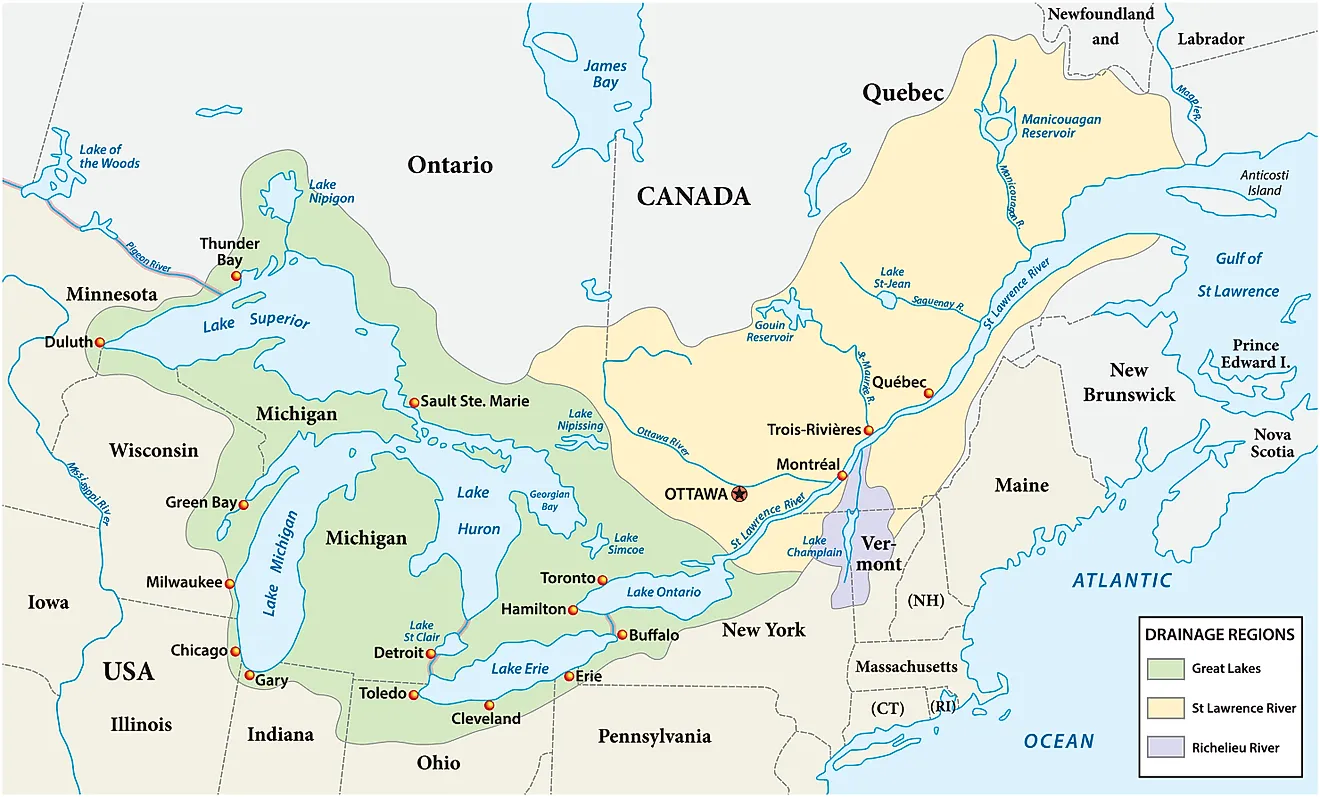
Depth adds a second limit to the one set at the Soo. The Great Lakes shipping system is maintained as a continuous 27-foot deep-draft waterway between Duluth, Minnesota, and the Gulf of St. Lawrence, and lakers have to load to a draft that clears the shallow stretches of the St. Marys River and Lake St. Clair. With draft held near the channel depth and beam held to the Poe's 110 feet, designers gained capacity through length, building long hulls with blunt bows that fill nearly the whole lock chamber. The Tregurtha's length is about 9.7 times its beam, compared with about 6.5 for Irina. That slender shape suits the lakes because Great Lakes waves are shorter and arrive at shorter intervals than the long swells of the open ocean, so a lake freighter's hull can be much longer in proportion to its width than an ocean ship's.
Both Ships Are Too Big for the Canals Between Their Routes

The only deep-water route between the upper lakes and the Atlantic runs through the Welland Canal and the St. Lawrence Seaway, which accept ships up to 740 feet long and 78 feet wide with a draft of 26.5 feet. A thousand-footer is more than 270 feet too long for those locks, so the Tregurtha and its 12 sisters spend their entire working lives on Lakes Superior, Michigan, Huron, and Erie.
Irina meets the same kind of barrier on a larger scale. The expanded Panama Canal takes ships up to 1,201 feet long and 168 feet wide, which leaves Irina too long and about 33 feet too wide to pass between the Atlantic and the Pacific there. Size limits at the Suez Canal and the Singapore Strait, along with the short list of ports equipped to handle these ships, restrict how large container ships can grow, and the biggest designs have stayed close to Irina's length. CMA CGM Notre Dame, delivered in 2026 with room for 24,212 containers, still falls just short of Irina's record.
American terminals handle somewhat smaller giants. In February 2025, the 1,204-foot OOCL Iris set size records at the ports of New York and New Jersey, Charleston, and Savannah with 16,828 containers, about 70 percent of Irina's capacity. On the West Coast, the 1,300-foot CMA CGM Benjamin Franklin docked at the Port of Los Angeles in December 2015 with room for about 18,000 containers, roughly three-quarters of Irina's load.
The Laker Carries Its Own 260-Foot Unloading Boom

Irina carries no cargo gear, so every container comes off under shore gantry cranes long enough to reach across a deck about 200 feet wide. The Tregurtha unloads itself. Cargo in its five holds feeds onto conveyor belts, climbs a loop belt elevator, and travels out along a 260-foot boom mounted at the stern, which can swing 100 degrees to either side. The system can move 10,000 long tons of iron ore an hour, and Interlake Steamship says it empties all five holds in about eight hours.
Because the equipment travels with the ship, a steel mill or power plant can take delivery of ore or coal at a plain dock with no cranes at all.
Fresh Water Lets a Laker Work for Half a Century

Lake freighters are usually designed for 45 to 50 years of service, largely because fresh water causes far less corrosion than salt water. The Tregurtha sailed to Silver Bay, Minnesota, on its maiden voyage in 1981 and loaded 55,944 long tons of ore pellets, and 45 years later it remains in service, near the end of that design span. Lakers also spend part of every year tied up. The Soo Locks close on January 15 and reopen on March 25, and in recent years the Tregurtha has wintered at the Fincantieri Bay Shipbuilding yard in Sturgeon Bay, Wisconsin, leaving in April 2025 for a first load of taconite at Superior, Wisconsin.
Lakers have been held to the Poe Lock's 1,200-by-110-foot chamber since the first thousand-footer arrived in 1972, and the new lock due at Sault Ste. Marie by 2030 is being built to the same dimensions. Any future Queen of the Lakes will therefore have no more width to work with than the Tregurtha has today. On the ocean side, no container ship has topped Irina's 24,346 containers since its delivery in 2023, and the newest ships of 2026 stopped just below that mark. A replacement for the Tregurtha, whenever one is built, will still have to pass through a chamber 91 feet narrower than Irina's hull, so the biggest ship on the Great Lakes will keep fitting through a lock that the biggest ship at sea could not enter.