The US Lakes Where Marinas Have Closed Because Of Low Water
In spring 2026, barges pushed Bullfrog Marina and its houseboats about three miles across Lake Powell, because the water under the docks was running out. Without the move, the marina would likely have been sitting on dry ground by July. Other lakes had no such option. Detroit Lake Marina in Oregon shut its moorage by July 20, and the slips at Lewis and Clark State Park on North Dakota's Lake Sakakawea could not be used by July 3. Some marinas chased the water with barges and cranes, and some simply closed for the season. What is left for a boater afterward varies just as much. On Lake Mead, it is a ramp being lengthened while people keep launching from it. At Lahontan Reservoir in Nevada, it is a beach and a four-wheel-drive vehicle.
Blue Mesa Reservoir, Colorado

Colorado's largest reservoir sits in Curecanti National Recreation Area, and the National Park Service went into summer 2026 with a list of elevations at which its two marinas would be taken apart. At 7,450 feet, Elk Creek Marina would be reconfigured. At 7,448 feet, the Lake Fork ramp would become unsafe for trailers, and at 7,443 feet, the walkway at Lake Fork would come out. Low winter snowpack and a dry spring pushed the lake through those marks quickly. On July 16 it stood at 7,440 feet, three feet under the walkway mark and nearly 80 feet below full pool, and it was dropping at least five inches a day.
Crews moved Elk Creek's marina infrastructure to deeper water, then about half of Lake Fork Marina. Every boat had to be out of the Lake Fork slips by noon on July 27, and hand-launching of boats without trailers stayed available at both ramps. In late July, the Interior Department projected 7,412 feet by the end of September, and by late August Blue Mesa was less than 20% full, lower than it had ever been. Boating season was cut months short.
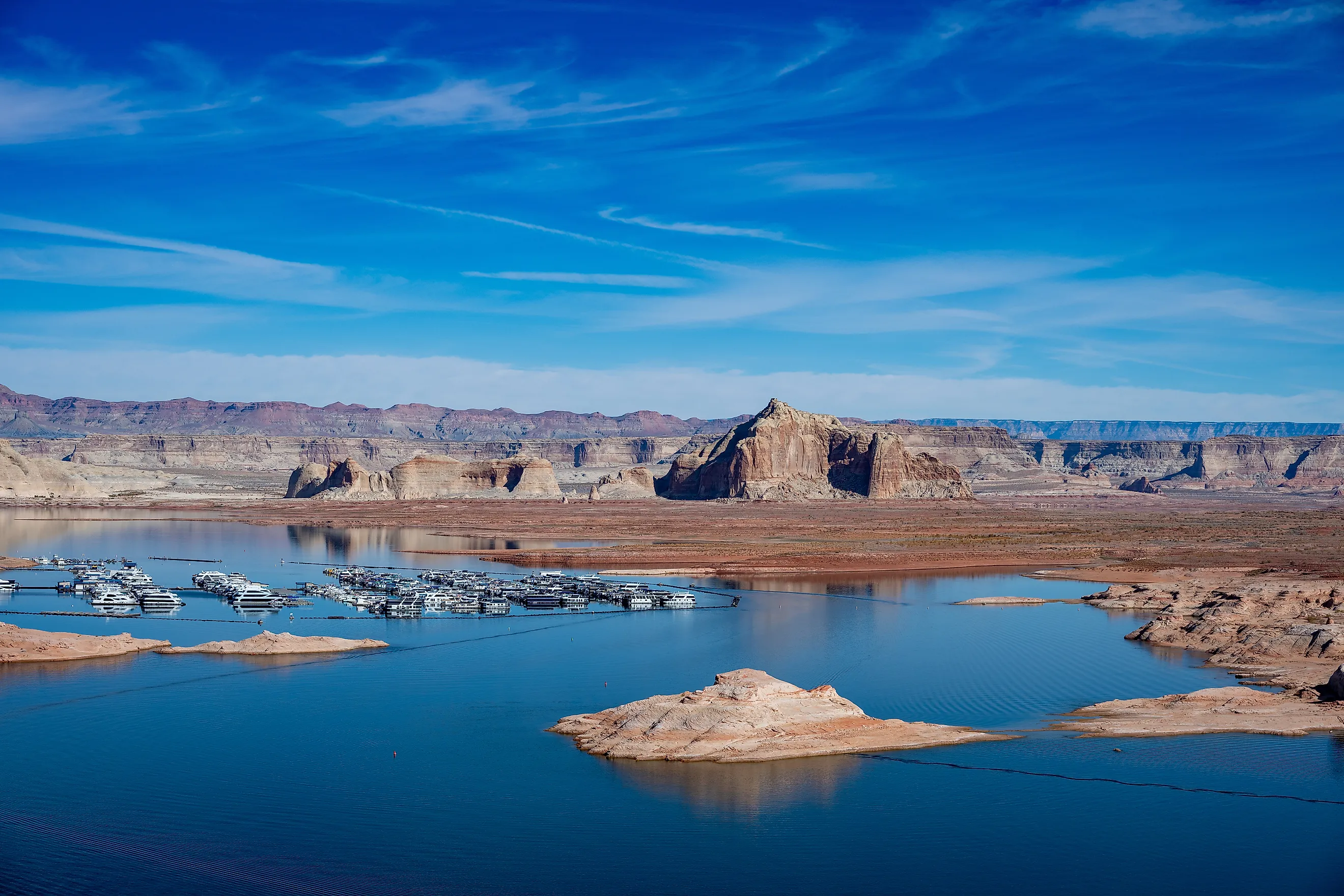
Lake Powell, Utah and Arizona

Downstream on the Colorado River, Lake Powell has a 100-mile stretch of water with nowhere to buy fuel. Dangling Rope Marina, the only place to refuel between Antelope Point and Bullfrog, was closed permanently by the Park Service in September 2024, which said the marina was "no longer sustainable due to declining water levels."
Bullfrog stayed open by moving. The barges had its docks and houseboats in deeper water at Halls Crossing by mid-June, while on shore the lake had dropped to the lowest reaches of Bullfrog's only open boat ramp. By July, the Park Service was warning that it was not safe for houseboats and small motorized boats to launch from most ramps on the lake.
Powell set a record low just under 3,520 feet on August 15 and kept dropping into mid-September. The fix for Bullfrog is a deeper ramp planned just south of it at Stanton Creek, estimated at $73.4 million and designed to reach water down to 3,500 feet, less than 20 feet below this year's lows. Robert Knowlton of Aramark, the park concessioner, expected a couple of years before the ramp is finished and the marina moves back.
Lake Mead, Nevada and Arizona

Below the Grand Canyon, Lake Mead set its own record low on August 7, 2026, and kept falling to about 1,038 feet in early October, when the reservoir was 27% full. Its marinas have been chasing that shoreline for more than two decades. The Las Vegas Bay marina became inoperable as the water dropped and was relocated to Hemenway Harbor in October 2002. Portions of Overton Beach's marina were moved to Callville Bay and Temple Bar in 2007, and its ramp closed in 2009. Boulder Harbor became too shallow, and its ramp closed in 2021.
What still works is set by each site's lowest usable elevation. Hemenway Harbor's four-lane ramp reaches 1,030 feet over a pipe mat, and work to extend it toward 1,000 feet resumes in early November, with the ramp staying open during construction. Echo Bay is closed to houseboats and keeps access open near 1,035 feet with a Mobi-mat until a hardened ramp is built. Temple Bar's ramp is usable down to 950 feet. At Callville Bay, a ramp redesign is expected to be awarded this winter, and getting that ramp down to 1,000 feet could mean moving the marina itself into open water.
Great Salt Lake, Utah

Sailing on the Great Salt Lake takes enough water under a deep keel, and on May 30, 2026, the marina at Great Salt Lake State Park ran short of it. Cranes lifted 23 sailboats out of the harbor and into dry storage, some of them onto the parking lot, and more removals were expected in June. The same crane work was needed in 2015 and in 2021, when nearly 100 boats came out.
The harbor has been dug out more than once to keep it usable. A first dredging project, funded in 2015 for $1.5 million, ran into the lake's salt water, which wore down the equipment. Crews were back in September 2025 on a roughly $4.5 million job to deepen the marina again, with the lake there at 4,191.5 feet and the state aiming to reopen by October, depending on lake levels. That work was mostly meant to benefit state boats used for public safety and scientific research.
Lahontan Reservoir, Nevada

West of the Great Salt Lake, in Nevada, the dock at Lahontan Reservoir's North Shore Marina had been pulled by September 3, 2025. The marina is also home to the Churchill Beach boat launch, and Nevada State Parks had already taken the reservoir's ramps out of service on August 19. By early September, Lahontan held about 90,000 acre-feet, less than a third of its 312,000-acre-foot capacity. Boats kept going in from the sand instead. Beach launching stayed open at the boater's own risk, with warnings about soft sand, mud, and objects below the surface, and drivers with four-wheel drive can launch from the same beaches where primitive camping is allowed.
Detroit Lake, Oregon

In Oregon's Cascades, Detroit Lake is scheduled to drop to its lowest levels ever this winter, and its two marinas had already closed early before any of that began. The Army Corps of Engineers plans a deep drawdown starting as soon as November 15, part of a multiyear plan that aims for a 55-foot drop. Detroit Lake Marina joined Oregon officials in urging the Corps to cancel it, and the plan has been challenged in federal court.
The summer closures came from the lake's own low level. Detroit Lake Marina began shutting its moorage on July 13 and had all of it closed by July 20, and Kane's Marina was reported to be shutting down on July 26. In 2021, moored boats had to be out even sooner, by July 11. Boaters were sent to the Mongold day-use area, which has picnic areas, a swimming area, and a ramp at 1,450 feet, the lowest on the lake and open through last winter. An $8 million project to dredge about 162,000 cubic yards of sediment from under the two marinas was put on hold in July.
Lake Sakakawea, North Dakota

On North Dakota's Lake Sakakawea, the area usually marked for swimming at Lewis and Clark State Park, east of Williston, was all sand this summer. The marina's slips could not be used by July 3, and no boat ramps or marinas were open at the park. The Missouri River reservoir stood at about 1,827 feet on August 2, roughly 12 feet below average and short of the 1,830 feet the park's marina needs for navigable water.
Boaters from the park drove about 10 miles to the ramp at Lund's Landing. Elsewhere on the lake, Van Hook Resort lost one of its two double-lane ramps to the low water this summer.
On the Colorado River, the big spending now goes into ramps that can reach lower water. On Lake Powell, the Antelope Point ramp extension carries a price of about $81 million, on top of the $73.4 million estimate for Stanton Creek, and the Stateline ramp at Wahweap has been extended as the lake drops. Lake Sakakawea's next fix is older. Ramps that have sat underwater for nearly 20 years will likely be needed to reach that reservoir next year. Lake Mead is expected to hold between 1,033 and 1,035 feet through the end of 2026, just above the 1,030-foot limit of Hemenway Harbor's current ramp. Federal projections then put it at about 1,003 feet by July 2027, a few feet above the roughly 1,000-foot reach of the ramps the park is building there now.