5 US Rivers With The Most Copperheads
The US rivers with the most copperheads run through rock. West Virginia's New River has cut a gorge where the National Park Service says copperheads are commonly seen throughout the park. The same snake turns up below Great Falls on the Potomac and in Kentucky's Red River Gorge. On the Cumberland Plateau, it is found along the Big South Fork and the Obed. Farther west, it lives under the dolomite bluffs of Missouri's Current River and Jacks Fork.
River corridors put the two kinds of ground copperheads use side by side. Texas Parks and Wildlife describes the species' preferred habitat as wooded lowlands, usually within a river bottom. In a six-year radio-tracking study at Powder Valley, in St. Louis County, Missouri, copperheads spent the winter in rocky outcrops and moved along the edges of power-line corridors. Where a river has cut deep, its gorge walls, bluffs, and ledges sit beside that wooded bottomland. Climbers on the New River's cliffs and hikers on the boulders above the Potomac use the same rock.
The Potomac River

A Labrador retriever named Sayner was bitten by a snake 2 to 3 feet long beside the C&O Canal towpath near Riley's Lock, on the Maryland bank of the Potomac River. One snake was photographed, and two more were seen just feet away. While Sayner stayed at a hospital in Clarksburg, the antivenom had to be picked up in Frederick.
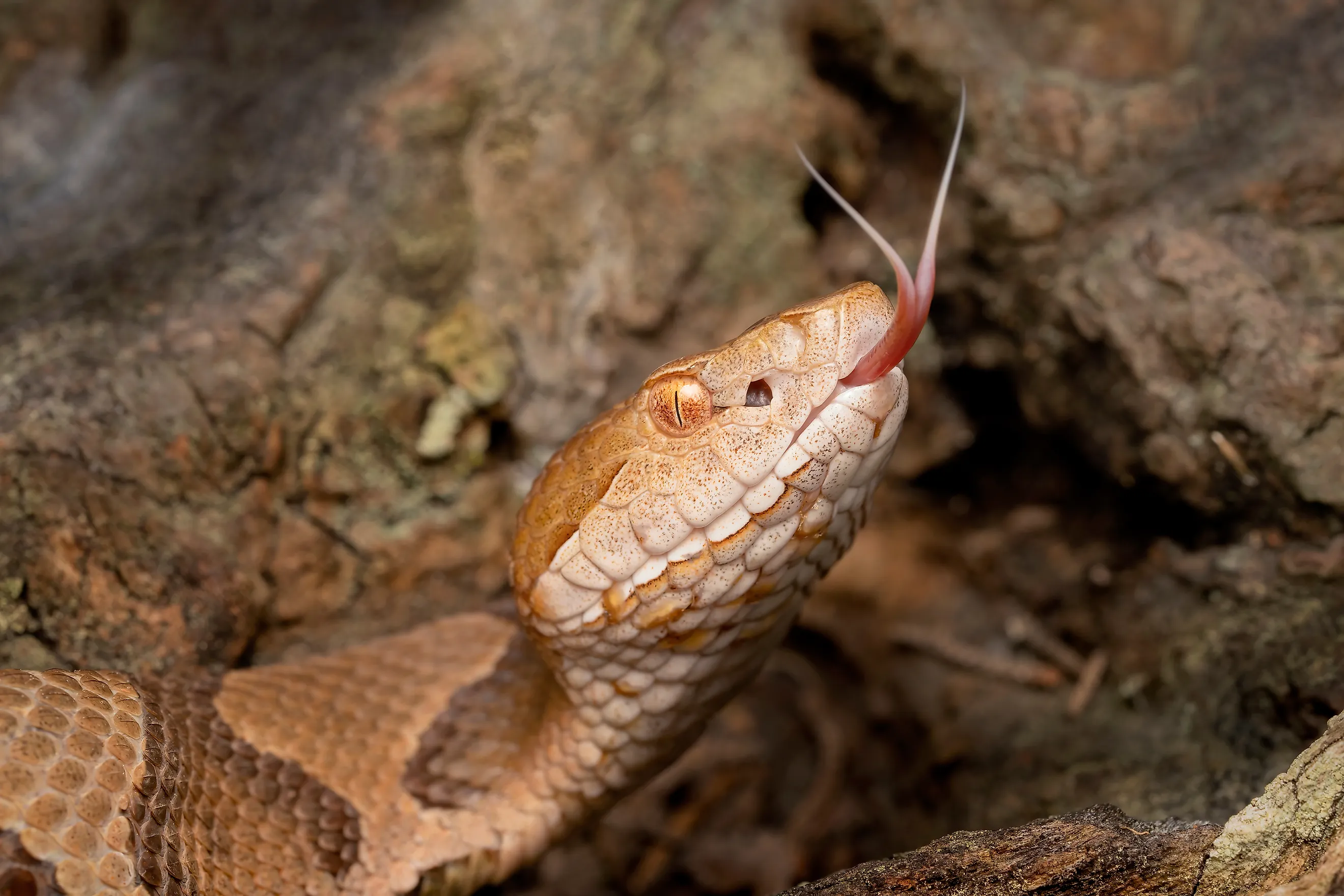
Downstream, hikers on the Billy Goat Trail scramble over angled rocks and boulders above Mather Gorge, below Great Falls. A copperhead's earth tones and hourglass bands blend into the forest floor, and like the harmless rat snake, it vibrates its tail in dry leaves to make a buzzing sound. It usually lets a passing hiker go by and bites when stepped on or picked up. Maryland's Department of Natural Resources calls the eastern copperhead fairly common in forested rock outcrops across central and western Maryland, and on the Virginia bank, Great Falls Park lists it as the only venomous snake in the park.
The New River

Climbing at the New River Gorge comes with instructions from the National Park Service. Climbers are asked to know the copperhead and the timber rattlesnake, the park's two venomous species, on sight, and to watch where they put their hands, because snakes may hide in crevices in the rock faces. Both species live in the park's wooded, rocky, mountainous terrain, and hikers occasionally meet one on a trail. Park Service species records rate the copperhead common here and on the neighboring Gauley River. Either snake can strike across about half its body length and can bite more than once.
The Red River

Kentucky's Red River Gorge, in the Daniel Boone National Forest, combines expansive mixed forest with open ground, and Eastern Kentucky University biologist Stephen Richter describes copperheads as fairly common across eastern Kentucky. In 2018, his team, working with the U.S. Forest Service, the Kentucky Department of Fish and Wildlife Resources, and the Louisville Zoo, released eight copperheads fitted with radio transmitters back into the gorge and tracked them from as far as half a mile away to learn where they spend the winter, feed, and breed.
The gorge was a practical place to start, because it is a popular destination for hiking and camping. Forest Service district biologist Christina Wampler has said the results are helping make areas of high human activity less attractive to copperheads.
The Big South Fork And The Obed

Rangers at the Big South Fork National River and Recreation Area, which straddles the Kentucky and Tennessee line on the Cumberland Plateau, led an evening program on snakes at Blue Heron Campground in August 2013. To the south in Tennessee, the Obed Wild and Scenic River runs through a gorge with sheer bluffs along the rim and arches, chimneys, cracks, and rock shelters in the stone. Park Service records list the northern copperhead as common at the Obed and as common and breeding on the Big South Fork.
The Current River And Jacks Fork

Missouri copperheads are normally active from mid-March through early November, with the busiest stretch from late April through October. On the Current River and Jacks Fork, in the Ozark National Scenic Riverways, that season plays out under dolomite bluffs and up narrow, steep-sided hollows. The Missouri Department of Conservation calls the eastern copperhead the most common venomous snake in the state, at home on open, rocky, wooded hillsides and in brushy areas along creeks.
Wet springs often bring more sightings, because high water floods snakes out of their burrows and into other places. For anyone walking through rocky ground, the department's advice is to carry a walking stick.
From mid-to-late October, most Missouri copperheads move into overwintering sites. Some spend the winter alone, and others gather at favorite communal sites, typically south-facing rocky ledges. Their diet runs mostly to mice and voles, and they also eat frogs, lizards, small birds, and insects, especially cicadas.
Copperheads give birth to live young in late summer or early fall, and the newborns at Great Falls start out eating insects and small mice. By the first days of November, Missouri's copperheads are at the tail end of their active season, and most have already moved into their winter sites. In Virginia, copperhead bites to people and pets are reported most often between May and October, though bites there have been seen as late as December, and as of 2023 the state's last death from a venomous snakebite had come in Chesterfield County in 2012.
Researchers at Eastern Kentucky University working in the Red River Gorge have said the copperhead will never be completely eliminated from areas with suitable habitat. Along these rivers, that habitat is the gorge walls, bluffs, and ledges that draw climbers and hikers in the first place.