The Lakes Where Tiger Muskies Grow Largest
Only two tiger muskies over 50 pounds have ever been recorded, and both came out of the same lake. That is the single most useful fact about this fish, and it explains why a question that sounds like it should have ten answers really has about three. The tiger muskie is a hybrid, a cross between a female muskellunge and a male northern pike, and it is almost always sterile, which is precisely why it grows so fast and why fisheries agencies stock it in places neither parent belongs. The weight record has stood since 1919 and was originally credited to the wrong species. The length record was set two years ago from a kayak, on a 226-acre lake in Montana, using a bait the angler built in his garage.
Here is where the giants have actually come from, and why sterility is the whole story.
Lac Vieux Desert, Wisconsin And Michigan

This lake, straddling the Wisconsin and Michigan line, is the answer and there is no serious competition.
The International Game Fish Association all-tackle weight record is a 51-pound 3-ounce tiger muskie measuring 54.25 inches, caught by John Knobla on July 16, 1919. It has stood for 107 years, which makes it one of the longest-standing records in freshwater fishing.
The second-largest ever recorded also came from Lac Vieux Desert. On June 28, 1951, a 21-year-old named Dolores Ott Lapp landed a 50-pound 4-ounce fish while out with her husband Jack, a Vilas County guide. It remains the largest tiger muskie ever caught by a woman.
Two fish over fifty pounds are known to exist in the species' entire recorded history, and one small lake in the northern Wisconsin woods produced both of them thirty-two years apart.
The Record Changed Hands By Reclassification
Here is the twist that makes the record book strange, and it is worth knowing before anyone quotes these numbers at you.
Lapp's fish held the hybrid world record for decades. Knobla's 1919 catch had been logged as a pure muskellunge, and only later did research determine it was actually a tiger. The reclassification retroactively demoted Lapp from first place to second, more than half a century after she caught it.
She died in December 2015 at 86. Her record stood for as long as the paperwork said it did.
Ackley Lake, Montana
The current length record is fresh, and the circumstances are excellent.
On May 20, 2024, Dan Caricaburu-Lundin was fishing Ackley Lake from a kayak when he hooked a tiger muskie that nearly flipped him and barely fit his net. It measured 45.28 inches and was certified as the IGFA all-tackle length record on August 18, 2024, beating the previous mark by roughly six inches. He estimated it comfortably over 30 pounds and caught it on an eight-inch kokanee glide bait he had built himself.
Ackley Lake is 226 acres. It was a trout fishery until Montana began stocking tiger muskie about a decade earlier, not for anglers but to knock down runaway populations of longnose and white suckers. The record fish was a byproduct of pest control.
Blue Water Reservoir, New Mexico
The record Caricaburu-Lundin broke came from a place nobody associates with muskies at all.
Joshua Daniels caught a 39.37-inch tiger muskie at Blue Water Reservoir in New Mexico in 2022, which held the all-tackle length record until 2024. New Mexico is not a state anyone thinks of for toothy northern predators, which is exactly the point about a stocked sterile hybrid.
Pineview Reservoir, Utah

The best tiger muskie water in the American West, and the numbers are genuinely startling for a desert state.
Pineview holds Utah's catch-and-release record, a 53-inch fish landed in 1998, and the state weight record of 33 pounds at 49 inches came from 2006. In August 2013 Bennett Oberg caught a 51-incher there and released it, estimating around 35 pounds, which would have broken the state record had he kept it.
The context is what sells it. Tiger muskies and northern pike are the only fish in Utah that reach fifty inches at all. Lake trout in Flaming Gorge and striped bass in Lake Powell top out around 45, and they compensate with girth rather than length.
Why Sterility Is The Whole Mechanism

This is the part that explains every other section, and it is the same principle behind the record brown trout out of Lake Taneycomo.
A tiger muskie is sterile in the way a mule is sterile. Spawning is metabolically expensive, and a fish that never develops eggs or milt, never migrates to spawn and never competes for a spawning site spends all of those calories on growth instead. It also keeps growing through seasons when a fertile fish would be losing condition.
So tiger muskies grow noticeably faster than either parent species. What they do not usually do is finish larger. Pure muskellunge reach heavier maximum weights, which is why the pure-strain record sits around 67 pounds and the hybrid record sits at 51.
Faster to the party, smaller at the end of it.
They Are Stocked As A Tool, Not A Trophy
The reason tiger muskies turn up in Utah, Montana, New Mexico, Colorado, Idaho and Wyoming is that sterility makes them controllable.
Stock a fertile predator into a reservoir and you have created a population you cannot remove. Stock a sterile one and you have installed a specific number of predators with a known lifespan and no capacity to multiply. Agencies use them to suppress suckers, chubs and stunted panfish, and when the job is finished the fish simply age out.
Pennsylvania runs the most aggressive program in the country. Tiger muskies are present in 34 lakes and 18 rivers there, and the Fish and Boat Commission stocks roughly 7,300 yearlings of 12 to 14 inches every other year.
They Do Occur Naturally, Just Rarely

Not every tiger muskie came out of a hatchery truck.
Wherever muskellunge and northern pike overlap, the cross can happen on its own, which is how Lac Vieux Desert produced two fifty-pounders decades before anyone was stocking hybrids anywhere. Natural populations are self-limiting for the obvious reason, so they never become common.
One naming warning. In Minnesota, the true muskellunge has long been called tiger musky locally, which means a Minnesota fishing story about a tiger musky may be about an entirely different fish. Check what species someone means before you compare weights.
How To Recognize One
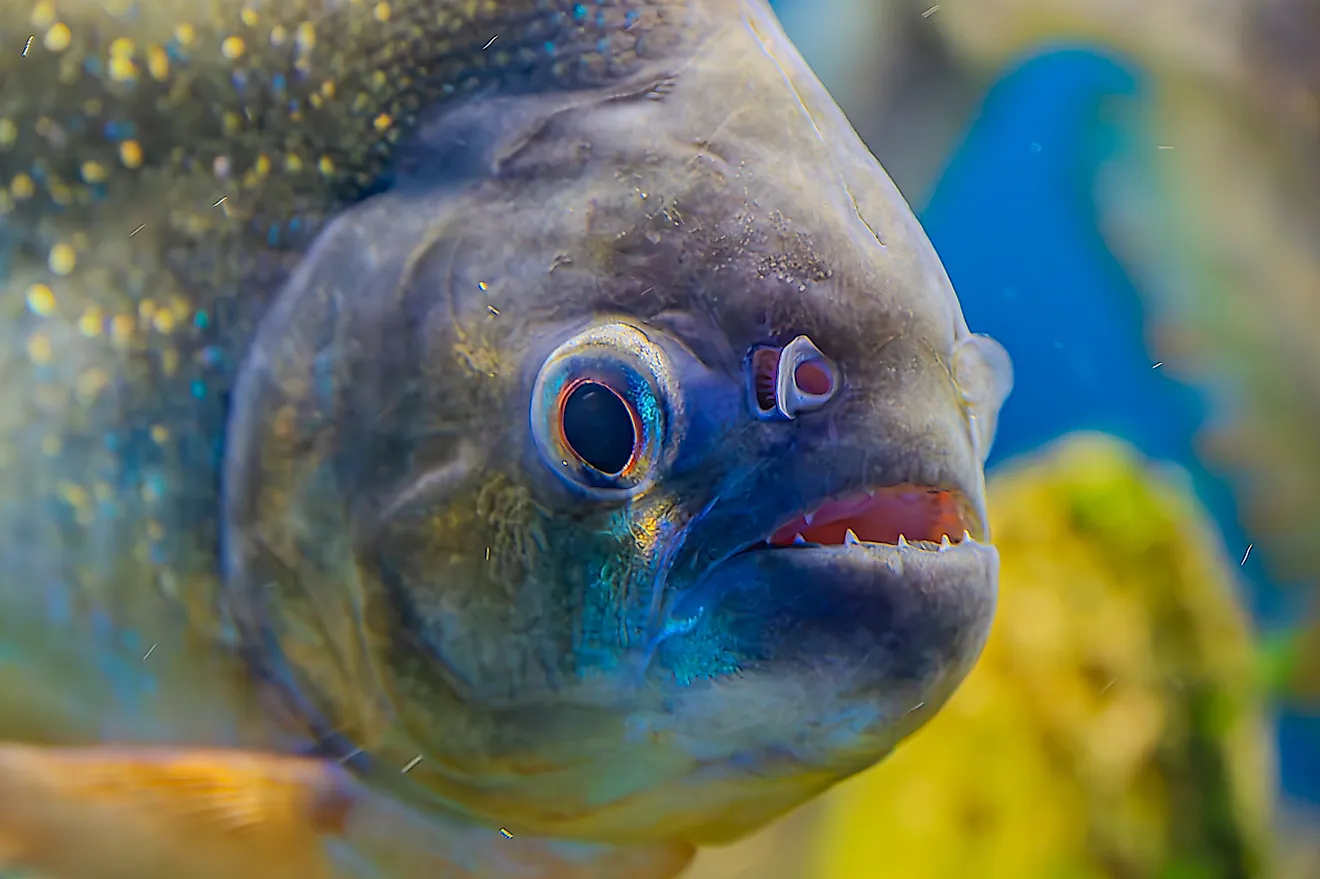
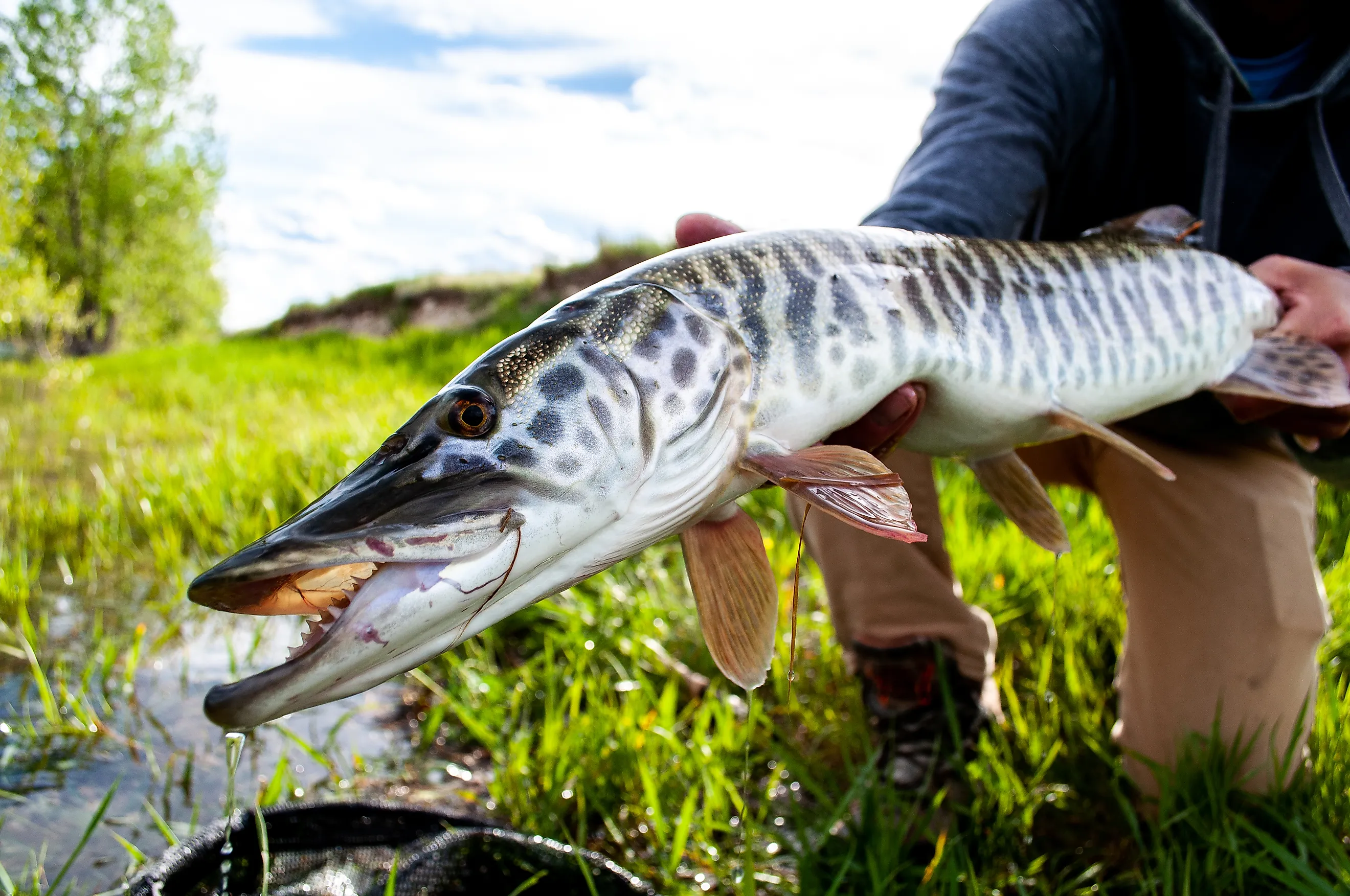
Look at the flanks. A tiger muskie carries dark vertical bars over a pale background, sharp and swirling, running down the sides like the stripes the name promises.
A pure muskellunge has spots or broken vertical marks that are usually darker on a lighter body but far less organized. A northern pike has the reverse pattern entirely: light bean-shaped spots on a dark green flank.
The tiger also carries a mouth inherited from both sides, full of long sharp teeth, which is the family resemblance nobody disputes.
What The Big Ones Have In Common

Three conditions turn up repeatedly, and none of them is lake size.
Cold water first, which is why the range runs across the northern tier and into high western reservoirs. Then a heavy forage base of soft-rayed fish, meaning suckers, chubs and whitefish rather than spiny panfish, because that is what a fish this shape is built to eat. Then low fishing pressure, since a tiger muskie needs a decade or more to reach trophy weight and cannot replace itself if it is removed.
Ackley Lake at 226 acres holding a world record is the proof that acreage is close to irrelevant. What matters is how much food is in the water and how few people are looking.
The Honest Answer

For the biggest tiger muskie ever recorded, and the second biggest, the answer is Lac Vieux Desert on the Wisconsin and Michigan border, and both fish predate modern stocking entirely.
For the current record and the best odds today, it is a stocked western or northern reservoir, with Pineview in Utah the standout and small Montana waters like Ackley punching well above their size.
And for the species overall, the honest framing is that the tiger muskie is a fish humans mostly manufacture, deploy for a job, and occasionally discover has grown into something enormous while nobody was paying attention.