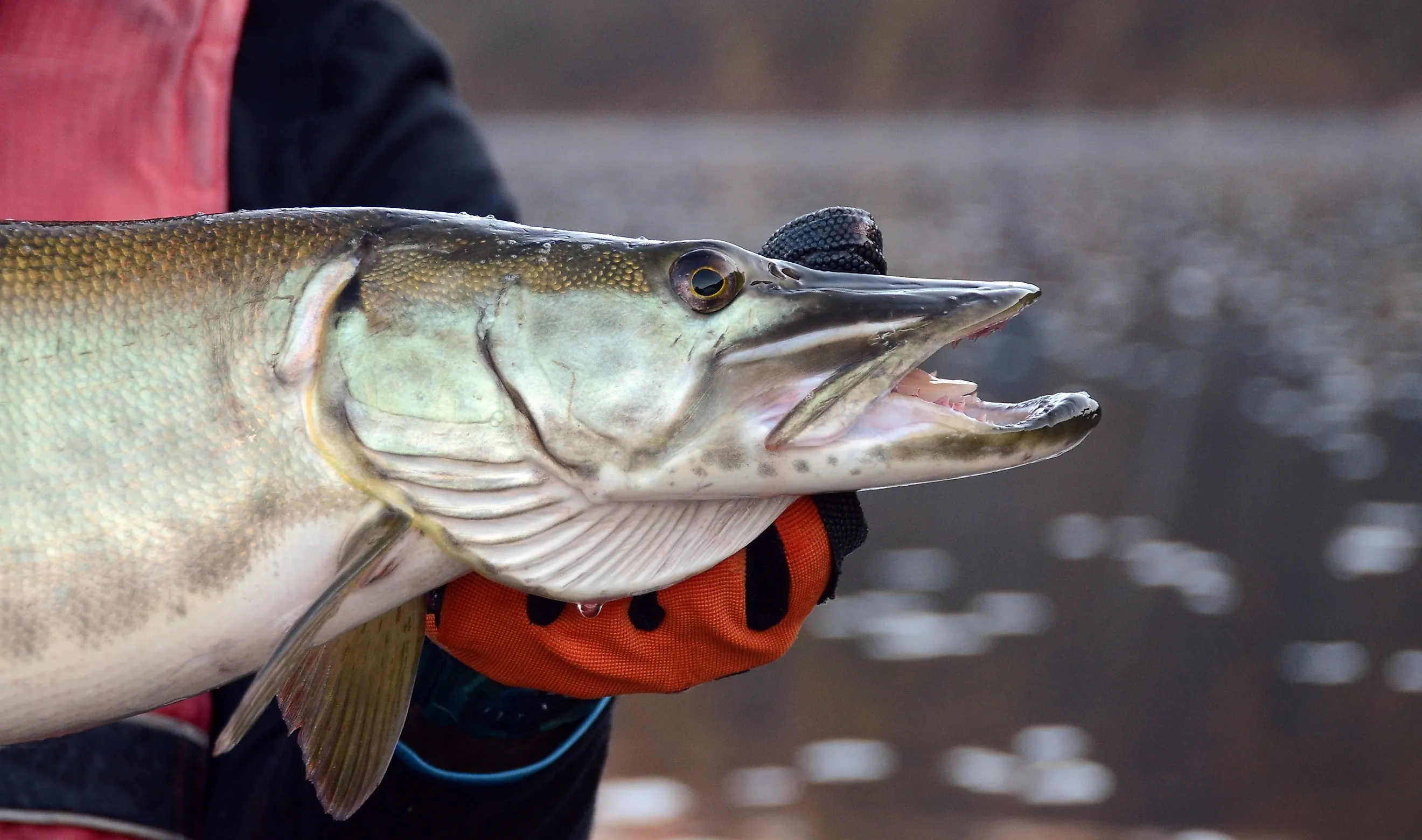
The Lakes Where Muskies Grow Largest
North America's biggest muskies are concentrated in a relatively small belt of cold, productive waters stretching from the Upper Midwest into southern Canada. Minnesota, Wisconsin, Ontario, and the Great Lakes region dominate because their large lakes combine abundant forage, complex habitat, and enough space for muskies to survive for decades. Waters such as Lake Mille Lacs, Lake of the Woods, and Georgian Bay have become especially famous for producing fish beyond 50 inches. A few southern reservoirs also break that geographic pattern.
Lake Mille Lacs, Minnesota

For many anglers, Lake Mille Lacs represents the benchmark for trophy muskie fishing. Covering 206.5 square miles, it is Minnesota's second-largest inland lake and has become internationally known for producing fish that regularly exceed 50 inches.
Unlike many trophy fisheries, Mille Lacs combines relatively shallow water. Its maximum depth is just 42 feet, with an exceptional forage base. Ciscoes (also called tullibees), yellow perch, and other baitfish allow muskies to grow rapidly while maintaining excellent body condition. Minnesota's strict catch-and-release culture and protective size regulations have further contributed to the lake's remarkable population of mature fish.
The lake gained even more attention in 2024 when it produced the International Game Fish Association (IGFA) All-Tackle Length World Record, a released muskie measuring 54.33 inches. Fisheries surveys conducted by the Minnesota Department of Natural Resources continue to rank Mille Lacs among the state's premier trophy muskie waters.
Chautauqua Lake, New York

Nearly every muskellunge stocked in New York traces back to Chautauqua Lake. The largest natural inland lake in western New York covers about 13,000 acres and has carried a muskie reputation for more than a century. State crews net its spawning muskies each spring for eggs, and that brood stock supplies New York's statewide stocking program. Recent netting has produced record catch rates and numerous fish beyond 50 inches.
Bemus Point splits the lake into two very different basins. The northern basin reaches about 75 feet, while the southern basin stays shallow and weedy. Muskies use the deep water as cool summer refuge and the shallows as ambush cover. At roughly 1,300 feet above sea level, Chautauqua also ranks among the highest navigable lakes in North America.
Catch-and-release is the norm among dedicated anglers here, and the lake feeds a strong perch and cisco forage base that pushes its muskies toward trophy length. Serious hunters travel from across the Northeast for a shot at one of its largest fish each fall.
Lac Seul, Ontario

Lac Seul made its name on walleye, but the muskies are why it belongs here. This crescent-shaped reservoir runs about 150 miles across the Kenora District of northwestern Ontario, covering roughly 640 square miles as the second-largest lake entirely within the province. Dams on the English River raised its level in the early twentieth century, flooding bays, channels, and thousands of islands into prime muskie water.
The muskie fishery drew little notice until the 1990s, when anglers began landing exceptional fish from the eastern end near Sioux Lookout. Studies since then describe a fast-growing population with an unusually high maximum length. These fish are wild and naturally reproducing, never stocked, and Ontario now requires that every muskie caught on Lac Seul be released.
Tea-colored water, remote country, and light fishing pressure let these muskies live long and reach exceptional size. Fish past 50 inches turn up every season, and serious muskie hunters increasingly time their trips to the fall bite.
Lake of the Woods, Minnesota, Ontario, and Manitoba

Straddling the borders of the United States and Canada, Lake of the Woods is one of North America's largest freshwater lakes, covering approximately 1,679 square miles. Its more than 14,500 islands and an estimated 65,000 miles of shoreline create an extraordinary amount of muskie habitat.
The lake's vast size means fishing pressure is spread across thousands of bays, reefs, and rocky shorelines, allowing many muskies to survive to old age. Healthy populations of perch, suckers, ciscoes, and other forage species provide the nutrition necessary for exceptional growth.
Unlike smaller lakes that rely heavily on stocking, Lake of the Woods supports substantial natural reproduction, helping sustain its reputation as one of the continent's premier destinations for fish exceeding 54 inches.
Lac Courte Oreilles, Wisconsin

Few lakes hold a more legendary place in muskie history than Lac Courte Oreilles in northern Wisconsin. Covering 5,039 acres with a maximum depth of 90 feet, the lake supports abundant cisco populations that fuel rapid muskie growth.
Its claim to fame came in 1949 when Cal Johnson landed a muskie measuring 60.25 inches and weighing 67 pounds 8 ounces. Although some anglers continue to debate historical world records, Johnson's catch remains recognized by the International Game Fish Association as the official all-tackle world-record muskie.
Today, Lac Courte Oreilles continues to benefit from careful fisheries management and remains one of Wisconsin's most respected trophy fisheries.
Georgian Bay, Ontario

As part of Lake Huron, Georgian Bay contains one of the largest naturally reproducing muskie populations in North America. The bay spans approximately 5,792 square miles and contains more than 30,000 islands, creating an intricate network of rocky shorelines, weed beds, and sheltered bays.
Unlike many inland lakes where stocking plays a significant role, Georgian Bay's muskies are largely wild fish. The combination of cool, oxygen-rich water, diverse habitat, and abundant prey allows many individuals to reach exceptional sizes.
Although muskie populations have experienced fluctuations over the years, conservation efforts by provincial agencies continue to focus on protecting spawning habitat and improving recruitment.
Leech Lake, Minnesota

Leech Lake is the reason so many other Minnesota muskie waters grow big fish. The third-largest lake entirely within Minnesota, it covers roughly 111,500 acres inside the Chippewa National Forest and holds a naturally reproducing muskellunge population whose genetics the state values above all others. Fisheries research in the 1980s found that the Leech Lake strain grew faster and reached larger sizes than the Shoepack strain Minnesota had stocked earlier. The Minnesota Department of Natural Resources switched to the Leech Lake strain and now keeps brood-stock lakes descended from Leech fish to supply its statewide stocking program.
The lake earned its trophy reputation long before that genetics work. Anglers still trade stories about the 1955 season, remembered locally as the "Muskie Rampage," when they boated an extraordinary run of big fish. Much of Leech stays shallow, with roughly 80 percent under 35 feet, though Walker Bay drops to about 150 feet. Healthy tullibee and yellow perch populations feed the muskies through a long growing season.
Leech Lake still produces fish well into the 50-inch class, and catch-and-release is the norm among serious anglers. Its mix of wild reproduction, deep forage stocks, and protected brood-stock status keeps it central to muskie fishing across the Upper Midwest.
Green Bay, Wisconsin

Connected to Lake Michigan, Green Bay has emerged over the past two decades as one of the Midwest's fastest-growing trophy muskie fisheries. The bay stretches approximately 120 miles long and reaches 23 miles wide in places, providing thousands of acres of productive habitat.
Unlike many inland lakes, Green Bay muskies frequently feed on large pelagic prey such as alewives and other open-water forage fish. Combined with relatively low fishing pressure across much of the bay, these food resources allow fish to attain exceptional lengths.
Wisconsin fisheries biologists have documented increasing numbers of muskies exceeding 50 inches, reinforcing Green Bay's reputation among serious trophy anglers.
Eagle Lake, Ontario

Located in northwestern Ontario, Eagle Lake covers roughly 68,000 acres and offers one of Canada's most diverse muskie fisheries. Its combination of deep basins, rocky reefs, cabbage beds, and countless islands provides year-round habitat for large predators.
The lake's healthy forage populations, including ciscoes, perch, and suckers, support steady growth rates. Many anglers specifically target Eagle Lake in autumn, when cooling water temperatures trigger increased feeding activity among large muskies preparing for winter.
The lake has earned an international reputation for producing both high numbers of fish and impressive trophy specimens.
Lake St. Clair, Michigan and Ontario

Despite an average depth of only 11 feet and a maximum depth of 27 feet, Lake St. Clair consistently produces some of North America's largest muskies. The lake covers approximately 430 square miles and contains vast expanses of submerged vegetation that shelter forage species throughout the growing season.
Healthy populations of perch, gizzard shad, and other prey fish allow muskies to feed efficiently, while the lake's relatively warm water contributes to rapid growth. Many experienced anglers consider Lake St. Clair among the continent's best destinations for catching multiple fish over 50 inches during a single trip.
Chippewa Flowage, Wisconsin

Created in 1923 after the construction of the Winter Dam, the Chippewa Flowage covers approximately 15,300 acres and contains around 200 islands. Flooded timber, submerged vegetation, and deep channels create ideal ambush habitat for apex predators like muskies.
The Chippewa Flowage has been associated with numerous record-class fish throughout its history and remains one of Wisconsin's signature muskie waters. Its combination of natural reproduction and careful fisheries management continues to produce impressive trophy catches each season.
Cave Run Lake, Kentucky

Although most famous muskie waters are found farther north, Cave Run Lake has become one of the premier trophy fisheries in the southern United States. The reservoir covers approximately 8,270 acres and owes much of its success to decades of intensive stocking by the Kentucky Department of Fish and Wildlife Resources.
Large schools of threadfin and gizzard shad provide abundant forage, allowing muskies to grow quickly despite the region's warmer climate. Fish exceeding 48 inches are caught regularly, while specimens over 50 inches are landed often enough to attract anglers from across the country for dedicated muskie tournaments.
Why Some Lakes Produce Bigger Muskies
Not every lake has the ingredients needed to produce giant muskies. The waters on this list earned their places through documented trophy catches and state and provincial fisheries surveys. Fisheries biologists consistently point to several factors that distinguish the continent's best trophy waters: abundant forage, low fishing mortality, protective harvest regulations, suitable spawning habitat, and ecosystems large enough to support fish throughout their long lives.
Growth is a slow process. Female muskies, which generally grow larger than males, often require 10 to 15 years to surpass 50 inches. Because of this, catch-and-release practices and science-based fisheries management have become essential to maintaining trophy populations. Many of today's finest muskie lakes owe their reputations not only to natural conditions but also to decades of conservation efforts that allow these remarkable predators to reach legendary size.