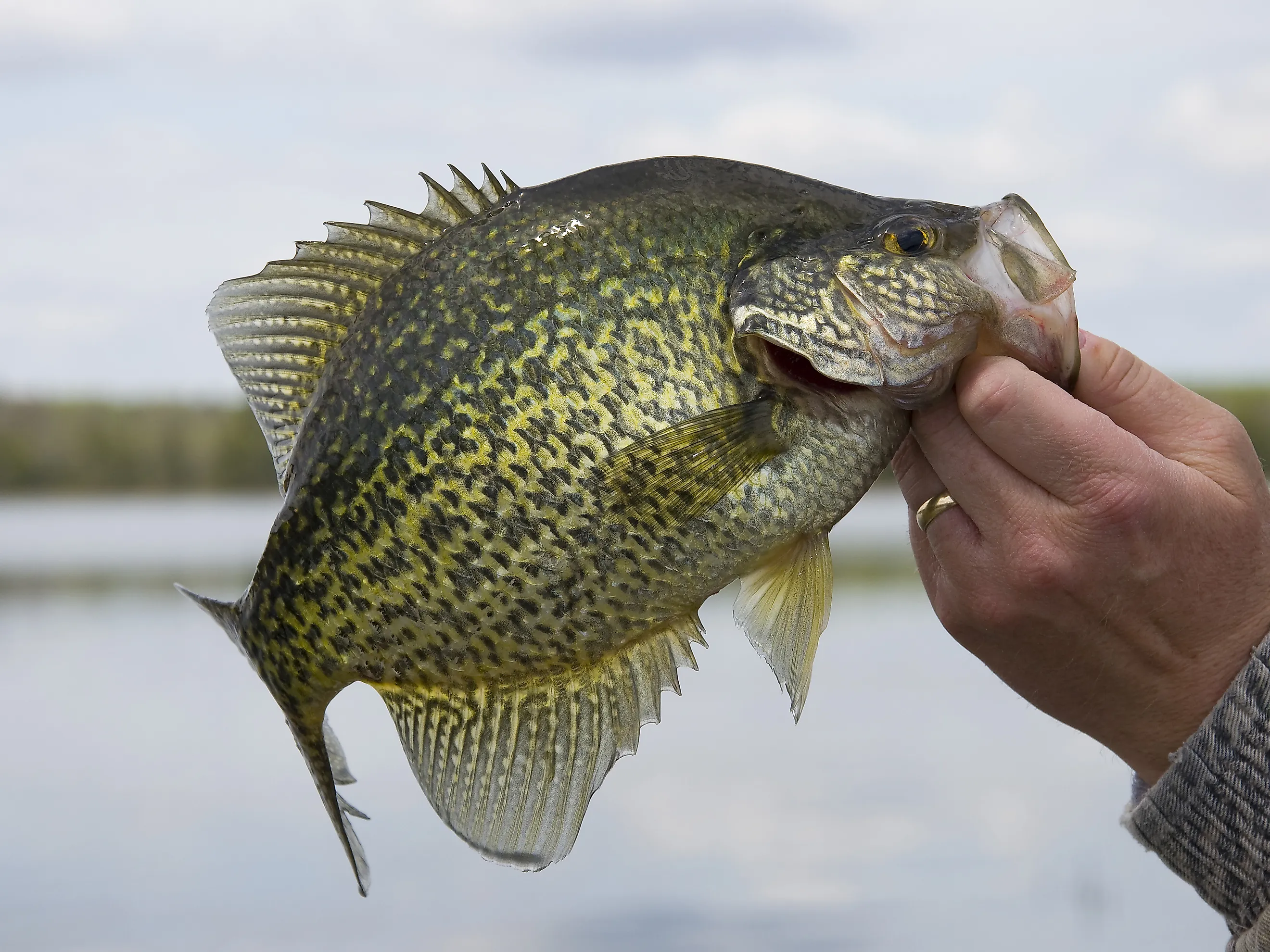
The Lakes Where Crappie Grow Biggest
Let us be honest, the crappie is a fish with an image problem. Its name sounds like a schoolyard insult, it answers to roughly a dozen aliases (papermouth, speck, calico bass, and the wonderful Louisiana "sac-a-lait," meaning "sack of milk"), and it is, at heart, a dinner-plate-shaped panfish. And yet, land a big one and grown adults start shaking. A true "slab" crappie, one pushing two or three pounds, is one of freshwater fishing's great trophies, precisely because most crappie never get anywhere near that big. Crappie overpopulate and stunt at the drop of a hat, so the giants only come from lakes with the perfect combination of groceries, space, and time. Here are the lakes where crappie skip nothing, hit the buffet, and grow into absolute units.

Grenada Lake, Mississippi

If crappie fishing had a capital city, it would be Grenada. This 35,000-acre reservoir in north-central Mississippi is so absurdly good at growing giant crappie that the local tourism people slapped a nickname on it that sounds like a boast but is basically just a fact: "Home of the 3-Pound Crappie." No other lake on Earth consistently coughs up as many slabs over three pounds. It is a shallow, stumpy, timber-filled soup of a lake, drawn down every fall by the Army Corps of Engineers, and every spring it turns into a pilgrimage site for slab hunters who show up in their hundreds. Tournament records here read like typos. This is, without contest, the number one crappie lake in America.
Enid Lake, Mississippi

Grenada's slightly overshadowed neighbor holds a trump card that not even Grenada can match: the actual world record. Back in 1957, an angler named Fred Bright pulled a white crappie weighing 5 pounds, 3 ounces out of Enid Lake, a fish reportedly 21 inches long with a 19-inch girth, essentially a swimming frisbee. Nearly 70 years later, nobody has beaten it. Enid is one of Mississippi's legendary "Big Four" flood-control reservoirs strung along Interstate 55, alongside Grenada, Sardis, and Arkabutla, a stretch of water anglers reverently call the land of the giants. The average crappie here is a modest pound, but Enid clearly has a ceiling most lakes can only dream about.
Reelfoot Lake, Tennessee

Reelfoot has the single best origin story on this list. This shallow, cypress-studded, swamp-like lake in northwest Tennessee did not exist until the winter of 1811 to 1812, when the monstrous New Madrid earthquakes shook the region so violently that the land sank and, according to legend, the Mississippi River briefly ran backward to fill the new hole. The result is a bizarre, stump-filled, bald-eagle-haunted lake that crappie find absolutely perfect. Anglers have chased slabs through its flooded timber for generations. Any lake born in an apocalypse and now beloved for its panfish deserves your respect, and probably a spot in your fishing calendar.
Weiss Lake, Alabama

Every region needs a lake bold enough to crown itself, and in Alabama that lake is Weiss. Sprawling across the Georgia border on the Coosa River, Weiss has long marketed itself as the "Crappie Capital of the World," which is exactly the kind of self-appointed title that makes rival lakes roll their eyes. Title fights aside, the fishing backs it up: Weiss still kicks out fat two- and three-pound crappie to anglers longlining crankbaits and live minnows along its channel bends and points. It has had some leaner years, as all lakes do, but when Weiss is on, it more than earns the crown it handed itself.
Santee Cooper, South Carolina

Down in the South Carolina Lowcountry, the twin lakes of Marion and Moultrie, known together as Santee Cooper, add up to a staggering 170,000 acres of prime crappie real estate. Created in 1941 when the Santee River was dammed, the land was never fully cleared, so drowned cypress trees and standing stumps still poke eerily out of the water, which is precisely the tangled, shady cover that crappie adore. The scenery swings from spooky moss-draped swamp to wide-open water, and trophy fish are genuinely common. The one downside is the sheer size: it is so big that first-timers are wise to hire a guide rather than wander this inland sea guessing.
Kentucky Lake, Kentucky and Tennessee

Some lakes grow the single biggest fish, and some just grow a ridiculous number of very good ones. Kentucky Lake, a massive Tennessee River reservoir straddling the Kentucky-Tennessee line, is firmly in the second camp, a sprawling crappie factory that has fed fish fries for generations. Its endless creek arms, ledges, and submerged brush piles give crappie limitless places to school up, and local guides have turned finding them into an art form. It is the kind of lake where a family can fill a cooler with keepers on a good spring day, which, for a lot of crappie anglers, is the entire point of the exercise.
Lake Fork, Texas
Texas does most things bigger, and its crappie are no exception. Lake Fork, the East Texas reservoir already world-famous for producing giant largemouth bass, moonlights as one of the best big-crappie lakes in the country. The same fertile, timber-filled water that grows monster bass grows monster slabs, and Fork is a genuine year-round destination where vertical jigging around standing timber can produce fish that make Northern anglers weep with envy. Coming here for the bass and leaving with a cooler of jumbo crappie is a very common and very happy accident.
Truman Lake, Missouri

Not everyone can road-trip to Mississippi, and for slab-hungry anglers in the Midwest, Truman Lake is about as close to heaven as it gets. This big, brushy Missouri reservoir is stuffed with the flooded timber and standing cover that crappie treat like a five-star hotel, and it has a well-earned reputation for kicking out impressive numbers of quality fish. It proves an important point: while the Deep South hogs the crappie glory, you do not actually have to cross the Mason-Dixon line to tangle with a proper slab. Sometimes the buffet is a lot closer to home than you think.