How Much Of The World's Water Is In The Oceans?
Earth has an abundance of water. Water fills the Pacific Ocean and the Great Lakes. It runs through rivers, lies frozen in glaciers, seeps into aquifers, and drifts through clouds. Yet the global supply is divided unevenly between saltwater and freshwater. About 96.5% of Earth’s water is in the oceans, while about 2.5% is freshwater. The remaining roughly 1% is mostly saline groundwater, with a much smaller amount in saline lakes. This imbalance affects drinking water, agriculture, ecosystems, and water supplies around the world.
Global Water Facts

The US Geological Survey estimates Earth's total water supply at approximately 332.5 million cubic miles (1.386 billion cubic kilometers), enough to cover the 48 contiguous US states to a depth of about 107 miles (172 kilometers). Of this total, the world's oceans contain an estimated 321 million cubic miles (1.335 billion cubic kilometers) of water, meaning that roughly 96.5% of Earth's water is stored in its oceans.
Even if you can envision the US covered by more than 100 miles of water, the sheer volume of water on Earth is difficult to fathom. A cubic mile of water contains about 1.1 trillion gallons (4.2 trillion liters), meaning it would take roughly 366,000,000,000,000,000,000 one-gallon containers to hold all of Earth's water. Or, if all the water were collected into a single sphere, the USGS estimates that the sphere would have a diameter of about 860 miles (1,384 kilometers), roughly the distance from Salt Lake City, Utah, to Topeka, Kansas. The USGS graphic instead shows an 860-mile sphere for all Earth's water, a 169.5-mile sphere for liquid freshwater, and a 34.9-mile sphere for freshwater in lakes and rivers.
Saltwater and Freshwater

The ocean's overwhelming share of Earth's water supply is not easy to use for drinking or agricultural purposes, because seawater contains dissolved salts. Rainwater and water flowing over and through the land gradually carry minerals and dissolved materials, including salts, toward the oceans. Over geologic time, weathered rock and seafloor processes supplied dissolved ions to the oceans, while evaporation concentrated them, and other processes removed some salts from the water.
Freshwater accounts for about 2.5% of Earth's water, while freshwater in lakes and rivers represents only about 0.007% of the total. The USGS estimates that more than two-thirds of Earth's freshwater is locked in ice and glaciers, while roughly 30% is stored underground as groundwater. Rivers and lakes account for only a tiny fraction of the planet's total water supply.
Where the Remaining 3.5% Is Stored

The water outside the oceans is not entirely fresh. About 2.5% of Earth’s total water supply is freshwater, while roughly 1% is primarily saline groundwater. A much smaller amount is held in saline lakes. More than two-thirds of the freshwater is locked in glaciers and ice sheets, particularly in Antarctica and Greenland. Roughly 30% is stored underground as freshwater groundwater.
Only a tiny share remains in lakes, rivers, soil, wetlands, and the atmosphere. The Great Lakes hold roughly 21% of the world’s surface freshwater by volume, yet even this immense system contains only a small fraction of Earth’s total water. Regional climate, precipitation, snowpack, groundwater recharge, and river flows determine how much of this limited supply is locally available.
The Water Cycle
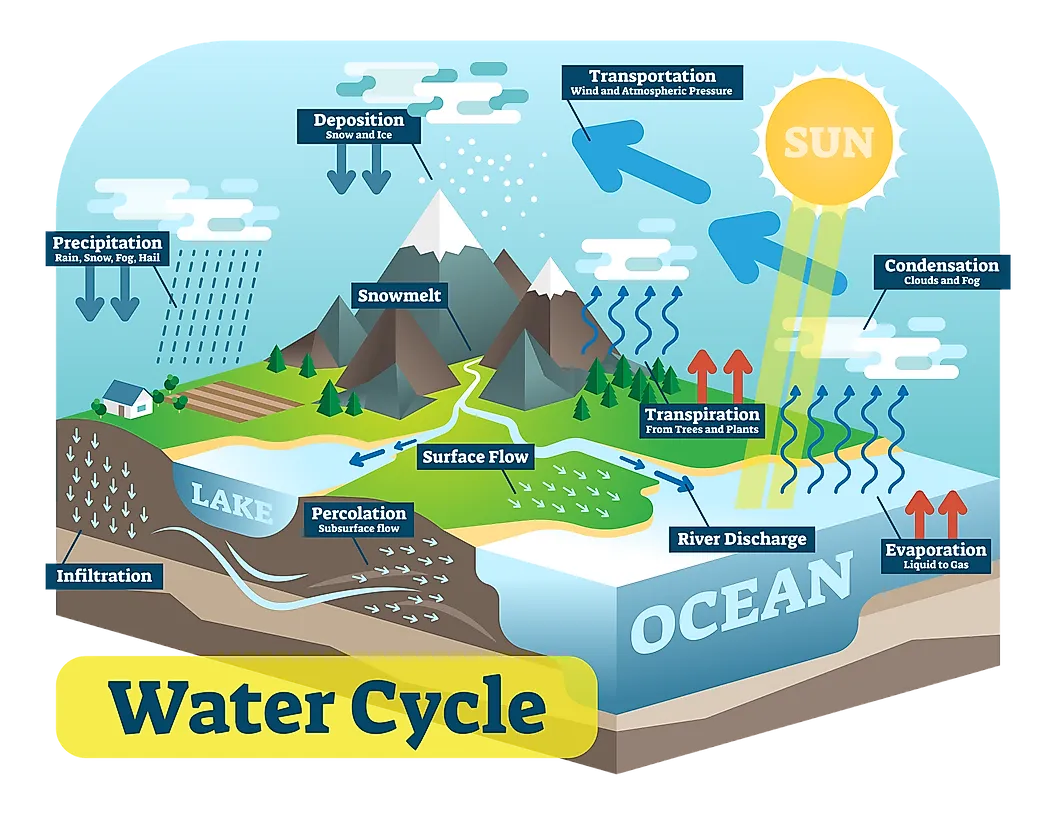
Saying that more than 96% of Earth's water is in its oceans does not mean that the planet's saltwater and freshwater are permanently separated. Instead, the water cycle is in constant action among Earth's various freshwater and saltwater repositories. Each day, more than 250 cubic miles (1,042 cubic kilometers) of ocean water evaporates into the atmosphere, which holds around 3,100 cubic miles (12,900 cubic kilometers) of water at any given time. In turn, atmospheric moisture falls as precipitation, and the fallen rain and snow eventually return to the oceans through rivers, groundwater, and runoff. Water continually circulates among the oceans, atmosphere, land, groundwater, and living organisms.
A Saltwater World

If you stand on a beach and look out on the seemingly endless expanse of the Atlantic or Pacific Ocean, it may not be so hard to believe that more than 96% of Earth's water is in the oceans. Of course, standing at the edge of Lake Superior might make it difficult to wrap your brain around the fact that the world's lakes, rivers, ice caps, underground aquifers, and atmosphere hold under 4% of the total water supply. In reality, Earth could be described as a saltwater planet home to an abundance of creatures suited to life in the oceans, along with a multitude of living things, including humans, that can survive on a comparatively small freshwater supply.