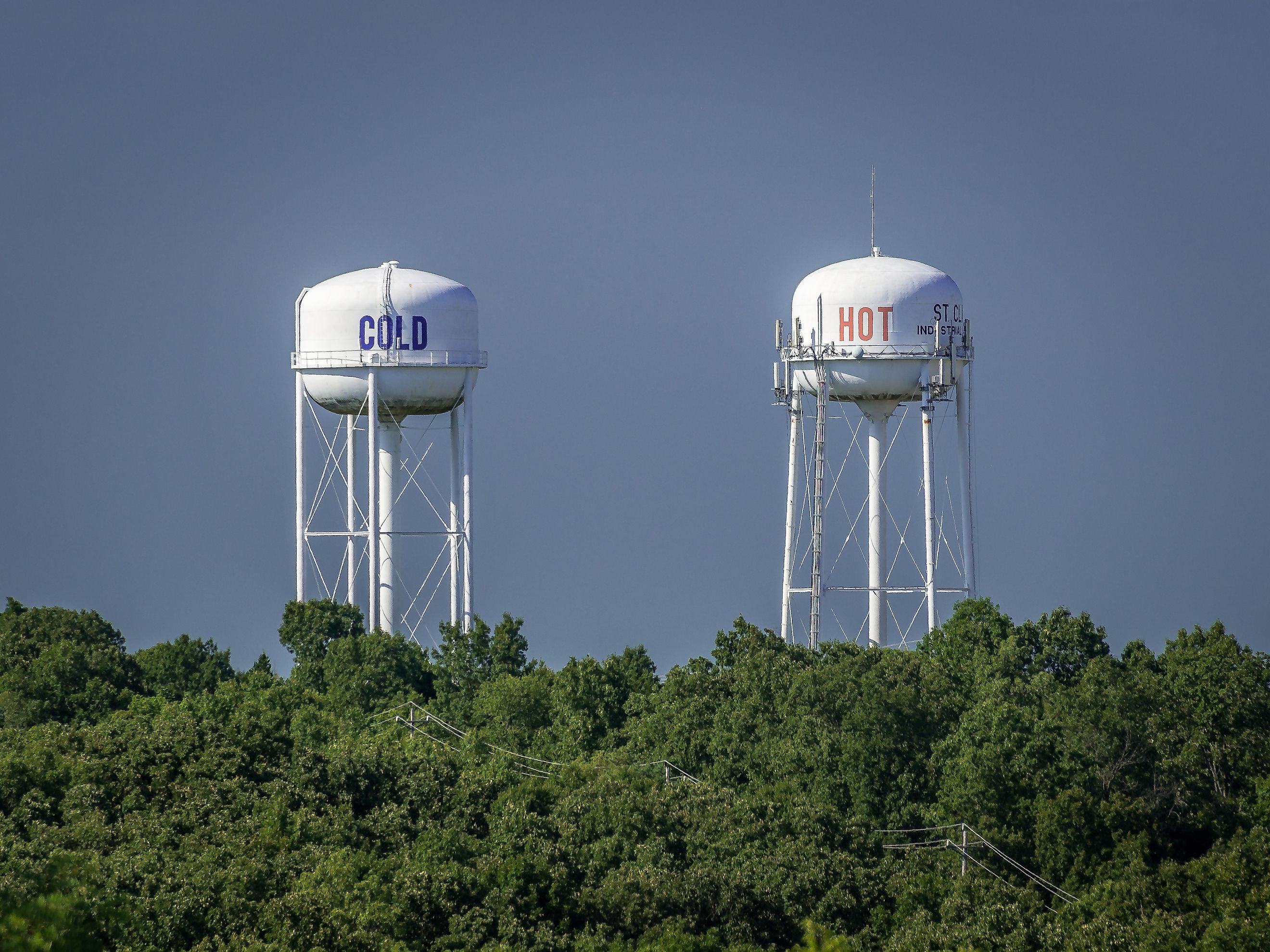
Why Some Towns Have A Hot And A Cold Water Tower
In towns with two water towers side by side, one might see the labels "hot" and "cold" listed on them. Despite the labels, they do not actually contain different temperatures of water, but are instead part of a larger trend of giving fun or quirky designs to community water towers. For some towns, this trend allegedly began as a prank by teenagers, before the town adopted it as a symbol of its town, which has been confusing drivers for decades.
Pratt's high school prank

The hot and cold water tower joke emerged in the Midwestern state of Kansas in the 1950s. According to several locals of Pratt, Kansas, a group of teenage boys, who have never been identified, climbed up the ladder to the top of the town's two water towers and spray-painted the word Hot on one and Cold on the other.
The towers themselves were already several decades old at the time, with one dating back to 1901 and the other to 1909, which coincides with the creation of the town's Water Utility System in 1901.
The prank was so pleasantly regarded by the town that residents decided to make the change permanent, painting the words on the water towers. Today known as the Hot and Cold Water Towers, these towers are now a roadside curiosity and are situated above the Hot and Cold Tower Gardens, first planted in 1995. Pratt has since installed two larger water towers, with a 500,000-gallon and 750,000-gallon capacity, respectively.
What other towns have hot and cold water towers?
The quirky joke was best in rural American towns, and Kansas has more than one example. In Canton, two water towers feature a red and blue top with the labels hot and cold, respectively, making them appear like two knobs on a faucet. The cold tower was built first in the 1920s, with the hot tower added in the 1950s less than 100 yards away to tap into a well water supply. Around 1956, a citizen thought adding the words hot and cold would be a fun way to draw attention to the town, and the idea stuck.
The idea spread to other towns independently of each other, such as St. Clair, Missouri. In the 1980s, a second tower was established next to the original 200,000-gallon water tower. According to local historians, the town mayor led the way in painting these towers hot and cold.
In some towns, there is not much information on how they got the hot and cold water towers, such as Tuppers Plains, Ohio, with its water towers sitting on a hill above the Pleasant Grove Cemetery. What is known is that this was an official designation, and that it was done for the same reason as the other three mentioned above: as a local joke.
Is the water actually hot or cold inside water towers?

Although the joke has often confused residents and visitors, temperatures in water towers tend not to be overly hot or cold. Its temperature mostly reflects the temperature of the water source, often groundwater.
Hydroflow USA notes that groundwater temperature varies depending on the region. In Kansas, groundwater tends to be anywhere from 51 to 60 degrees Fahrenheit, while in North Dakota it can drop below 40 degrees Fahrenheit. In the hotter southern states, like Texas, water temperatures can range from 61 to 70 degrees Fahrenheit.
Once the water is transported into the water tank, it keeps moving as water flows into the tank and out of the tank depending on water demand, which helps it stay at a relatively cool temperature. Some towers in cold climates use mixing or heating systems to prevent freezing.
What is a water tower for exactly?

Water towers primarily act as a backup water storage system. The first American water towers were built in the mid 1800s as a way to store safe water, especially with the outbreak of waterborne illnesses such as cholera. In addition to drinking water, water towers helped put out fires.
According to most records, one of the first American water towers was the Chestnut Hill Water Tower, constructed in 1859 as a stone tower with a wooden tank on top that could hold 40,000 gallons of water. Water towers would spread throughout much of the U.S. from the late 1800s to the early 1900s.
Water towers use gravity to keep water pressurised. This is why they need to be tall, as each foot adds 0.43 PSI of pressure. In American towns, water treatment facilities work alongside water towers to continually provide pressurised water. During times of peak demand, such as after 9-to-5 work hours, water towers can release water down their central pipe to connect with the main water system.
How does water become hot or cold from a faucet?
Water moves from the municipal water system through a supply line pipe made of iron, copper, or plastic into waterlines in the house. From the mainline, there is the cold water line and then the hot water line branches after the water heater.
Cold water here is just the same temperature as the water in the pipes. However, at times, air temperatures can warm up pipes and make even cold water hot, as it sits in the pipes without moving. Typically, once the faucet is turned on for a longer period of time, the water will begin to cool as it moves and replaces the warm water from the pipes.
For hot water, it enters a water heater. As water enters the heater, the tank heats the water with a gas burner or an electric element. It keeps a portion of hot water in reserve for use at faucets to wash dishes, hands, or to have a shower. However, when this reserve runs out, the water can turn cool again. This is why after someone takes a long hot shower, if someone else gets into the shower, they will find that the water just won't get quite as hot as normal.
The joke writes itself
These hot and cold water towers likely developed independently from each other based on a simple joke. With two water towers right next to each other, they look just like two knobs on a faucet, one for hot and one for cold. It also brings some character to an already unusual landmark of two water towers close enough to each other that one can easily see them side by side. The actual water inside the tower, however, is kept cool due to constant movement and the temperature of the groundwater.
These water towers are not just practical pieces of equipment, but a big visual representation of the American town itself, making them ripe for all sorts of quirky designs and catchphrases.