Lakes That Have Survived Millions of Years
With only 20 ancient lakes remaining on Earth, continuously carrying water for over one million years, they stand as geological wonders. Home to thousands of species, including endemic varieties not found anywhere else on the planet, these are biodiverse hotspots. Additionally, these bodies of water hold shorelines to historic settlements, reflecting early human activity. Travel back in time, across periods and continents, as you discover lakes that have survived millions of years.
Lake Baikal, Russia

As the oldest and deepest lake in the world, dating back 25 million years with a depth of 1,700 meters, Lake Baikal is set in the remote wilderness of southeast Siberia. Due to its long history and isolation, this Russian rift lake boasts an extraordinary range of unusual freshwater fauna and flora, contributing significantly to evolutionary science.

Roughly, scientific sources report 1,500-1,700 species, with about two-thirds endemic (≈66%), meaning they cannot be found anywhere else. Today, Lake Baikal also holds nearly 20% of the world's unfrozen freshwater reserve. This striking landform, with its crystal-clear waters, was officially declared a UNESCO World Heritage Site in 1996.
Lake Ohrid, Southeast Europe

Located at the border between North Macedonia and Albania, Lake Ohrid, which has continuously existed for approximately two to three million years, is of tectonic origin. Over 200 species of endemic plants and animals can be found here, including several species of fish, algae, birds, crustaceans, turbellarian flatworms, and snails. You will also find stunning, historic towns situated on the shores of the lake.

Ohrid, a historic city in North Macedonia, is one of Europe's earliest human settlements, mainly developed between the 7th and 19th centuries. Struga is another remarkable destination set along the northern shores, with archaeological records dating back to the Neolithic period.
Lake Tanganyika, East Africa

The second-largest of the African Great Lakes by volume, 16-17% of the world’s surface freshwater, Lake Tanganyika is one of the lakes that have survived millions of years. This East African wonder is the longest freshwater lake on the planet, spanning 410 miles, and is the second-deepest after Lake Baikal with a depth of 4,710 feet.

It spans across four African countries, including Burundi, the Democratic Republic of Congo, Tanzania, and Zambia. This geological landmark was formed approximately 9 to 12 million years ago in the East African Rift Valley. Over 2,000 species can be found here, with 500 of those not discovered anywhere else on the planet.
Caspian Sea, Eurasia

Discover the Caspian Sea, the largest inland body of water in the world. Bordered by five countries, including Russia, Kazakhstan, Turkmenistan, Iran, and Azerbaijan, this Eurasian landform spans approximately 371,000 square kilometers. While it now stands as the largest salt lake on the planet, with no direct outlet to any ocean, this was not always the case. Studies showcase that millions of years ago, the Caspian was part of a prehistoric sea called the Paratethys.

Caspian Sea near Aktau, Mangystau Region, Kazakhstan. Wikimedia Commons.
Due to elevation by tectonic forces and a drop in sea level, the lake has undergone significant changes over time and has been landlocked for 5.5 million years. Today, there are no outflows to the Caspian other than evaporation, which has increased over the past couple of decades, primarily due to rising air temperatures caused by climate change. The salinity level is now about one-third of oceanic water.
Lake Biwa, Japan

In Shiga Prefecture lies Lake Biwa, Japan's largest lake. Fossils and sediments in the Lake Biwa Museum showcase the rich history and transformations of Biwa, its beginnings dating back roughly four million years. Over 3,100 species in the lake and vicinity, with 62 confirmed endemic and 84 suspected endemic.

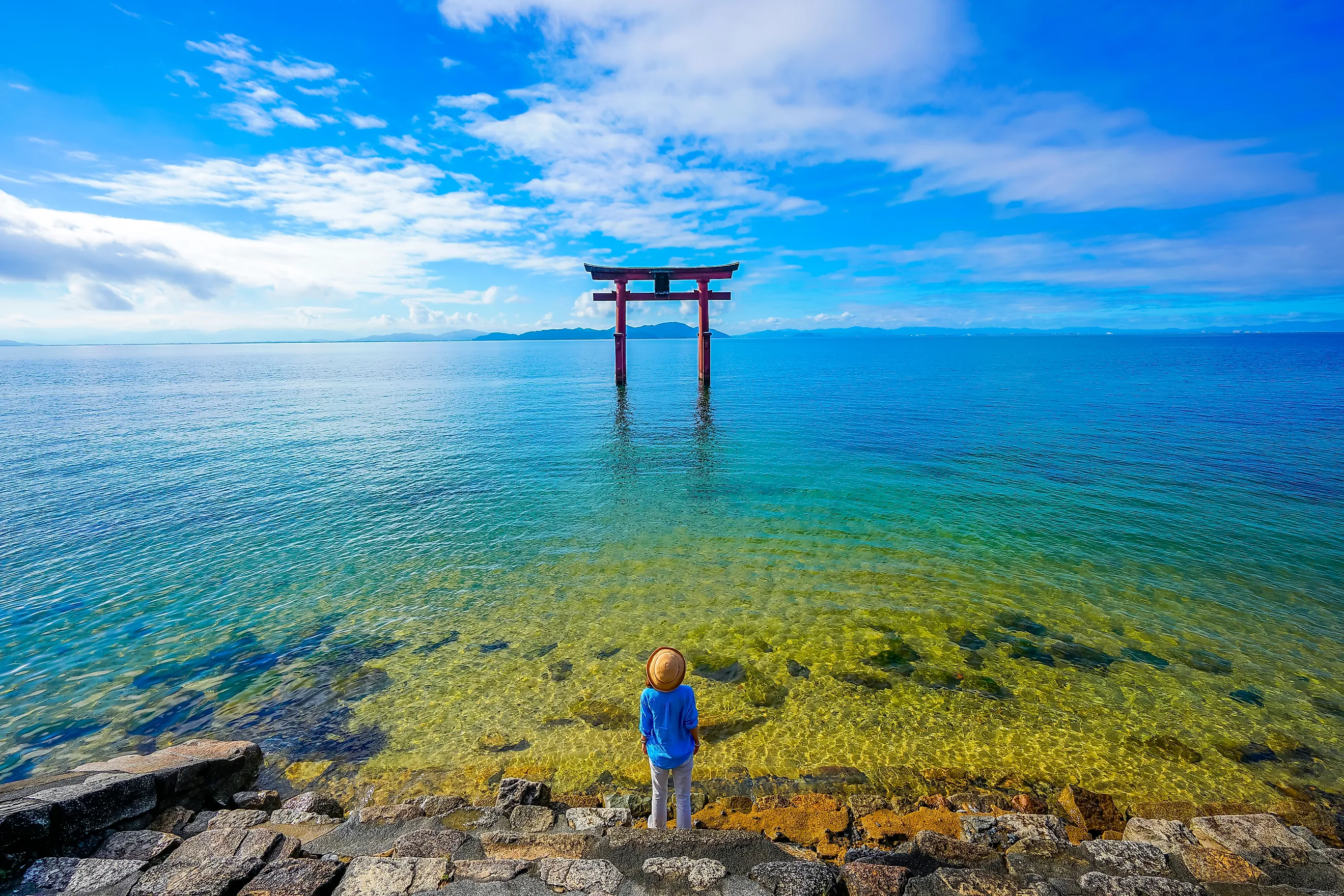
The water is home to Shirahige Shrine's vermilion torii gate, a famous photography spot on one of the world’s oldest lakes. Over 3,100 species have been recorded from the lake and vicinity, with 62 confirmed to be endemic, and another 84 which are suspected to be (further scientific research is required to confirm).
Lake Titicaca, South America

Covering 3,200 square miles in the Andes Mountains across Peru and Bolivia, Lake Titicaca is South America's largest freshwater lake. Geologists and historians believe it is about three million years old, and is thought to be the sacred birthplace of the Inca Empire (specifically Isla de Sol in Bolivia). Titicaca is also the world's highest navigable lake, set 12,500 feet above sea level. The Tiquina Strait splits the water into two basins: Lake Pequeño in Peru and Lake Huinaymarca in Bolivia.

Endemic species such as the Titicaca Giant Frog reside here, although they are endangered due to mining pollution and heavy use in traditional medicine. The basin is also home to a variety of bird species, including the distinctive yet endangered Titicaca Grebe or the rare Andean Flamingo, which uniquely thrives in high-altitude waters.
Only a handful of ancient lakes remain on Earth, but each one demonstrates extraordinary resilience. Having survived dramatic climatic changes, shifting continents, and fluctuating sea levels over millions of years, they have withstood remarkable forces. Today, thousands of species reside in these lakes that have survived millions of years, many not found anywhere else, creating some of the most biologically diverse ecosystems known to humanity. Beyond their geological significance, these landforms border early human settlements, where towns first developed, cultures flourished, and traditions were established, highlighting their significance for both the natural world and civilizations.