The Rise of Ottoman Artillery Warfare
As one of the largest empires in world history, the Ottoman Empire utilized various tools and strategies to rise to prominence, including artillery warfare. Indeed, it proved crucial as the Ottomans moved into the Balkans and later played a major role in their conquest of Constantinople in 1453. Thereafter, it remained part of military strategy as the Ottomans expanded into Central Europe and the Middle East. Although many factors contributed to the success of the Ottoman Empire, including their cavalry, navy, and strong administrative systems, one cannot fully understand the empire's rise to power without comprehending the crucial role of artillery.
Early Adoption of Gunpowder

Gunpowder was invented in China sometime in the 9th century. However, it did not become widely used across Europe and the Middle East until the late Middle Ages. The Ottomans adopted gunpowder early and quickly integrated it into their siege warfare alongside other emerging powers in Europe and the Middle East. They took full advantage of it, utilising primitive cannons to bombard city walls as they moved into the Balkans in the 14th and 15th centuries. To fully capitalise on this technology, the Ottomans created the Topçu corps, a professional group of artillerymen trained in ballistics and siege warfare. They worked in conjunction with the elite Janissaries, one of the earliest centrally organized standing infantry forces in the region. This combined arms approach made the Ottoman army particularly effective during the empire's early expansion.
The Conquest of Constantinople

The full strength of Ottoman artillery was on display during the siege of Constantinople in 1453. To break through the city's Theodosian Walls, which were triple-layered and had protected Constantinople for over a thousand years, Ottoman Sultan Mehmed II utilised massive cannons. The bombardment greatly weakened the city, both because of the damage it inflicted on the defenses and the psychological toll it took on the people inside the city walls. Ottoman artillery played a crucial role alongside naval pressure, numerical advantage, and prolonged siege tactics in the fall of Constantinople in May 1453. The collapse of the Byzantine Empire left the Ottoman Empire to emerge as a key power in the Middle East and Southeastern Europe.
Further Developments and the Peak of Ottoman Power

After the Conquest of Constantinople, Ottoman artillery consistently improved. Cannons became lighter and more mobile, and gunpowder became easier to produce. These improvements were on full display in the 1514 Battle of Chaldiran with the Safavid Empire. As the first major Ottoman expansion into Eastern Anatolia, they decisively beat the Safavid army, which relied heavily on cavalry and lacked comparable artillery and firearms. Both traditional Ottoman artillery units and the Janissaries utilized gunpowder weapons during the battle. On the other hand, the Safavids lacked artillery and were forced to use cavalry to charge the Ottomans. This was disastrous, and the Safavids lost the battle and thousands of soldiers. The Ottomans subsequently annexed Eastern Anatolia and part of Mesopotamia.
Ottoman artillery reached its peak under the reign of Suleiman the Magnificent (1520 to 1566), who presided over what is often remembered as the empire's "Golden Age." Perhaps most significantly, it proved crucial during the Ottoman expansion into Central Europe. This was exemplified by the Battle of Mohács (1526), in which the Ottomans faced the Hungarians. The battle began with Hungarian cavalry charging the Ottomans, who responded with heavy artillery and musket fire. This devastated the Hungarians and stalled their attack, allowing the Ottomans to mount a counterattack and encircle and defeat them. The Hungarian King, Louis II, subsequently died while fleeing the battle. After the battle, the Kingdom of Hungary collapsed, and the region was eventually divided between the Ottoman Empire, the Habsburg monarchy, and the semi-independent Principality of Transylvania. With this victory, the Ottomans took Hungary and gained a firm foothold in Central Europe.
Eventual Decline

Ottoman artillery declined after the 17th century as many European states began innovating more rapidly in military technology and organization. Moreover, the Janissaries gained increased political and cultural privileges. This led them to resist reforms that threatened these privileges. Even though the Janissaries were an infantry unit, this stagnation eventually impacted all aspects of the Ottoman military, including the artillery.
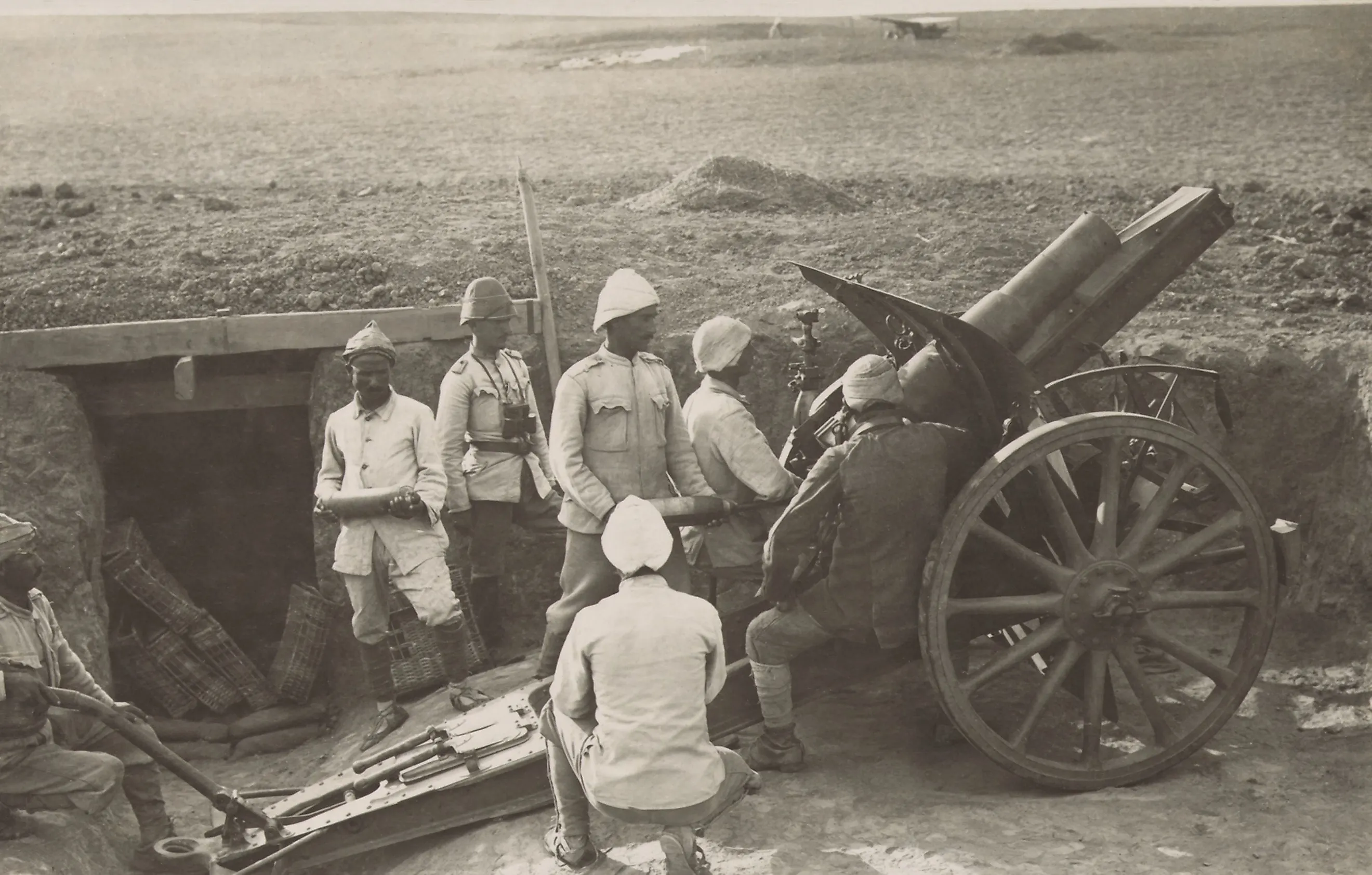
By the early 20th century, the Ottoman Empire was no longer a dominant military power, but artillery remained an important part of its army. During World War I, Ottoman forces used modern field guns and heavy artillery in campaigns such as Gallipoli (1915-1916), where Ottoman artillery helped defend the Dardanelles against British and Allied forces attempting to seize the strait. Artillery batteries positioned along the coastline and on elevated ground bombarded Allied ships and landing forces, contributing significantly to the invasion's failure.
However, by this time, the Ottomans relied heavily on German military technology, advisors, and equipment, and their artillery capabilities lagged behind those of the major European powers. After the Ottoman defeat in World War I and the empire’s collapse in 1922, the new Republic of Turkey inherited and modernized the remaining artillery systems.
Impact and Legacy

Despite its eventual decline, Ottoman artillery was nevertheless indispensable in allowing the empire to become a world power. Indeed, it was crucial during the early expansionary period into the Balkans. Furthermore, it was a major reason why the Ottomans were able to take Constantinople. Finally, artillery was a key factor during the Ottomans' Golden Age, with it being utilised to further the empire's territorial reach in Anatolia, Mesopotamia, and Central Europe.