How Rome Conquered Egypt In 30 BCE
Egypt's grain fed much of the Roman world, and by the first century BCE, that economic reality had become a political liability. A kingdom rich enough to bribe Roman generals was still one that grew ever more dependent, increasingly so with every generation of Ptolemaic rule. And when Cleopatra allied herself with Mark Antony and ended up on the losing side of a Roman civil war, she was not suffering a sudden military defeat. She was reaching the end of a process her own dynasty had spent a century setting in motion.
Early Roman Influence

Before Cleopatra came to power in 51 BCE, Rome had already established a strong influence in Egypt over the previous century. This happened for several reasons. First, Egypt’s power in the Mediterranean weakened due to infighting within the Ptolemaic family and a stagnant economy. At the same time, the Roman Republic’s influence grew as it expanded into North Africa, Anatolia, and Greece. This power imbalance meant that Egypt needed to stay in Rome’s good graces to avoid being conquered. Rome also became a major importer of Egyptian grain and other agricultural products, making Egypt economically dependent on it.
Finally, Rome began to intervene more directly in Egyptian affairs. The most notable instance of this occurred under the reign of Pharaoh Ptolemy XII. In 59 BCE, as his grip on power waned, he bribed Roman leaders like Pompey and Julius Caesar to secure their support. This backfired, and riots erupted in response, forcing him to flee to Rome. Nonetheless, in 55 BCE, he financed a Roman expedition back to Egypt, where he regained power. This set a precedent for further Roman intervention in Egypt.
Cleopatra and Rome

Ptolemy XII’s daughter, Cleopatra VII, better known simply as Cleopatra, followed this precedent. Initially, she was supposed to co-rule Egypt with her brother (and husband), Ptolemy XIII. However, Cleopatra’s push for dominance in this arrangement led to her removal from power and exile to Syria. Nevertheless, she quickly raised an army and returned to Egypt. At the same time, Roman general Julius Caesar was in Alexandria pursuing Pompey, who was now his opponent in a civil war. Cleopatra appealed to Caesar for help, which he provided, and the two managed to remove her brother from power by 47 BCE, leaving her as ruler with Ptolemy XIV as nominal co-ruler. Cleopatra also had a child with Caesar named Caesarion, further tying her rule to Roman politics.
A New Ally

While Caesar won his civil war and declared himself dictator of Rome, he was assassinated in 44 BCE. Cleopatra now lacked her main ally. This changed in 41 BCE, when she was summoned by Mark Antony, a powerful Roman general and Caesar's ally who controlled Rome’s eastern provinces. The two needed each other: Cleopatra required Roman protection and recognition as Egypt's ruler, and Antony needed Egypt’s wealth and military support in his campaigns. They formed a strategic and romantic partnership, strengthened their position in the region, and had three children together.
Civil War

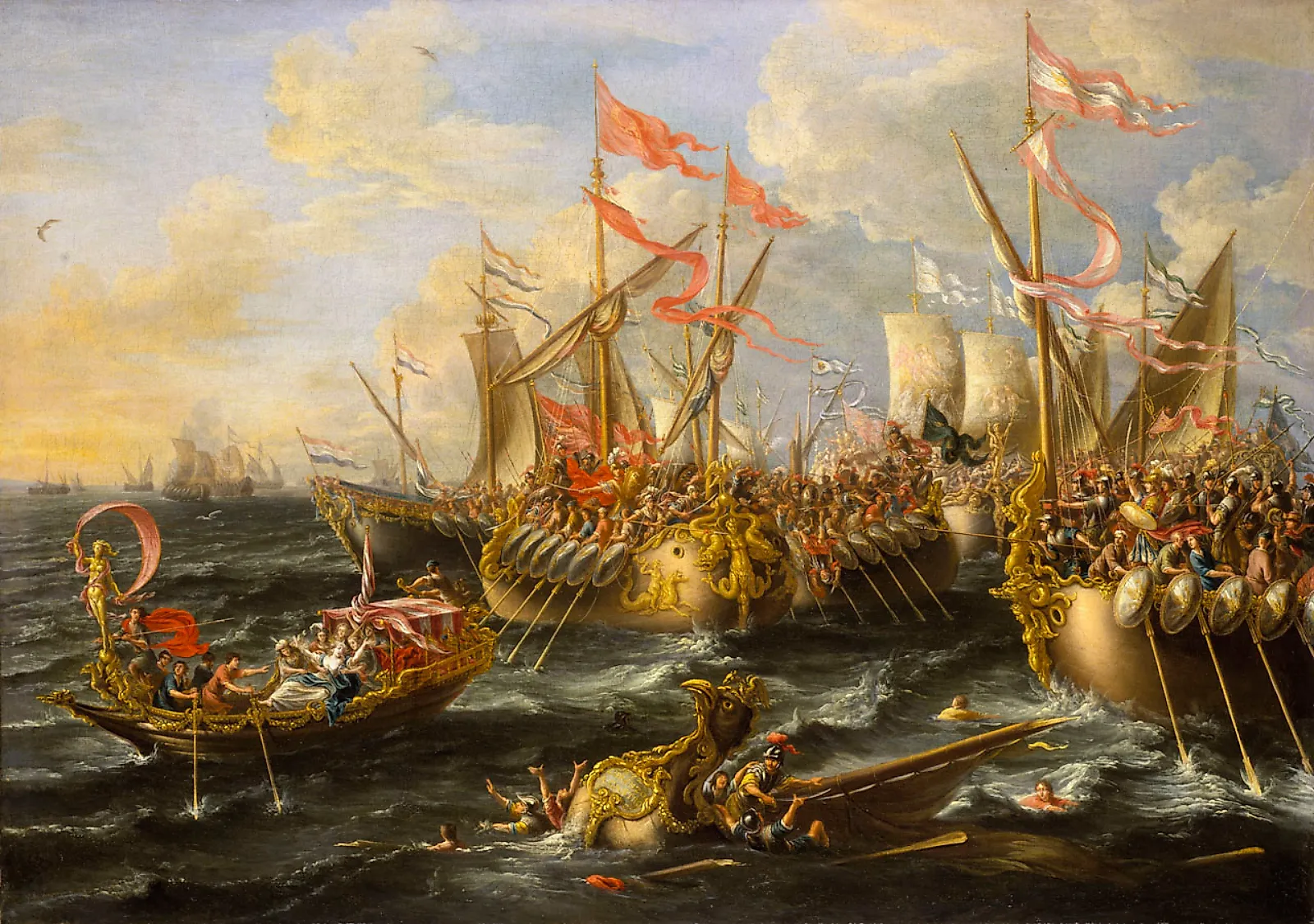
A major turning point in their partnership came with the Donations of Alexandria in 34 BCE, when Antony granted Cleopatra and her children control over large territories, including Armenia, Media, Parthia, Cyrenaica/Libya, Syria, Phoenicia, and Cilicia. This act provoked outrage in Rome. Antony’s main rival, Octavian, asserted that it proved that he had betrayed Roman interests and was controlled by Cleopatra. The Senate also stripped Antony of his powers and declared war on Cleopatra. A civil war then broke out between the western Roman provinces, led by Octavian, and the eastern provinces, led by Antony and Cleopatra. This culminated in the Battle of Actium in 31 BCE. At the Battle of Actium, fought near the entrance of the Ambracian Gulf off the coast of western Greece, Octavian’s fleet outmaneuvered and decimated Antony’s ships. Cleopatra then retreated mid-battle, causing Anthony to do the same.
Rome Takes Egypt

Cleopatra and Antony fled to Egypt to raise new armies and restore morale. They also made plans to escape to Arabia or India if necessary. However, the situation was increasingly dire. The Eastern provinces were increasingly defecting to Octavian, leaving Antony and Cleopatra effectively isolated by 30 BCE. That same year, Octavian invaded Egypt. He laid siege to Alexandria before the city fell. Upon being falsely told that Cleopatra had died, Antony committed suicide. Cleopatra attempted in vain to negotiate with Octavian. But, not wanting to be taken to Rome to be publicly humiliated, she also committed suicide. With Antony and Cleopatra dead, Octavian officially incorporated Egypt into the Roman Empire. He also had Caesarion executed to ensure that Caesar’s “true heir” did not rival his power.
Why Egypt Fell Under Roman Rule
While Rome conquered Egypt in 30 BCE, it had influenced the country for over 100 years before then. Indeed, Egypt’s economy relied on Rome, and Egyptian leaders like Ptolemy XII and Cleopatra used Roman aid to secure their grip on power. While useful in the moment, this alliance also bound Egypt’s fate to Rome. Therefore, as Cleopatra found herself on the losing side of a Roman civil war, the Ptolemaic dynasty and Egyptian independence crumbled.