How Did The Battle of Kosovo Strengthen Ottoman Power?
The Battle of Kosovo (1389) was a key event in Ottoman history. It saw the empire demonstrate the full force of its military power against a tenuous and fracturing coalition of Christian states. This paved the way for deeper Ottoman influence in the Balkans and helped transform the empire from a largely Anatolian power into a multicontinental one. It also set the stage for the Second Battle of Kosovo, almost fifty years later, and for the eventual Ottoman conquest of Constantinople in 1453.
Background

The Ottoman Empire was founded at the very end of the 13th century. Under its first leader, Osman, and his successors, the empire gradually accumulated power and influence. A founding legend describing Osman receiving a vision of an empire spanning three continents helped unify previously divided Anatolian groups. Conflict with neighboring Christian powers, including the Byzantine Empire and Balkan states, also encouraged cooperation among these mostly Muslim frontier groups.

All this enabled the Ottomans to enter the Balkans in 1352 as a unified, cohesive force. In 1352, they gained a foothold at Cimpe (Tzympe), and in March 1354, following an earthquake, they seized Gallipoli. In the early 1360s, the Ottomans captured Edirne, and it became Murad I’s capital. Then in 1371, they crushed a coalition of Serbian forces in the Battle of Maritsa.
Serbia was a major power in the 1350s. United under Stefan Dušan, the Serbian Empire stretched across much of the southern Balkans, including Serbia, Macedonia, Albania, and about half of Greece. However, after Dušan died in 1355, the empire fragmented and weakened. Thus, by the 1380s, the most powerful Serbian leader was Prince Lazar. He ruled Moravian Serbia, a significant but much smaller state than Dušan’s former empire.
The Battle

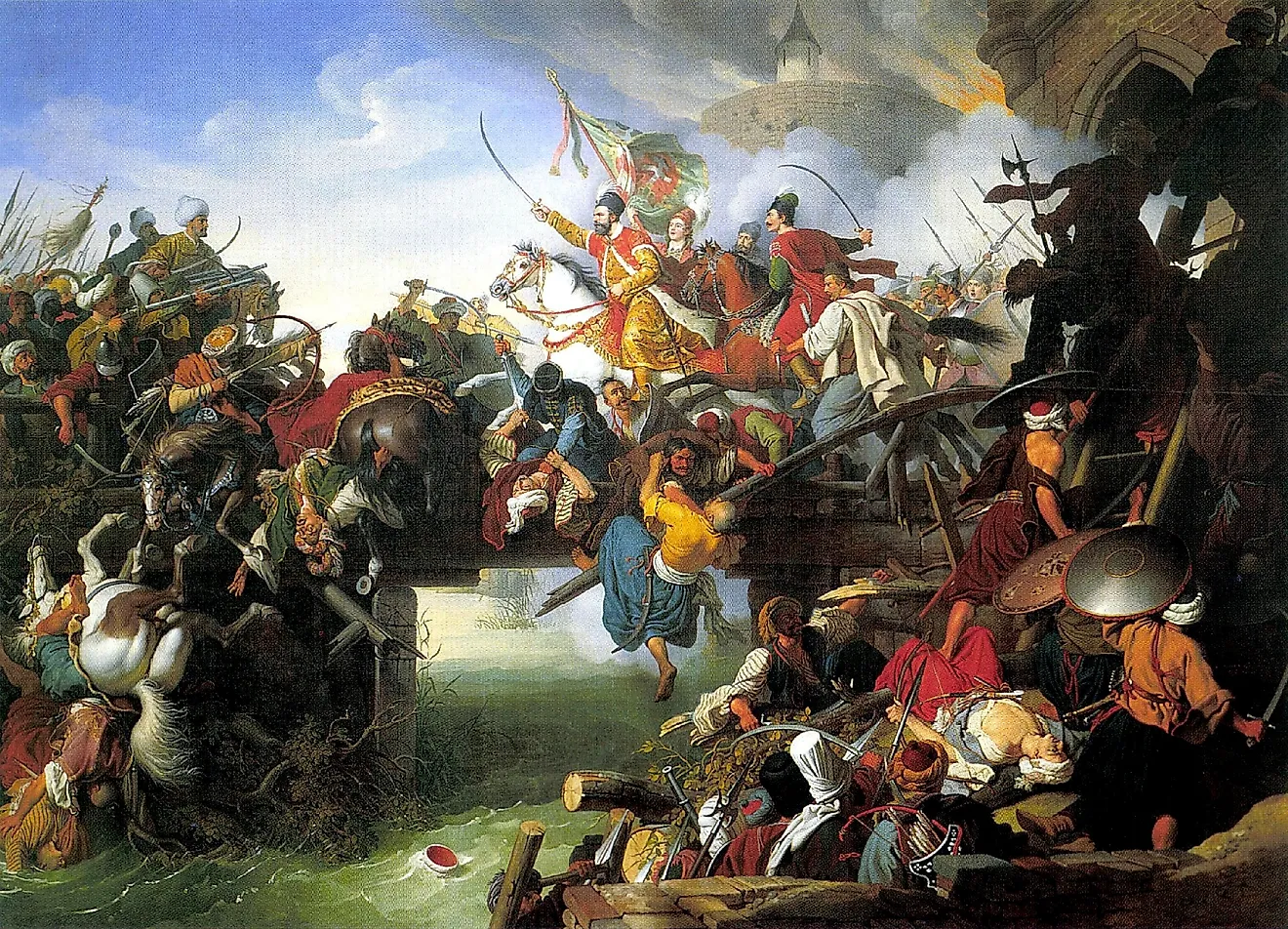
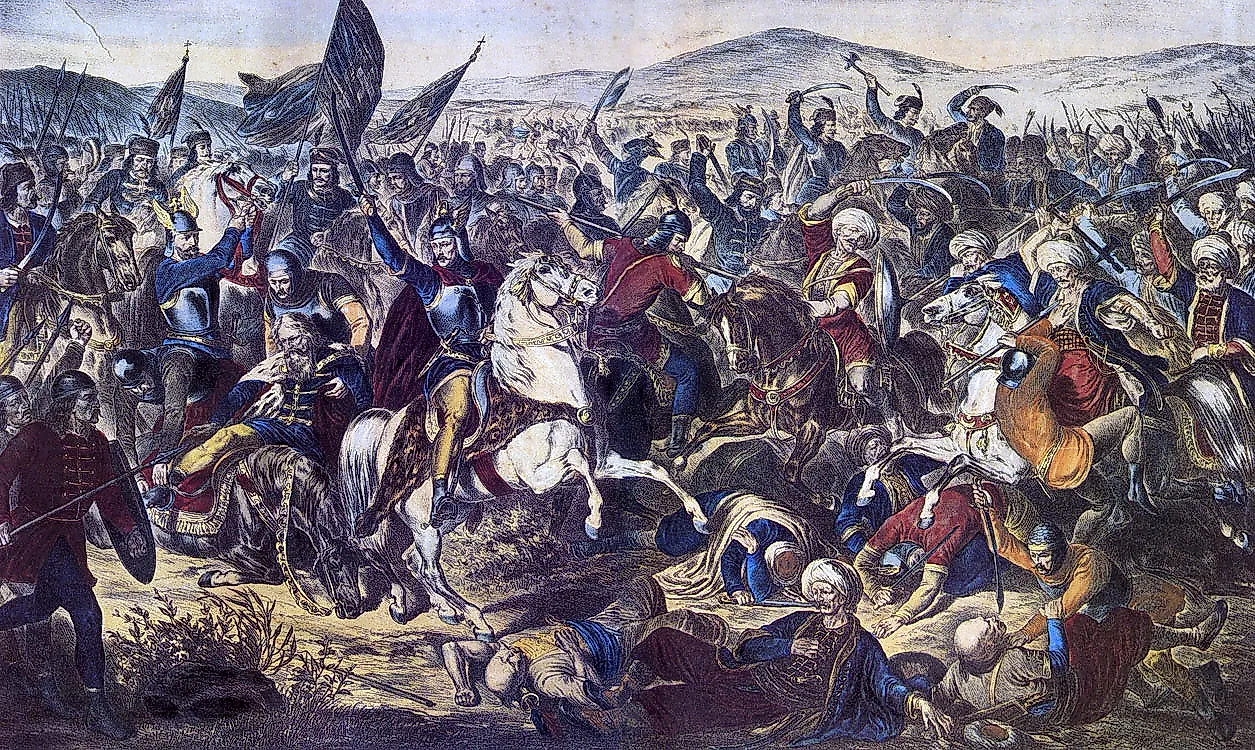
The Battle of Kosovo occurred in June 1389. The Ottomans were led by Sultan Murad I, whereas a coalition of Serbian, Bosnian, and other Christian forces was commanded by Prince Lazar. Since there are few sources from the battle, much of what supposedly occurred is likely heavily exaggerated or mythologized. Nevertheless, both sides suffered heavy losses. Furthermore, both Murad I and Prince Lazar died; Murad was assassinated, but accounts differ on the timing. The Ottomans rallied under Murad I’s son and successor, Bayezid I, while the Balkan coalition quickly fractured. This allowed the Ottomans to secure a strategic advantage after a tactically inconclusive battle, paving the way for further incursions into the Balkans, for Ottoman expansion in the Balkans, and for Serbia’s rulers to become Ottoman vassals/tributaries.
The Second Battle of Kosovo

In the sixty years following the first Battle of Kosovo, Hungary emerged as the main Christian power fighting against Ottoman dominance in the Balkans. This coincided with a period of Ottoman weakness in the early 1400s, when their defeat by the Timurid Empire sparked the Ottoman Interregnum (1402-1413). Nonetheless, by the 1420s, the Ottomans had returned to full strength. Therefore, in the late 1440s, with Hungary fearing complete Ottoman domination of the Balkans, its general and governor (regent), John Hunyadi, launched a major military campaign in Kosovo to push them out.

The Second Battle of Kosovo lasted from October 17th to October 20th, 1448. The Hungarians began by aggressively assaulting the Ottomans. However, the Ottomans' defensive positions held, largely due to their elite infantry unit, the Janissaries. The Janissaries were elite infantry who formed the sultan’s household troops. As the first modern standing army in Europe, they benefited from specialised training and the sultan's reliance on them, making them particularly disciplined and effective. The Janissaries' strength thus gave the Ottoman cavalry time to surround the Hungarians and eventually defeat them. This defeat halted the last major effort by Christian Crusaders to free the Balkans from Ottoman rule.
Impact and Legacy

The Battles of Kosovo paved the way for Ottoman dominance of the Balkans. The first battle fractured an already divided Balkan coalition, leading to further Ottoman incursions into the region and to Serbia eventually becoming an Ottoman vassal. The Second Battle of Kosovo ended any major Christian resistance to Ottoman control of the Balkans. This allowed the Ottomans to focus on the final major obstacle to their becoming the region's main power: the Byzantines. The Ottomans began their siege of the Byzantine capital, Constantinople, in the spring of 1453. They then took it at the end of May. With this, the Byzantine Empire fell, and the Ottomans emerged as a major world power.