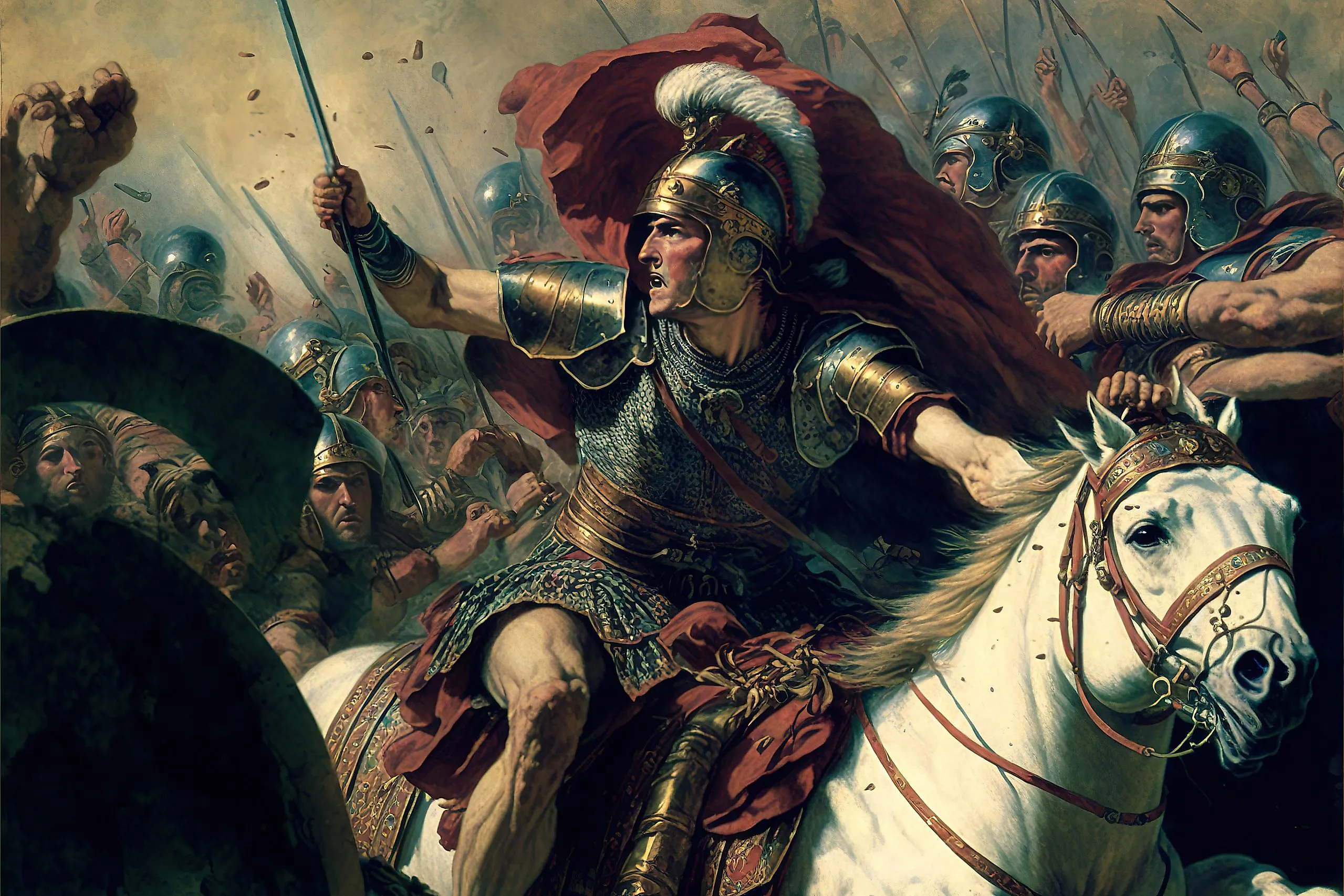
What Happened After Alexander The Great Died?
The death of Alexander the Great is one of the most contested and mysterious events in world history. It also caused seismic shifts in the ancient world, resulting in an immediate succession crisis. This then spiraled into wars between Alexander's generals, culminating in the breakup of his empire and the rise of the Hellenistic period. These major political and cultural implications make investigating what happened after Alexander the Great died in detail worthwhile.
Alexander's Death

In 324 BCE, after a decade of campaigning, Alexander returned to Persia, settling in Babylon in 323 BCE. The intention behind this return was to give his troops time to rest, consolidate control over his now-vast empire, and plan new campaigns in places like the Arabian Peninsula. This all changed when Alexander died on either June 10th or 11th, 323 BCE. The two main ancient accounts of this event, from historians Plutarch and Diodorus, differ on the timeline. Plutarch states that Alexander developed a fever 14 days before his death after a day of drinking with Macedonian generals, while Diodorus posits that Alexander became ill 11 days before his death after drinking a large bowl of unmixed wine to honor Heracles.

The cause of Alexander's death is also unknown. Some speculate that it was a natural illness like malaria or typhoid fever. However, due to the history of assassination amongst the Macedonian aristocracy, some accounts suggest he might have been poisoned. Others theorize that Alexander died due to complications from years of drinking and wounds he had suffered during his campaigns.
The Succession Crisis

Alexander's empire faced an immediate succession crisis. His half-brother, Philip III Arrhidaeus, was mentally impaired, and his child, Alexander IV, was yet to be born. This left a dangerous power vacuum and resulted in a contest between Alexander's generals with competing visions. Perdiccas wanted to keep the empire together and supported Alexander IV's claim to the throne, while Ptolemy I Soter did not trust centralized power and instead wanted to divide the empire among the generals.
To avoid conflict, the two sides reached a tense, fragile compromise. Philip III Arrhidaeus was made king, with the understanding that Alexander IV would co-rule alongside him once he was born. Perdiccas was also made regent. Finally, different regions of the empire were given to the major generals and officers in Alexander's army. Called the Partition of Babylon, this agreement was tenous from the start. The two official kings were weak figureheads and controlled by Perdiccas. Furthermore, the other generals, all with their own ambitions, began to expand their territory. Therefore, despite an agreement to avoid it, Alexander's empire still almost immediately descended into civil war.
Civil War And The Breakup Of Alexander's Empire

The first major conflict began when Ptolemy I Soter took Egypt. Then, in 321 BCE, he seized the funeral carriage that was bringing Alexander's body back to Macedonia and placed it in Alexandria. By doing so, Ptolemy portrayed himself as Alexander's true successor, rather than Perdiccas. In response, Perdiccas attempted to invade Egypt. However, this failed, and Perdiccas was assassinated by his own troops that same year.
Perdiccas' death was just the beginning. Despite the Partition of Triparadisus in 321 BCE, which acted as a modified version of the Partition of Babylon, more and more generals began to assert their power. This included Antigonus I Monophthalmus in Anatolia and Syria, Seleucus I Nicator in Babylon, and Cassander in Macedonia and Greece. A series of battles occurred from 320 BCE to 310 BCE, during which the generals claimed to be fighting in the name of Alexander's family. This changed around 310 BCE, when Cassander had both Alexander IV and his mother Roxanna executed. Since Phillip III had already been executed in 317 BCE on the orders of Alexander's mother, Olympias, the bloodline of the Macedonian royal family was effectively terminated.

With Alexander's family dead, the generals no longer feigned unity and promptly declared themselves kings of their respective regions. The final decisive battle then occurred in 301 BCE when Antigonus I attempted, in a last-ditch effort, to unite the empire under his rule. He failed and died in battle. Subsequently, Alexander's empire officially broke up, with three major successor states emerging: Egypt under the Ptolemaic dynasty, Persia and Central Asia under the Seleucid dynasty, and Greece and Macedonia under the Antigonid dynasty.
The Rise of the Hellenistic World
While Alexander's empire quickly fell apart after he died, his influence remained. Indeed, all the major successor states were Greek in nature. Egypt became the arguable cultural center of the Greek world, since it was the location of the cosmopolitan city of Alexandria and its famed library. Nonetheless, both Persia and Greece also maintained their Greek language, systems of governance, and cultural touchstones. This Greek identity across the Mediterranean and Middle East lasted for centuries, and is thus known as the Hellenistic period. Hence, the death of Alexander the Great and the subsequent breakup of his empire are important due to their role in fundamentally reshaping the political and cultural landscape of the ancient world.