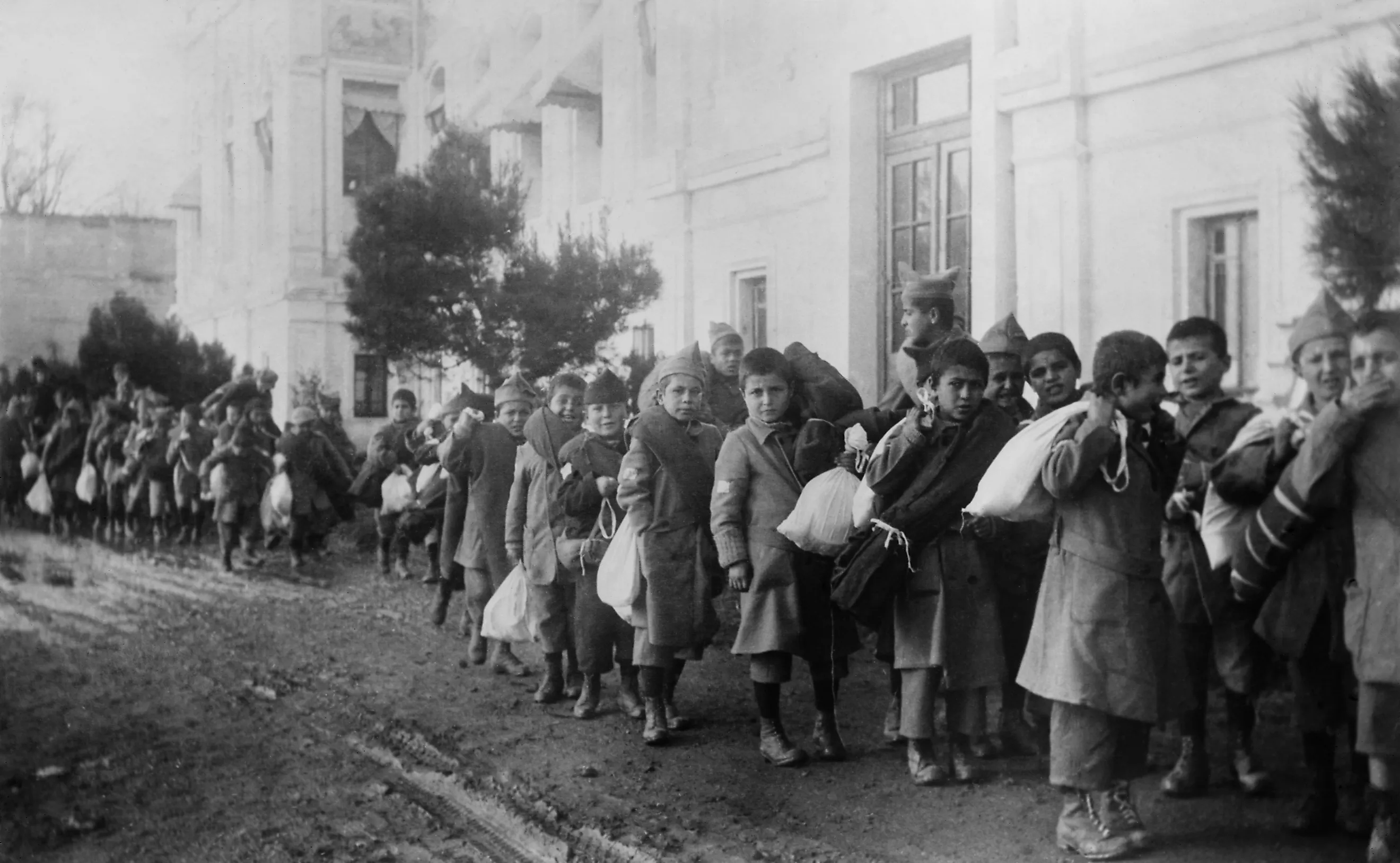
Armenian Genocide
The Armenian Genocide is one of the most important and contested events in world history. While the vast majority of historians consider it to have indeed been a genocide, Turkey continues to deny it, and only 34 countries formally acknowledge its existence. To understand how and why this event is so contested, we need to analyse its background and its aftermath. Doing so reveals the depth of anti-Armenian discrimination in the Ottoman Empire. It also demonstrates how acknowledging the existence of the genocide runs counter to nationalist narratives in Turkey.
Background

The Ottoman Empire was majority Muslim. Nonetheless, due to its sheer size, it contained millions of religious minorities. Rather than forcibly converting or expelling them, the Ottomans utilised the millet system to govern these minorities. This meant that they were allowed to practice their religion if they paid a tax called the Jizya. Armenians, the majority of whom were Christian, were thus included in this system.

Nevertheless, Armenians were still considered second-class citizens and had difficulty reaching the same political, economic, and social status as Muslims. Moreover, by the 1890s, a weakening Ottoman Empire and rising Turkish nationalism made it outright dangerous for Armenians. For instance, amidst (false) fears that Armenians were rebelling en masse, locals began massacring Armenians in the Sasun region in 1894. These killings soon spread across the empire. In total, around 80,000 to 300,000 Armenians were killed. Named the "Hamidian Massacres" after the Sultan Abdulhamid II and his attempts to assert pan-Islamism as the empire's dominant ideology, they were a precursor to larger-scale atrocities in the coming decades.
The Outbreak Of World War I

On June 28, 1914, Serbian nationalist Gavrilo Princip assassinated Archduke Franz Ferdinand of Austria-Hungary. This set off a chain reaction that led to the outbreak of World War I. Austria-Hungary declared war on Serbia. Russia, which was allied with Serbia, then declared war on Austria-Hungary. Germany, which was allied with Austria-Hungary, subsequently declared war on Russia. Finally, Britain and France were allied with Russia, and thus declared war on Germany. As for the Ottomans, while they did not immediately enter the war, they signed a secret treaty with Germany in August 1914. The empire then formally entered the conflict when Ottoman troops fired on Russian ports in October 1914, thereby bringing them into an alliance with the Central Powers of Germany and Austria-Hungary.
The Armenian Genocide

As World War I progressed, tensions regarding the Armenian community that had been bubbling for decades came to a boil. Since Armenians were mostly Christian, many in the Ottoman government falsely believed that they were collaborating with their Christian counterparts in Russia. Furthermore, the year before the war began, a coup brought three Turkish nationalists, Talaat Pasha, Enver Pasha, and Djemal Pasha, to power. They encouraged a hardline approach to Turkish nationalism, one that had little tolerance for ethnic minorities.

All this culminated on April 24, 1915, when hundreds of Armenian intellectuals were arrested in Istanbul. Most were then executed. Then, at the order of Talaat Pasha, millions of Armenians were deported and sent on death marches across the Syrian desert throughout 1915 and 1916. The major sources of death included starvation, dehydration, disease, and massacres by Ottoman troops. Rape, sexual abuse, and forcible conversions to Islam were also common. Afterward, Armenian property was confiscated. All this meant that by 1915, Armenian civilisation had essentially been extinguished from Anatolia. Massacres, deportations, and other forms of violence occurred against Armenians throughout the rest of the war and during the Turkish War for Independence in the early 1920s. In total, between 640,000 to 1.2 million Armenians were killed.
Legacy And Importance

Historical memory of the Armenian genocide is complex. On the one hand, it remains one of the most impactful events in modern history. In 1944, Polish Jewish lawyer Raphael Lemkin coined the term "genocide" and cited the Armenian case as a key example. The Armenian Genocide is also formally recognised by countries like Canada, the United States, and France. Finally, the genocide is core to national identity in Armenia, with it being a key motivating factor behind foreign policy and security measures.

On the other hand, Armenian genocide denial is still relatively widespread, particularly in Turkey. This is the case for several reasons. First, acknowledgment of the genocide brings into question the founding myth of the Turkish state, that being that Turkey was a unified and heroic nation that fought for independence against invading foreign threats. The notion that Turkish nationalists themselves were the aggressors runs counter to this claim. Second, many officials in Turkey fear that acknowledgment of the genocide could lead to reparations claims in the form of financial payments and territorial aspirations by Armenians in Eastern Anatolia. Finally, acknowledgment of the genocide in Turkey can have risky legal and safety implications. For instance, Turkish-Armenian intellectual Hrant Dink faced legal prosecution for his criticism of Armenian genocide denial. He was then assassinated by a Turkish nationalist in 2007.
In short, even over a century later, the legacy of the Armenian Genocide can still be felt. It was instrumental in the coinage of the term "genocide", and it continues to shape politics in Armenia. At the same time, many continue to deny that it occurred, whether that be due to nationalist pride, fear of reparations, or fear for their own safety.