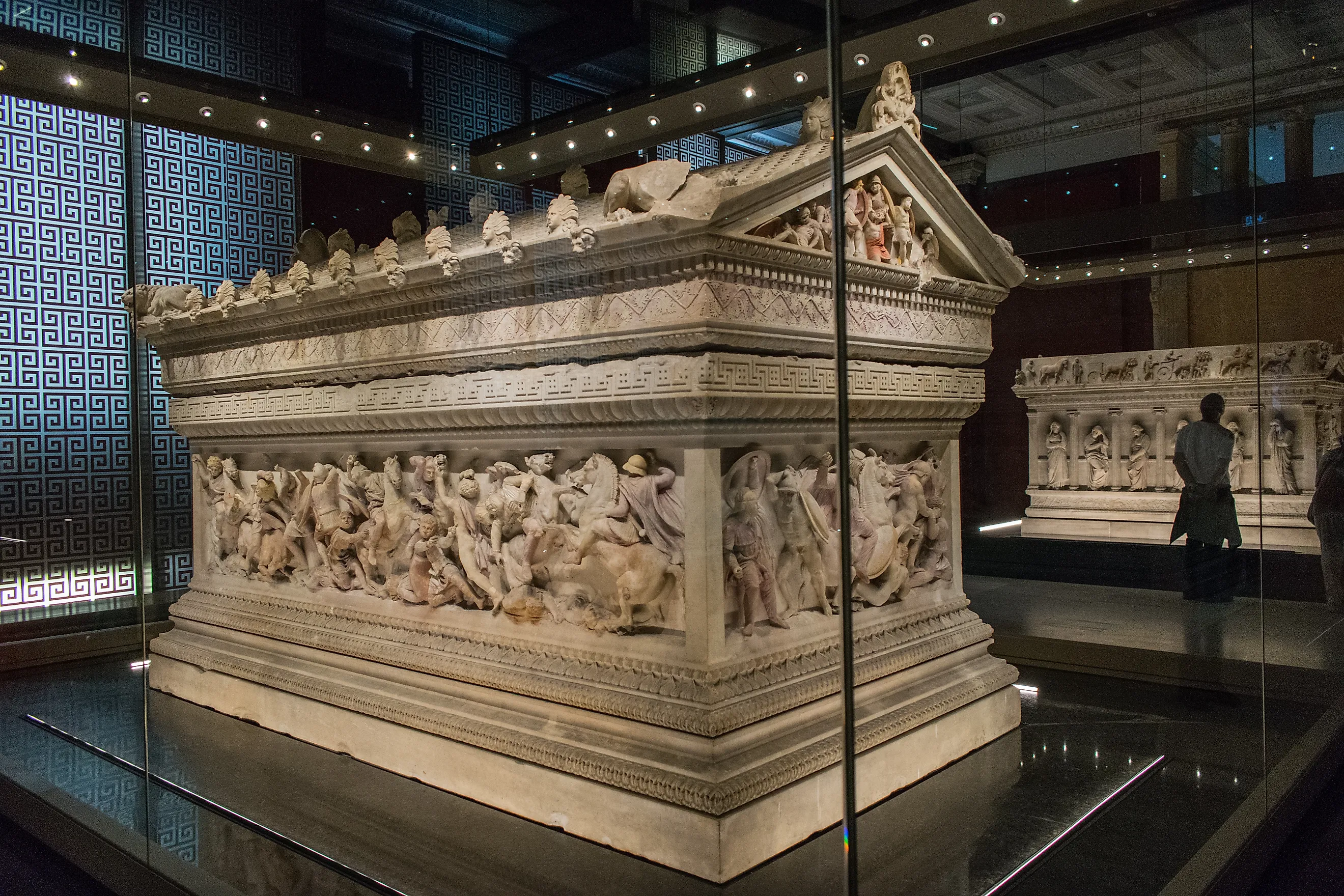
The Disappearance of Alexander the Great's Body
Few rulers have shaped the ancient world as decisively as Alexander the Great. By the time of his death in Babylon in 323 BCE, he had built an empire stretching from Greece to the Indus Valley. What followed was not only a struggle for territory, but for his body.
After Alexander died, his remains were embalmed and prepared for transport to Macedon, where the Argead kings were traditionally buried. The funeral carriage, described in detail by Diodorus Siculus, was designed to project imperial grandeur. Before it reached its intended destination, however, it was intercepted by Ptolemy I Soter, one of Alexander’s former commanders.
Ptolemy diverted the body to Egypt, first burying it at Memphis and later transferring it to Alexandria. The move was political. In the fractured years after Alexander’s death, possession of his remains conferred symbolic authority. By anchoring himself to the memory of the conqueror, Ptolemy strengthened his claim to rule Egypt.
For centuries, Alexander’s tomb in Alexandria became a site of pilgrimage for powerful visitors, including Roman leaders such as Julius Caesar and Augustus. Sometime in Late Antiquity, the tomb vanished from the historical record. Its precise location remains unknown.
The seizure of Alexander’s body was not an act of theft in the modern sense. It was a calculated assertion of legitimacy in a collapsing empire. The mystery today lies not in who took him, but in where he ultimately rests.
Alexander's Sudden End

From 356 BC to 323 BC, Alexander the Great embarked on a seemingly endless stream of military campaigns and conquests, in the process carving out one of the ancient world’s largest empires stretching all the way from Greece to northwestern India. This ambitious journey, however, ended abruptly in Babylon in 323 BC when he fell ill and died unexpectedly. His age? Just 32.
While the exact cause of his death is a matter of debate - theories range from fever to poisoning - the impact of his passing was immediate and profound. With no heir or succession plan in place, Alexander's death triggered a power struggle among his generals, setting off a series of events that would shape the course of history.
The Quest for Immortality

The preservation of Alexander the Great’s body reflected a convergence of Macedonian royal custom and Egyptian funerary practice. Ancient sources report that his remains were embalmed in the Egyptian manner in Babylon, a process that delayed burial for months and underscored his imperial stature.
The elaborate funeral carriage constructed under the regency of Perdiccas was intended to transport the body to Macedon. Before it arrived, however, Ptolemy I Soter intercepted the procession and redirected it to Egypt. The body was first placed in Memphis and later transferred to Alexandria.
Accounts describe Alexander’s remains being housed in a gold anthropoid coffin. Centuries later, writers note that the gold was removed and replaced with a more transparent sarcophagus, possibly glass or alabaster. These changes reflect evolving dynastic politics rather than a single funerary design.
Ptolemy’s actions were strategic. He did not claim the entire empire, but securing Alexander’s body strengthened his authority in Egypt during the wars among the Diadochi. In a fractured political landscape, proximity to the conqueror’s remains became a form of legitimacy.
A Tomb Fit for a King

After intercepting the funeral procession, Ptolemy I Soter brought Alexander the Great’s body to Memphis, then a major political and religious center in Egypt. There it remained for a period before being transferred to Alexandria, the city Alexander had founded on the Mediterranean coast.
By the early third century BCE, the body was housed in a royal mausoleum in Alexandria known as the Soma, a name derived from the Greek word for “body.” The structure became closely associated with the legitimacy of the Ptolemaic dynasty. Later rulers, including Julius Caesar and Augustus, are recorded as having visited the tomb.
Ancient descriptions indicate that the body was displayed within an elaborate sarcophagus and remained visible for generations. Precise architectural details of the mausoleum are uncertain, but its political role is clear. In Alexandria, Alexander’s remains were not only preserved. They were positioned at the symbolic center of a new Hellenistic kingdom.
A Legacy in Jeopardy

Alexander's body lay in state for centuries, with Soma becoming a symbol of Alexandria's grandeur and the enduring legacy of the city’s namesake. But as time passed, political unrest and shifting religious tides would threaten the tranquility of Alexander's eternal rest.
At around the time that the Roman Empire was at its peak, a series of events unfolded that would forever cloud the whereabouts of Alexander's remains. While the precise details are shrouded in mystery, legends, and historical accounts do offer us tantalizing clues about what may have transpired to lead to the mystery we’re faced with today: what, exactly, happened to Alexander the Great’s remains?
The Theories

One centers on Caligula, who ruled from 37 to 41 CE. Ancient sources describe his admiration for Alexander and claim that he removed the conqueror’s breastplate from the tomb in Alexandria. There is, however, no credible evidence that Caligula took the body itself. The story of a full imperial theft appears to be a later embellishment.
Another possibility lies in the turbulence of Alexandria’s later history. The city endured dynastic conflict, Roman intervention, and economic strain. Some scholars speculate that officials may have moved or concealed the body during periods of unrest. Yet no surviving ancient account confirms a secret relocation.
A third explanation considers the transformation of Alexandria in Late Antiquity. As Christianity became dominant in the Roman Empire, pagan monuments lost official protection. Under emperors such as Theodosius I, temples were closed and, in some cases, destroyed. While there is no direct record of Alexander’s tomb being dismantled, the religious and urban reshaping of the city may have contributed to its disappearance.
Enduring Legends and Intrigue

Over time, the disappearance of Alexander the Great’s tomb has generated layers of speculation. With no confirmed archaeological site and no clear record of its destruction, historians are left with fragments rather than conclusions.
One recurring idea is that the body may have been relocated within Alexandria during periods of unrest. The city endured earthquakes, invasions, civil conflict, and major urban rebuilding across Late Antiquity. In such conditions, relocation or concealment is conceivable. However, no ancient source describes a hidden chamber or secret transfer, and no archaeological evidence has confirmed such a scenario.
Other stories drift further from the historical record. Later traditions attributed unusual events and supernatural associations to the site, reinforcing its mystique. These accounts reflect the enduring symbolic weight of Alexander’s memory more than verifiable events.
What is certain is this: a tomb once visited by Roman emperors and positioned at the center of Alexandria disappeared gradually from the written record. The mystery persists not because of dramatic theft or legend, but because one of antiquity’s most visible monuments was absorbed by centuries of change.
The Final Word? Possibly not!
Despite the disappearance of his physical remains, Alexander the Great's legacy continues to resonate. His influence can be seen in the spread of Hellenistic culture, the founding of iconic cities, and the enduring tales of his military campaigns. His conquests not only reshaped the political landscape but also facilitated cultural exchange and the dissemination of knowledge, with the period that followed seeing a flourishing of philosophy, science, and the arts.
The quest to locate Alexander the Great's remains continues to fascinate historians, archaeologists, and, of course, the general public (that’s us!), with expeditions and investigations still being mounted from time to time to unravel the truth.
Whatever the facts - whether this greatest heist in history was conducted by Caligula, the Ptolemies, or some other unknown force - there’s no doubt this tale has secured a place as one of the most daring acts of relic theft in history.