The Foggiest Cities In The US
Fog is a weather condition that's familiar to most of us. But what is it, exactly? How does it form, and where, and why? Fog happens when warm, moist air cools and condenses. Once that occurs, tiny water droplets become suspended in the air. This phenomenon is normally seen at ground level, and it typically occurs when the air is cool and close to its dew point. This can be caused by the ground cooling at night, or if moist air moves over a cold surface, or even by the addition of moisture through evaporation.
That's all well and good, but where does this phenomenon occur and why should you care? If you're someone who stresses over long-distance driving under the best of conditions, you'll probably appreciate the heads-up if some of these upcoming locations are along your route. It can also impact things like sightseeing tours, photo shoots, and even flights. If visibility is greater than a kilometer (0.6 miles), it's considered mist, but if it's less than that, your experience can be greatly affected. Below is a list of 6 large cities across the US that experience more than their share of fog, plus one honorable mention, as it holds its own particular interest.
New Orleans, Louisiana

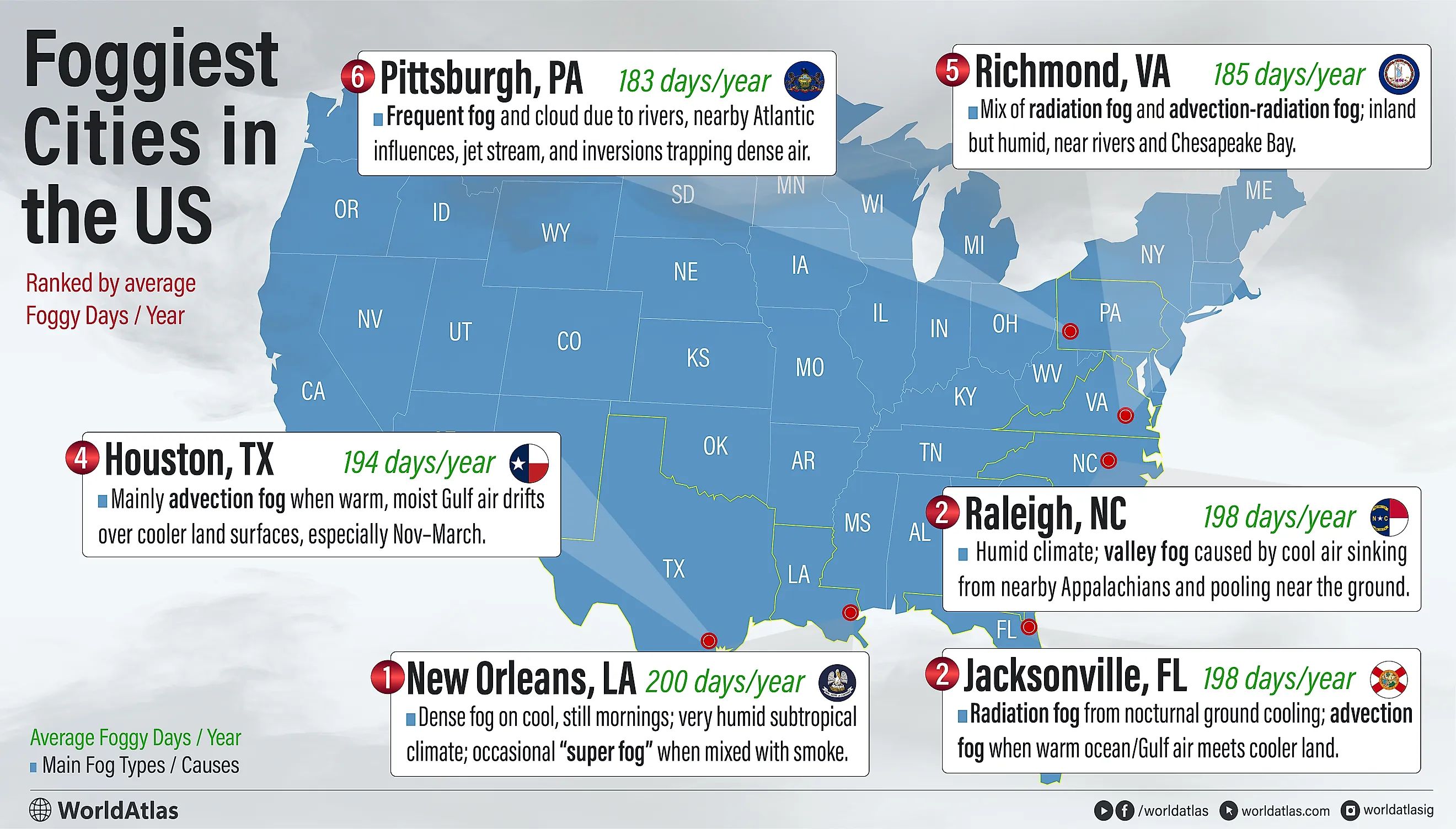
New Orleans experiences an annual average of 200 days of fog, making it the foggiest city in the United States, and there are another 118 days per year when the sky is cloudier than normal. New Orleans has a subtropical climate and is known for its high humidity. When the dense fog on most cool, still mornings mixes with an external occurrence, such as smoke from marsh or brush fires, a "super fog" is categorized and can wreak havoc on the freeways in and around southern Louisiana by reducing visibility to the point of creating dangerous driving conditions.
Raleigh, North Carolina

Raleigh, which receives 198 days of fog on average, also has a very humid climate, though the fog generated along this coastal city is far different from that in New Orleans. The city's proximity to the Appalachian Mountains influences the weather in this particular region, creating conditions known as "valley fog." The cooler air in the higher elevations sinks into the valley, creating a stable air mass situated near ground level. This phenomenon is particularly common at night as the ground cools and air temperatures drop. When all the moisture trapped in the air meets the cooling ground, water vapor condenses into tiny water droplets, forming a thick, dense fog.
Jacksonville, Florida

If you find yourself driving south into Florida during the colder months, you'll more than likely encounter a bank of fog once you hit Jacksonville, a city that also sees an average of 198 days of fog per year. Here, fog depends on the right atmospheric conditions of moisture and cooling temperatures, mainly during the cooler months from late fall into early spring. There are two types of fog that affect Floridians, namely radiation fog, which occurs when the ground cools and brings the air to a temperature near its dew point, and advection fog, which happens when warm water off a large body of water, such as the Gulf of Mexico or Atlantic Ocean, meets cooler air over land. The former is more typical, while the latter tends to occur mostly in the spring. Sometimes, however, the two types of fog converge, creating a heavy mix that can stick around for hours, if not days.
Houston, Texas

The Southeast region of Texas is often the recipient of the aforementioned advection fog when warm, moist air from the Gulf of Mexico drifts across cooler surfaces on land. The combination of long, cool desert nights and this persistent Gulf moisture can create the ideal conditions for low-lying condensation to form, which is essentially a cloud sitting on or near the ground, which can make for low-visibility driving conditions. Houston suffers such a fate roughly 194 days out of every year. The most active period for dense fog, as you might guess, is during the cooler months, typically from November into late March, as it is during this stretch that the temperature difference between the warm Gulf air and the cooler land surface is the most pronounced.
Richmond, Virginia

In the city of Richmond, Virginia, the fog that permeates the area roughly 185 days per year is primarily a mix of radiation fog and advection-radiation fog. This combination is a result of the area's inland location, characterized by a humid mid-Atlantic climate, and its proximity to several rivers and the nearby Chesapeake Bay. Radiation fog is most common, forming overnight as the ground cools under clear skies, with light winds moving over the ground's surface and causing the low air near the surface to reach its moisture saturation point.
Pittsburgh, Pennsylvania

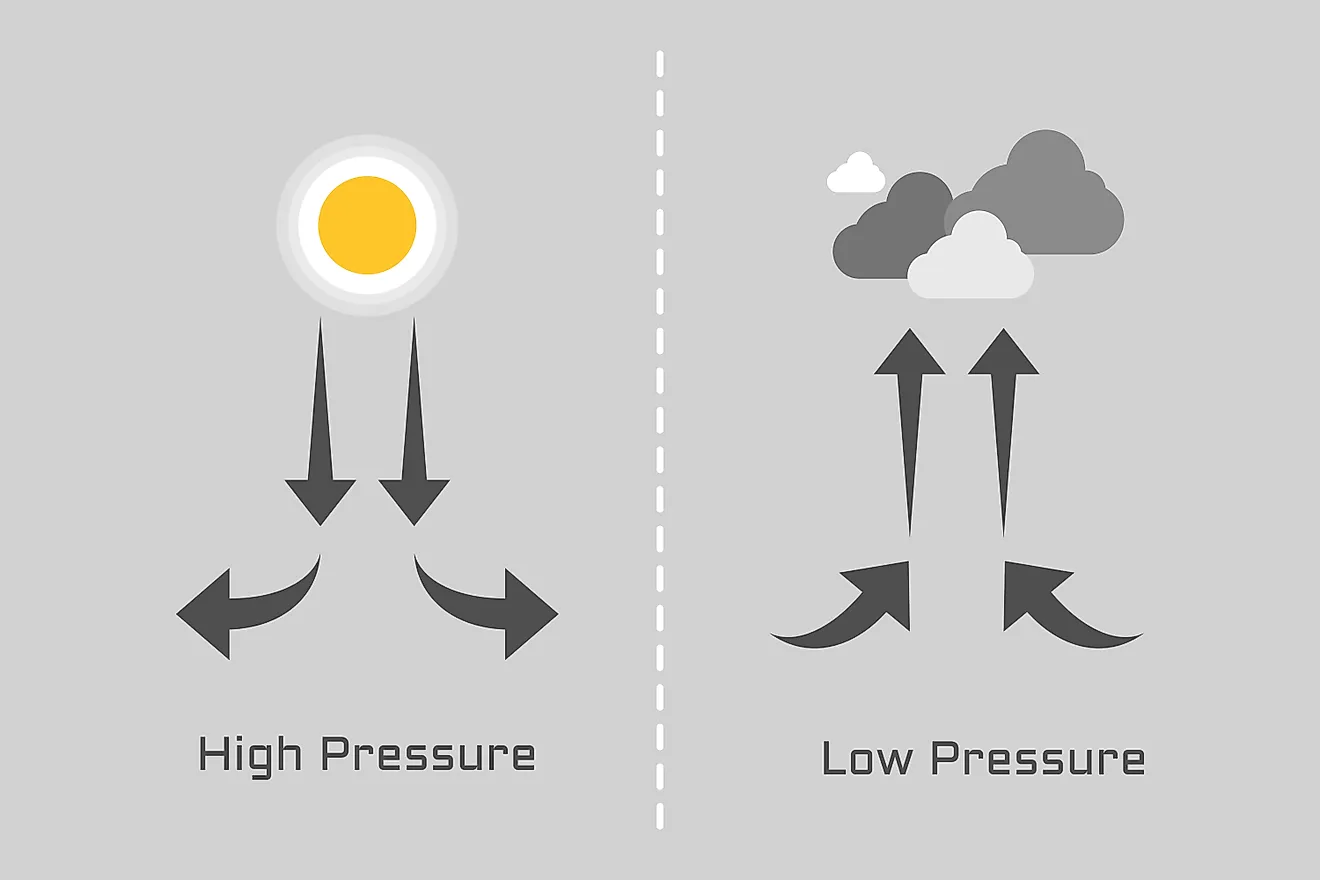
This Pennsylvanian metropolis also experiences its share of cloud cover and fog. With an average of 183 foggy days recorded each year and an additional 20 days of general cloudiness on top of that, the air in Pittsburgh is among the densest of any major US city. Unsurprisingly, part of the reason for this is the city's geographic location at the confluence of three rivers and pinched between the Great Lakes and the Atlantic Ocean. Pittsburgh also sits along the edge of the jet stream, which brings cool air from the north. These features, in combination with the city's hilly terrain, often result in a phenomenon called an inversion, which traps warm air and high-pressure systems above a dense layer of cloud, fog, and generally cold air closer to the surface.
Point Reyes, California

Though not considered a large city, Point Reyes begs to be included on this list with an honorable mention. This remote stretch of California coastline owes its notoriety to several factors. Not only is it one of the windiest places on the Pacific Coast, where hurricane-force winds have been regularly recorded, but it’s also known as one of the foggiest places in North America, let alone the US. Thanks to the Pacific Ocean, which provides the moisture, and to its generally cool temperature, this area regularly gets more than 200 foggy days per year. Most years, those days seem to be consecutive and can linger for weeks at a time, especially during the spring to summer months. Visibility reduced to mere feet is not uncommon here.
These are just a few examples of places across the US where fog and condensation in the air can wreak havoc on the region's overall climate profile. As demonstrated, most of these areas are located along coastal regions or near large bodies of water. As beautiful as it appears, as it envelopes a bridge or a coastal mountain range, it does offer a bit of danger, or at least deserves consideration, when deciding on the time of year you plan to visit these interesting locations. However, if a moody aesthetic calls to you and entices you to explore further, these fantastic locations should do more than satisfy your curiosity.