9 Iconic Animals That Live Only In Colombia
Colombia covers an area that is known as a biodiversity hotspot, a region that has high levels of endemic species, but is facing severe habitat loss. The ecosystems of Colombia are diverse, from the Andes to the Amazon rainforests and the Sierra Nevada de Santa Marta coastal mountain range, and its varied geography and climates create isolated habitats that allow distinct flora and fauna to evolve only there.
In Colombia’s Chocó-Darien forests, the species are diverse and isolated, with approximately 20% of the region's vascular plant species found nowhere else on Earth. Climate conditions, such as high humidity and elevated temperatures, create niches for species to evolve. In the entire country, 14% of its wildlife is endemic to Colombia.
Colombian Woolly Monkey

The Colombian woolly monkey (Lagothrix lagothricha lugens) is a large primate native to Colombia's cloud forests. It is sometimes mistaken for a common woolly monkey, who have a wider range, but the Colombian woolly monkey is only found in Colombia. Its fur is wool-like, thick, and varies in color from silver-grey to black. They possess a strong prehensile tail that acts as a fifth limb when climbing.
The Colombian woolly monkey is among the largest New World monkeys and displays a high sexual dimorphism, with males being significantly larger than females. Their diet is primarily fruit (frugivorous), and they play a crucial role in their ecosystem as seed dispersers. When fruit is scarce, they will eat leaves, flowers, insects, and other arthropods. The Colombian woolly monkey lives in large groups, from 20 to 70. Their social life is described as a fission-fusion dynamic: they split into small groups for foraging, and then reunite as a larger group for sleep.
Blue Anole Lizard

Although the term blue anole is often used to describe other lizards with some blue coloration, it most commonly refers to Anolis gorgonae, a lizard endemic to Gorgona Island in the Pacific. The true blue anole lizard is remarkable for being the world’s only pure blue reptile. Gorgona Island is a small volcanic island off the Pacific coast of Colombia, and is the only place you will find the blue anole. Because of its extremely limited range, like most species endemic to a single island, the blue anole is threatened by invasive predators such as rats, cats, capuchin monkeys, and the western basilisk, a much larger mainland lizard.
Both males and females are a solid sky blue, with males featuring a pure white dewlap (throat fan). Other lizards that are sometimes called blue anole include blue beauty anole (Anolis equestris potior), which comes in a range of blues and yellows, and is native to Cuba. Likewise, Allison's anole (Anolis allisoni) is sometimes referred to as the Cuban blue anole. The males usually have a blue head and forebody, with the rest of the body being green. The blue beauty anole is regularly found in the pet trade, while the threatened blue anole is not found in legal pet markets.
Blue-billed Curassow

This large bird is found only in the Magdalena Valley region along the Magdalena River in Colombia. The blue-billed curassow (Crax alberti) is a ground-dwelling bird, and although capable of flight, it is mainly a terrestrial bird that will fly to escape predators or to reach high tree branches to roost. It is primarily a forager, eating fruit, worms, and insects from the ground, plus small stones to aid digestion. Males stand 32 to 36 inches tall, while females are slightly smaller. Both are mostly black, but males have a white vent and a white tip on the tail, with bright blue wattles at the base of the bill. Females have some white on their wings and tails, and a reddish-brown bell and vent. Chicks are born fully feathered and able to fly.
It is classified as critically endangered due to habitat loss and hunting. It is estimated that no more than 1,500 to 5,500 mature individuals remain in the wild. They are included in the Association of Zoos and Aquariums’ Species Survival Plan, which aims to prevent extinction through captive breeding and reintroduction.
Santa Marta Parakeet

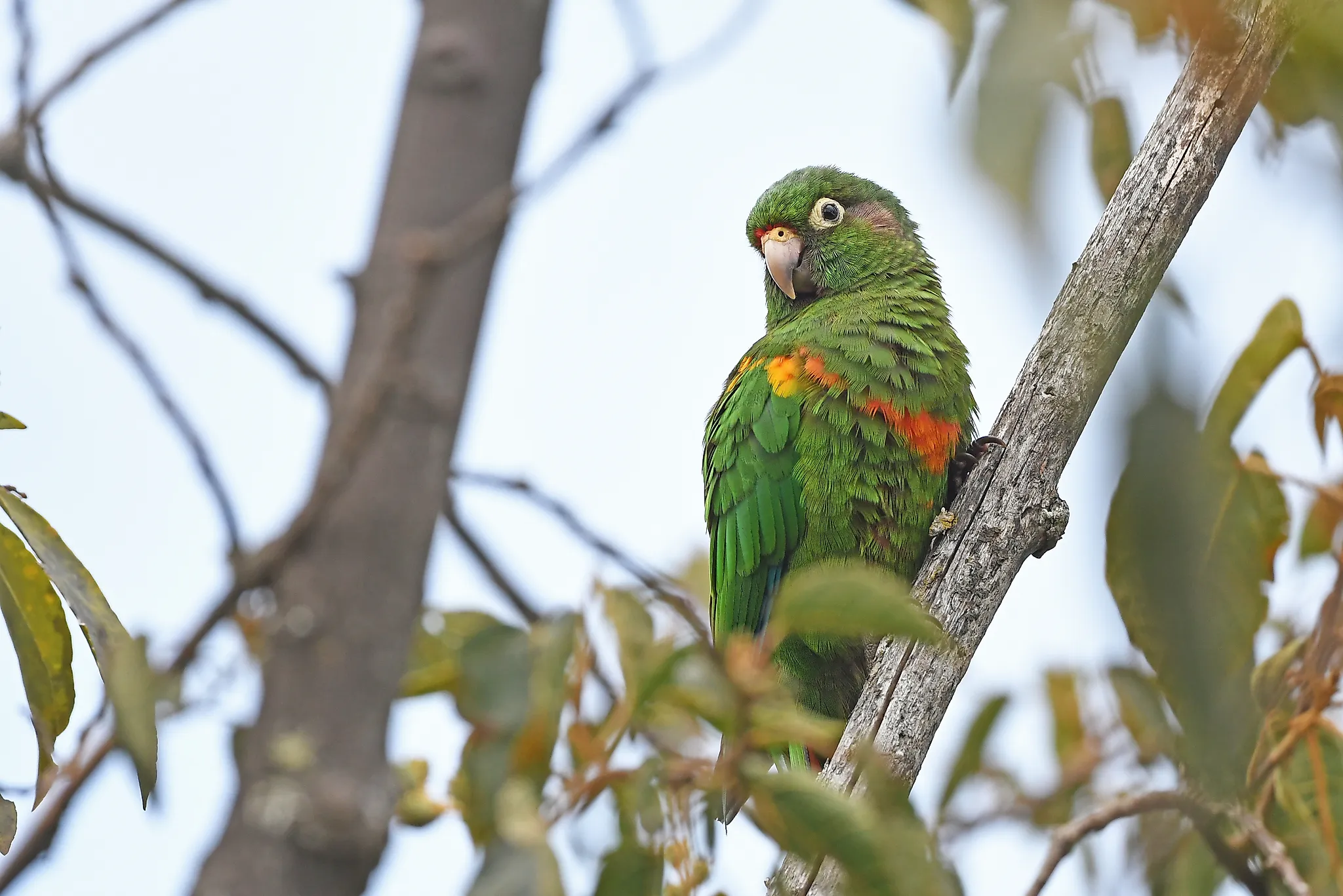
The Santa Marta Parakeet (Pyrrhura viridicata) is endemic to the Sierra Nevada de Santa Marta mountain range of Colombia. Its habitat is isolated in the mountains with only about 1,800 to 3,200 mature individuals in the wild. Major habitat loss is caused by agricultural expansion, which eliminates native trees in favor of pastures and the planting of non-native pine and eucalyptus. Found in the humid cloud forests at 6,000 and 9,800 feet, they eat fruit, seeds, flowers, and lichen.
The Santa Marta parakeets live in small flocks of between 3 and 20. Their plumage is green, with a scarlet band across the lower breast. When in flight, they display blue with yellow-to-orange underwing coverts. They nest almost exclusively on dead wax palms, though they have adapted to artificial nest boxes set up by conservationists. Given their isolation and fragile conservation status, the best place to see the Santa Marta parakeet is at the El Dorado Nature Reserve in Colombia.
Gold-ringed Tanager

This brightly colored bird is found only in the forests of Colombia's Chocó region. The gold-ringed tanager (Bangsia aureocincta) is a highly sought-after bird for birdwatchers due to its unique, vibrant plumage and its difficulty to spot. These animals are round, short-tailed birds that measure about 6 inches, with a black head and throat, green underparts, and a golden-yellow breast patch. It is most renowned for a distinctive feature, a bright yellow ring above the eye that circles the ear coverts (openings), and joins into a yellow stripe at the beak. The females are similar in color to the males, albeit less vibrant.
The gold-ringed tanager is primarily frugivorous but also consumes insects. They primarily stay in pairs but will also join mixed-species flocks for foraging. With its extremely limited range, these animals are currently listed as vulnerable to endangered. Threats to their habitat include deforestation, mining, and road construction. The best places to see a gold-ringed tanager are at the Tatamá National Natural Park and the Las Tángaras Nature Reserve, both in Colombia.
Caquetá Titi Monkey

The Caquetá titi monkey (Plecturocebus caquetensis) is a small primate found only in the Caquetá department of Colombia. Its tiny and fragmented habitat and range, and the stresses from human encroachment, make it one of the most threatened primates. Roughly the size of a house cat, they have grey-brown fur and a distinctive red beard. Other closely-related species have a white bar on the forehead, something the Caquetá titi lacks. For humans who have had a chance to interact with them, a particularly endearing quality they possess is that they purr like cats when they are content.
Caquetá titi monkeys are monogamous and mate for life. They usually live in small family groups, and an endearing bonding trait is their intertwining of tails when sitting or sleeping together. An interesting variation on other primate behavior, the father Caquetá titi is the primary caregiver, carrying the infants and passing them off to the mother for nursing. In the Department of Caquetá, the Caquetá titi monkey is found only in the fragmented forests between the Orteguaza and Caquetá rivers. It is estimated that only 250 adults remain in the wild. Major threats to their population and habitat include deforestation for cattle ranching and the historical use of herbicides in anti-narcotic actions, destroying their food sources.
Bogota Rail

The Bogota rail (Rallus semiplumbeus) is a bird that lives exclusively in the high-altitude wetlands of the Bogota savanna, the flat grasslands in the Eastern Ranges of the Colombian Andes. It tends to be an elusive bird that the locals call Tingua Bogotana. About 12 inches long, the Bogota rail has a dark grey face and underparts, with olive-brown upperparts marked with black streaks. Its most striking physical characteristic is a bright red bill and coral-red legs.
They tend to prefer emperate marshes and savanna lakes and live at altitudes of up to 13,000 feet. Their diet consists of aquatic invertebrates and mollusks, insect larvae, and sometimes small fish and plants. The Bogota rail is classified as vulnerable. There are serious threats to its habitat due to wetland drainage, pollution, and invasive predator species such as feral dogs. There are roughly 3,700 mature individuals left in the wild, and numbers are decreasing.
Dusky Starfrontlet

This rarely-seen, critically endangered hummingbird is found in the western Andes. The dusky starfrontlet (Coeligena orina), also known as the glittering starfrontlet, is very colorful and lives in the high-altitude forests of the Andes. At 5.5 inches, this hummingbird has glistening dark green plumage. The males have a glittering green forehead and a sapphire-blue throat patch, while females have a blue patch, a bright buff-colored throat, and a scaly-looking green crown.
Their diet is mostly nectar from flowering plants, but they also eat small invertebrates. They prefer living in humid forests at an altitude of 7,000 feet, but sometimes much higher. Due to their small and fragmented range, they are classified as endangered. The Colibrí del Sol Nature Reserve was established to protect the remaining habitat of the dusky starfrontlet.
Magdalena Giant Glass Frog

A frog living in the Colombian cloud forests, the Magdalena giant glass frog (Ikakogi tayrona), is actually only about 1.2 inches long. What makes it a “giant” is in comparison to other glass frogs that are even tinier. The key characteristic of the Magdalena giant glass frog, like other glass frogs in the Centrolenidae family, is its translucent skin on its belly. This reveals the internal organs, including the heart and liver, through the see-through skin. Its skin is pale green with a granular, or bumpy, back.
Another unique feature of the Magdalena giant glass frog is that it is the only grass frog species, and one of the few frog species overall, where the mother takes care of her young. In other glass frogs, the father often takes over, or, as in the case of most other frogs, there is no care. In total, only about 10% of frog species rear their young in some fashion, rather than abandoning the eggs. The male Magdalena giant glass frog has humeral spines, sharp bones in their upper arms, used to fight other males over territory. The Magdalena giant glass frog is endemic to the Sierra Nevada de Santa Marta coastal mountains, living in and around streams at high altitudes, around 7,800 feet. They are listed as vulnerable due to habitat loss and water pollution.
An Uncertain Future For Colombia’s Wildlife
With its biodiversity and high number of endemic species, Colombia faces critical threats to its wildlife and habitat. With agricultural expansion, particularly for coca production in the Amazon and Pacific coast regions, deforestation and habitat loss are the primary threats to the nation’s biodiversity. Wildlife trafficking, pollution, mining, and invasive species all pose significant threats. This includes a peculiar and unique situation where escaped hippos from drug lord Pablo Escobar’s former estate have created threats to wildlife in the Magdalena River basin. These problems remain an ongoing concern for Colombia’s unique wildlife.