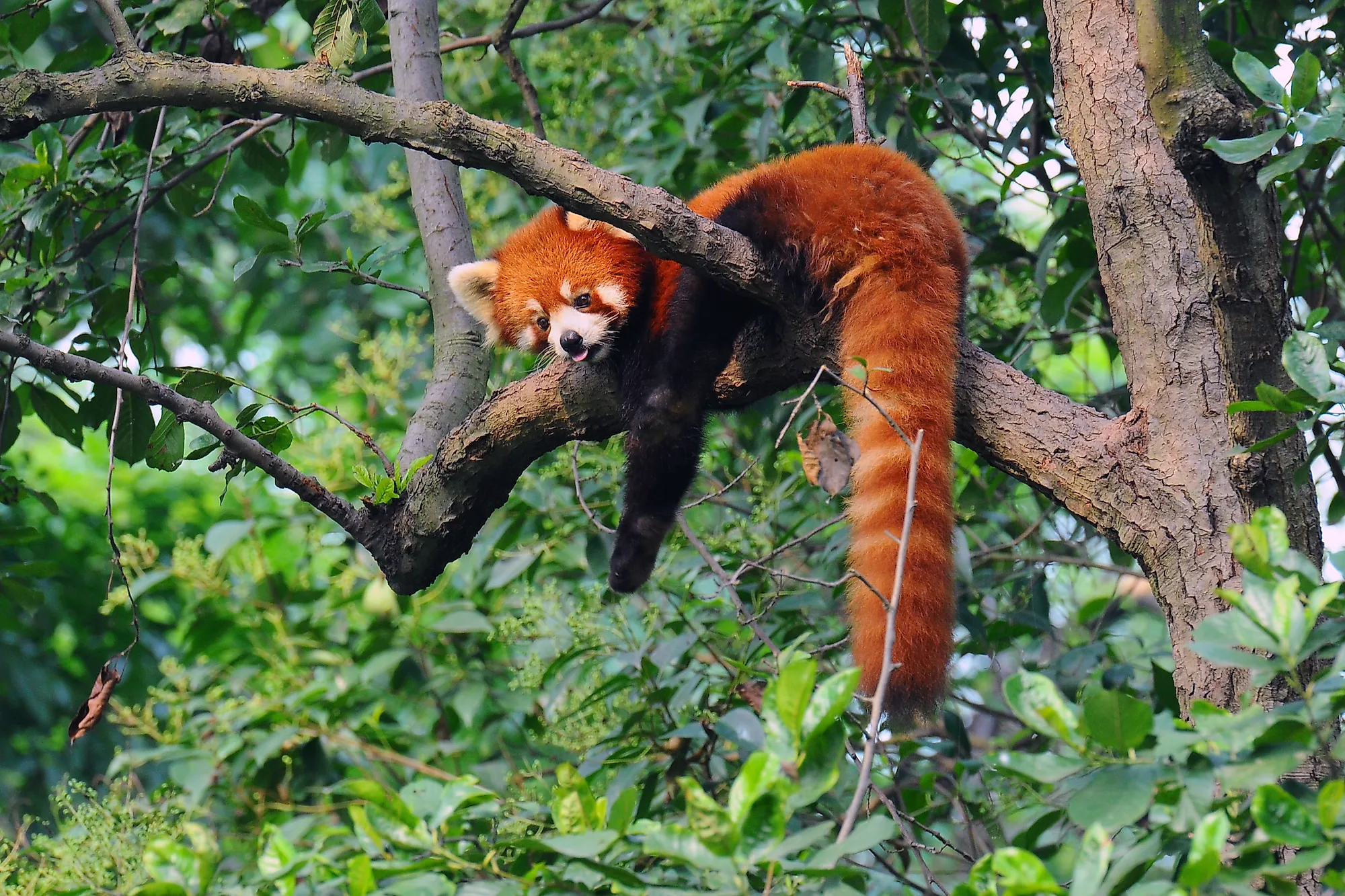
Red Panda
Seemingly part fox, part raccoon, yet entirely its own, the red panda lives in the high-altitude bamboo forests of the Himalayas and nearby ranges. The name is misleading; red pandas share no close family tie with giant pandas. Western researchers wrote about their existence decades before the giant panda entered Western science. With their red coats and chunky, banded tails, they have a look that stands out. They still have sharp canines, but spend their days way up in the Himalayan treetops searching for bamboo. They’re shy, generally quiet loners, so most people never see one in the wild.
Taxonomic Classification

When it comes to classification, the red panda is an unusual case. Even though it technically belongs to Carnivora, it eats mostly plants. Under its scientific name, Ailurus fulgens, the animal is the sole surviving member of the Ailuridae family. For years, scientists thought they could classify the red panda as either a bear or a raccoon based on its appearance.
DNA tests, though, ended up proving something different: the red panda doesn’t belong in either group. Instead, researchers suggest two distinct species: the Himalayan red panda (Ailurus fulgens) and the Chinese red panda (Ailurus styani), each occupying its own isolated evolutionary branch on opposite sides of the mountains.
Physical Description

A red panda is around the size of a large house cat, and normally comes in at around 22 to 24.6 inches from nose to tail base. They look bigger than they are, thanks to their thick fur. That thick, double-layered fur is a built-in shield against the chilly mountain temperatures. Add to that length the tail, which adds another 12 to 20 inches from tip to tip. The tail is bushy and marked with pale and reddish rings. They use it like a balancing pole when they are navigating high branches, then wrap it around themselves like a built-in sleeping bag at night.
Their faces have white tear streaks that, it is theorised, could have evolved to help keep the sun out of their eyes. But their real secret weapon is their pseudo thumb. It is actually a modified wrist bone that helps them grab bamboo stalks. On top of that, they have ankles that swivel up to 180 degrees, making them one of the rare creatures that can scoot down a tree headfirst without falling. Most times, they tip the scales between 8 and 17 pounds, which is about right for dodging around the treetops with ease.
Where They Live

Wildlife researchers estimate fewer than 10,000 mature red pandas remain in the wild. These numbers are drawn from studies and mapping efforts by groups such as the International Union for Conservation of Nature, which lists red pandas as Endangered. Habitat loss and fragmentation from logging, agriculture, and infrastructure can divide what was once a continuous forest into separate patches of habitat.
Red pandas have long inhabited the cold mountain forests of the eastern Himalayas, the southwestern part of China, and Myanmar. As human settlements expand, forests begin to disappear, fragmenting the red panda's habitat. These days, red pandas can be found living in separate sections of forest at high elevations. The climate is cold and moist there, which allows bamboo plants to flourish and nourish these animals. They spend nearly all their hours tucked away among the branches, most active at dawn and dusk. Whether these mountain forests remain in good condition and remain connected will help determine whether the red panda can survive in the long term.
Diet and Food

If there is one thing they have in common with giant pandas, it is their love of bamboo. Red pandas are technically listed in the Carnivora order, but their diet is basically vegetarian. Bamboo makes up close to 95 percent of their diet, specifically the young leaves and tender shoots. Because bamboo is so incredibly low in calories, these animals have to spend up to thirteen hours every single day chewing and eating.
It is a constant effort to get enough energy to sustain them day to day. They use that specialized wrist bone to pull stalks toward their mouths. Then they use large, flat molars to crush the fiber. They are not totally stuck on bamboo, though. Occasionally, if the season is suitable, they will eat berries or fruit. In less frequent situations, they will eat insects or eggs. However, overall, bamboo is the food that sustains the red pandas.
Behavior and Reproduction

Usually, the animals hang out on tree branches, relaxing alone during the day. To let others know the area is theirs or that they are hunting for a partner, they mark with urine, anal glands, and scent glands between their footpads. Breeding season takes place from January through April. The females get a brief shot each year to mate and are only fertile for a day or two.
Red pandas experience delayed implantation, which gives an opportunity to postpone the embryo’s growth immediately following fertilization and causes some challenge in the gestation timing. The majority of births occur during the early summer months. The mother establishes a shelter in the hollows of trees or in hidden rocky areas, and pads it with moss or leaves. Litters often contain one or two cubs, and the newborns are blind and completely reliant upon the mother.
Dangers and Threats

Unfortunately, red pandas in the wild face the real possibility of disappearing from parts of their range. Some scientific research indicates their population has dropped by nearly 50% over the last three generations. Habitat loss stands out as the vital threat. Fast-moving timber harvesting and extension of farm areas in the mountains have disrupted formerly continuous temperate forests into numerous separate sections, especially in Nepal.
Roughly 70% of the places where red pandas live are outside protected park boundaries in Nepal. Splitting up forests makes it way harder for pandas to spot bamboo and find partners. Plus, they have to deal with expanding livestock operations and all sorts of human interference. Sadly, illegal hunting remains a big issue, and red pandas get caught in traps meant for other animals or captured for illegal trade.
Importance to the Ecosystem

As a specialised species, red pandas depend entirely on cool, high-elevation forests with bamboo and secure nesting trees. Because they are very sensitive to their surroundings, their declining numbers can signal significant environmental instability. In the end, they perform as an umbrella species within the eastern Himalayan ecosystem. By safeguarding the forest corridors, which provide access to them, we are protecting the entire biodiversity in this area.
The global link is water. Red panda habitat lies in the upper parts of watersheds that feed large rivers, providing water for people to drink and for crops to grow. Protecting forests slows soil loss from steep hills and keeps water moving steadily, whether it is rainy or bone-dry. There is also a practical conservation reason the species matters. People are drawn to red pandas, which brings in money and sparks teamwork across nations. The Red Panda Network has started projects in eastern Nepal and Bhutan, focusing on corridor protection and involving local people, including through habitat corridor projects.
Why Connected Forests Matter
Red pandas hang on in a narrow stretch of mountain woods that keeps getting reduced across Asia. Their long-term security hangs on the forests remaining connected and their nesting trees kept secure. Protecting red pandas is also about safeguarding high-altitude water sources and keeping wild corridors open, supporting not only red pandas but also other species. After all, their survival reflects the health of the Himalayas themselves.