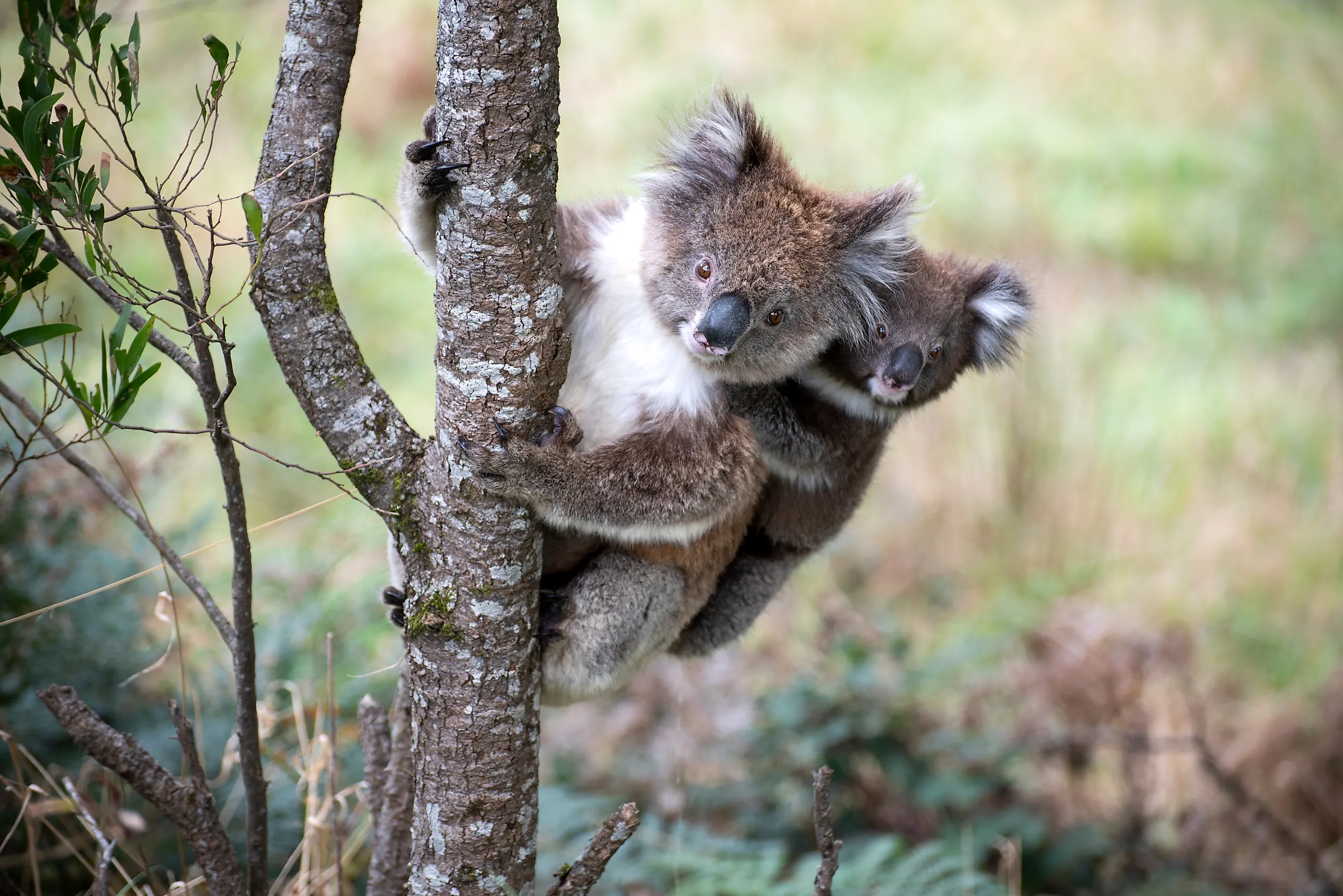
Koala
Koalas have long been one of the most recognizable animals in Australia. These cute, cuddly, compact creatures are more than just sleepy tree climbers; they are physically and biologically unique. There are several qualities possessed by koalas that make them one-of-a-kind, from being the only non-primate to have fingerprints to having complex social structures. Since their discovery, these marsupials have long been misunderstood. By examining their classification, habitat, behaviour, and physical features, one can gain a deeper understanding of what makes these adorable animals so special.
Taxonomic Classification

While koalas are often referred to as koala bears, this term is a misnomer, but easy to see why it occurs. Koalas, scientifically known as Phascolarctos cinereus, are tree-dwelling marsupials classified as belonging to the Phascolarctidae (suborder Vombatiformes) family. When first seen by European settlers, they were thought to be small bears. In 1816, the generic name Phascolarctos was given by French zoologist Henri Marie Ducrotay de Blainville, with later scientists adding cinereus. The name given is drawn from two Greek words, ‘phaskolos,’ which means pouch, and ‘arktos,’ which means bear. This translation is one of the reasons why some may call them koala bears, even though they are marsupials, like kangaroos. They are the only extant representative of the phascolarctidae family, with the closest living relatives being wombats. Many scientists believe there are three subspecies of koalas, with differences/adaptations being based on their location. The first are those found in Northern or Queensland areas, known as Phascolarctos cinereus adustus. The second are found in the Intermediate or New South Wales area and are known as Phascolarctos cinereus cinereus. The third is in the Southern or Victorian area (also including South Australia) and is known as Phascolarctoscinereus victor.
Food

An arboreal herbivorous marsupial, koalas are extremely selective eaters. Primarily living in open eucalyptus woodland, the eucalyptus leaves make up most of their diet. They consume an average of 200 to 500 grams of these leaves daily, but sometimes eat leaves from related trees such as paperbark, wattle, and teatree. These plants contain toxins inedible to most animals, have high fiber and low caloric and nutritional content, which are broken down by the unique specialized gut bacteria that koalas have, as well as aided by their extremely slow rate of digestion. Koalas possess a unique fiber-digesting organ known as a caecum, which is 200 cm long and contains millions of bacteria that help break down fiber so it becomes easier to absorb. Baby koalas are not born with these bacteria; they acquire them by eating their mothers' "pap," a runny form of their mother’s feces. Additionally, these animals rarely drink water, as most of their hydration comes from the moisture found in Eucalyptus.
Physical Description
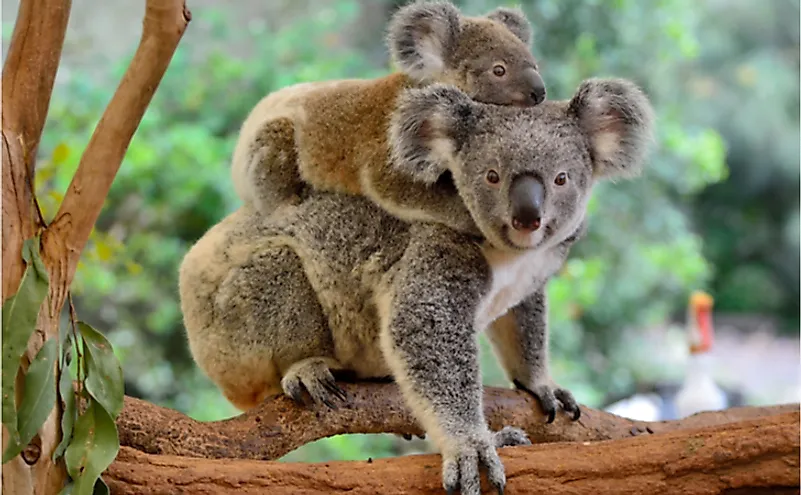
The physical description of these animals is distinct, with a large, round, dark, leathery nose, a large head with round, fluffy ears, and a short, almost tailless body. They have small, prominent eyes that face forward, giving them almost human-like expressions. Usually ranging in color from chocolate brown to silver grey in color (depending on their geographical location), they have thick, soft coats of fur. Koalas have strong, clawed feet with opposable digits, and on each front paw, they possess two thumbs, allowing them to climb and grip trees. Described as medium in size, they weigh between 8.8 and 33.1 pounds, and are between 24 and 33 inches in length, making them among the biggest arboreal marsupials. Koalas found in the northern part of the state are often lighter in color and smaller than those living in the more southern areas.
Koalas also have some pretty unique characteristics that make them one-of-a-kind. The most well-known characteristic is that, similar to humans, they have fingerprints. In fact, they are the only non-primate mammal known to have this type of feature. This is an example of convergent evolution, meaning different species that are unrelated to each other develop traits that are similar. It is thought that these fingerprints serve two important roles, allowing better perceptions of shapes and textures and gripping rough surfaces. Another unique characteristic is that while they have pouches like kangaroos, these pouches face backward, providing protection for their young.
Behavior

In order to conserve energy, koalas sleep up to twenty hours a day. They are largely sedentary, making them usually docile creatures. Koalas have complex social structures that are managed by vocalizations. They use a wide range of sounds to communicate over great distances. Male Koalas will use a deep grunting bellow to signify their physical and social position, conserving their fighting energy through bellows of dominance. Babies and their mothers can be heard making soft squeaking and clicking sounds, as well as gentle humming and grunts. While koalas are by nature not generally aggressive, if they feel threatened or stressed, they may become dangerous. They can hiss, scratch, bite, and snarl when approached too closely. These asocial creatures are more active at night, and this activity increases during breeding season and warmer months.
Range and Habitat

Koalas can be found in eastern coastal areas of Australia, inhabiting South Australia, Queensland, Victoria, and New South Wales. What makes these animals unique is that they live in complex social groups. They are territorial, not migratory, meaning individual members maintain areas that are considered their "home range." These ranges include numerous trees, which create an individual long-term territory that provides places for social contact, shelter, and food. When there is no habitat loss, these spaces are used to support them for their entire life. The home ranges of individual koalas, within a socially stable group, overlap with those of their neighbours. As a koala becomes sexually mature, it moves away from its mother's home range to seek out its own territory. During this time, they are looking for another breeding group to become attached to. Interestingly, there are some animals that remain transient, hanging around the borders of stable groups. These koalas are primarily young males, often wandering between breeding aggregations in hopes of becoming permanent residents. Similar to other animals, koalas communicate by marking trees with their scent.
Reproduction

August to February is the approximate breeding season for koalas. During this time, movement surges as well as sounds, with males bellowing at increased frequency. Additionally, this is the time when mature young leave their mothers and find a new place to live. At around three or four years old, females generally begin breeding, giving birth to one baby per year. Some females in the wild will produce offspring every two or three years, depending on the quality of the habitat and age. During the lifespan of an average female, they can give birth to up to five or six babies. After conception, it takes only 35 days before a baby koala is born. Koalas are born blind, without ears, and hairless. At an early stage of development, young koalas are known as joeys, and they crawl into the pouches of their mothers, living there for the first six to seven months. At one year old, young are fully weaned, able to leave the pouch, and become independent.
Importance and Threats

Koalas have many important roles in terms of making forests thrive. They are needed to maintain healthy eucalyptus trees by promoting rejuvenation through dropping based, nutrient-rich fertilization, limiting fuel for fire by reducing foliage, and regulating tree growth by shaping vegetation composition. In the wild, koalas can live between 13 and 18 years, with females typically outliving males. Although they have few natural predators, Koalas are classified as an endangered animal in parts of Australia, due to a number of other threats.
Climate change has resulted in increased frequency of droughts and increased risk of fire-danger weather in numerous parts of Australia, causing koalas to move more to find new habitats or in search of water. This increased movement causes them to become more vulnerable to being struck by vehicles or encountering predators. The second most significant threat to these animals is being killed or injured by vehicles, with more than half of the deaths recorded being linked to car strikes. The loss of habitat due to farming, urbanization, and land clearing is also a significant threat to koalas. This creates barriers for movement, reducing gene flow and limiting the genetic variation of koalas. Additionally, koalas face risks of disease, with four different types of chlamydia impacting the population. These diseases can cause blindness, female infertility, and pneumonia.
Help the Koalas
Koalas are considered a species at high risk from climate change, making their survival dependent on the conservation of their natural habitat and, more generally, the environment. Facing increased threats, these animals are some of the most adorable and complex creatures found in Australia. These adorable marsupials need the help of everyone, not only because their loss would disrupt biodiversity and damage an important ecosystem, but also because they serve as an important symbol of Australia’s natural heritage.