10 Most Hospitable Towns In Germany
Hospitality in Germany often shows up in small, practical gestures. A hotel by the Angermünde train station keeps its bike storage locked and its breakfast buffet stocked for arriving guests. On Rügen, an entire beach is set aside so visitors can bring their dogs. In an Eifel village, one small hotel sends a car to collect guests from two different train stations. These are towns that make the logistics of a visit easy. The ten below include Baltic beach resorts and Alpine villages beneath Schwangau's castles.
Angermünde, Brandenburg

Stolper Turm has watched over the Oder valley since the late 12th century. This brick tower, 18 meters across, is often called the thickest fortified tower in Germany, and its platform looks out over the Nationalpark Unteres Odertal (or Lower Oder Valley National Park). Angermünde sits about 89 kilometers (or 55 miles) northeast of Berlin, a former industrial town that now works as a base for the Uckermark region near the Oder River and the Polish border. West of town, the NABU-Naturerlebniszentrum Blumberger Mühle opens the larger Schorfheide-Chorin Biosphere Reserve to birdwatchers tracking European golden plovers, white-tailed eagles, common cranes, and black storks. A little farther on, the Grumsin beech forest, a UNESCO World Natural Heritage Site, has grown here since the last Ice Age.
The welcome starts at the station itself. Hotel 1912 stands right at the Angermünde stop and takes groups of any size, with free wifi, lockable bike storage, pet-friendly rooms, and a full breakfast buffet.
Binz, Mecklenburg-Vorpommern

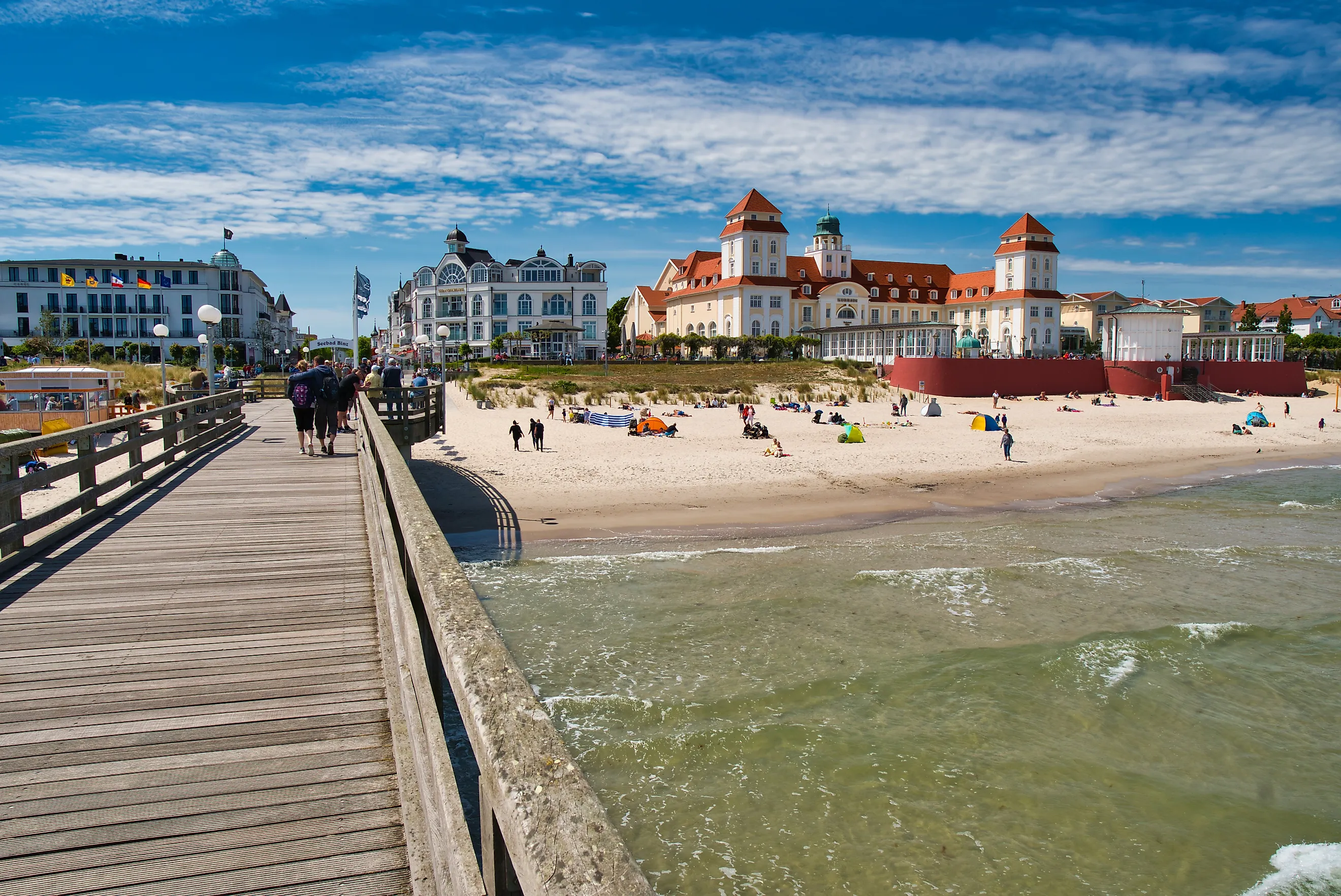
Binz greets dogs as warmly as their owners. North of the main resort, Hundestrand is the area's official dog-friendly beach, set aside so visitors can bring the whole family down to the water. Binz sits on Rügen, Germany's largest island, and its main strand runs long and flat for easy swimming and sunbathing. For a wilder stretch of coast, the Biosphärenreservat Südostrügen (or Southeast Rügen Biosphere Reserve) is a UNESCO reserve of rocky beaches, New Stone Age megalithic tombs, and beech woodlands shaped by post-Ice Age glacial erosion.
Rugard Thermal Strandhotel keeps the focus on rest. Its Rugard Royal Spa runs a saltwater pool, several saunas, and a full menu of massage and beauty treatments, and guests can choose among three restaurants and a set of smoke-free rooms.
Graal-Müritz, Mecklenburg-Vorpommern

Rhododendronpark packs about 2,500 flowering plants into 4.5 hectares, and it draws crowds when the blooms come in. Graal-Müritz sits on Germany's Baltic Sea coast, roughly 225 kilometers (or 140 miles) south of Copenhagen, at the point where forest gives way to open shore. That forest is Rostocker Heide, some 6,000 hectares of trails where walkers spot foxes, deer, wild boar, white-tailed eagles, and grey herons. Down at the water, Ostseestrand Graal-Müritz is a blue flag beach known for clean air and clean water.
Strandhotel Ostseewoge finished a full renovation in 2025. Its 42 rooms now come with flat-screen TVs, wifi, in-room safes, and walk-in showers, all a short distance from the sand.
Zarrentin am Schaalsee, Mecklenburg-Vorpommern

The Elfenpfad, or Fairy Trail, runs 16 kilometers through the forest by Neuenkirchener Lake. Zarrentin am Schaalsee sits about 70 kilometers (or 43 miles) east of Hamburg, on the shore of northern Germany's deepest lake. A second route, the "Place of the Black" to the "Gate of Heaven" path, follows the water through the UNESCO Biosphere Reserve Schaalsee and passes the grounds of a Cistercian monastery. Come summer, Zarrentin Lido opens for swimming right on the lake.
Seehotel Zarrentin gives visitors a quiet place to land afterward. Its 45 rooms include modern bathrooms, plush bedding, and in-room coffee and tea, and every guest gets the morning breakfast buffet.
Norderney, Lower Saxony

Norderney has taken in spa guests since 1797, which makes it Germany's oldest North Sea resort. It sits at the heart of the Wadden Sea, a UNESCO World Natural Heritage Site. At the center of it all, bade:haus Norderney spreads saunas, steam rooms, and pools across 8,000 square meters, making it Europe's largest thalassotherapy center. For the beaches, families head to Weststrand (West Beach) and its seaside playground, while Weiße Düne (White Dune) draws a younger crowd to white sand where the water can reach 28 degrees Celsius in summer.
Hotel Südblick sits a short walk from that sand. Rooms come with soundproof walls, walk-in showers, flat-screen TVs, and wifi, and the day starts with a full breakfast buffet.
Höxter, North Rhine-Westphalia

Parts of Schloss Corvey date to the ninth century, and its Princely Library holds around 75,000 volumes, ranking it among Germany's most important private collections. Höxter sits on the left bank of the river Weser, and this UNESCO World Heritage abbey anchors its link to the Carolingian Empire and the Weser Renaissance. In the town center, the Historisches Rathaus (Historic Town Hall) has stood since the 13th century and took on its half-timbered Weser Renaissance look in the early 17th. Across the river, Naturpark Solling-Vogler lays out more than 1,000 kilometers of signposted paths through the forests, meadows, and hills of the Weser Uplands.
Hotel Niedersachsen sits in the historic core and leans on local hospitality. The rooms and suites are built for comfort, the spa runs saunas and a year-round heated pool, and the kitchens at Huxori Stube and Sachsenklause serve classic German fare.
Gemünd, North Rhine-Westphalia

Eifel National Park covers 110 square kilometers of clear lakes, streams, and natural beech forest west of Gemünd, home to black storks, kingfishers, Eurasian eagle owls, beavers, and wildcats. The town sits about 66 kilometers (or 41 miles) southwest of Cologne and serves as a gateway to that biodiversity. Also on park land, Ordensburg Vogelsang went up in the late 1930s as a Nazi leadership academy, became a British and Belgian training ground after World War II, and opened to the public as a museum complex in 2006.
Gemünd puts real effort into getting guests there. Hotel Haus Salzberg offers 10 homestyle rooms, a full breakfast every morning, and free pickups from the Kall and Euskirchen train stations, while Gemünder Brauhaus handles the hearty German cooking in town.
Ketsch, Baden-Württemberg

Ketscher Rheininsel, the "green lung" of the town, wraps nature trails around one of the last natural floodplains on the Upper Rhine. Ketsch sits on the right bank of the Rhine River, about 95 kilometers (or 59 miles) south of Frankfurt am Main. Just north, Schwetzinger Wiesen-Edinger Ried protects more floodplain meadow and shelters black kites, golden orioles, European tree frogs, and garlic toads. At the west end of town, Badestrand Hohwiese doubles as a local swimming hole and a family play area.
SeeHotel Ketsch keeps things simple. This 70-room hotel sits by Anglersee lake and gives travelers a calm setting for a night or two.
Schorndorf, Baden-Württemberg

Gottlieb Daimler was born in Schorndorf, and the town keeps his memory at the Gottlieb-Daimler-Geburtshaus. The engineer built the first high-speed petroleum-fueled engine in the 1880s and founded the company that grew into Mercedes-Benz Group AG. That gives this town east of Stuttgart a real claim in global transportation history, though the Rems Valley and Swabian Forest around it invite a slower pace. Stadtmuseum Schorndorf fills a pair of 350-year-old half-timbered buildings with exhibitions on the town's path from ancient times to the industrial era. For a different kind of ride, Freeride Mountain Bikepark Schorndorf lays out a network of mountain bike and BMX tracks.
Hotel Reich an der Rems sits by the Rems River as the town's four-star option. It offers unusually large rooms and suites, Swabian cooking at its restaurant, and space for family and business gatherings.
Schwangau, Bavaria

Schloss Neuschwanstein is the reason many travelers come to Schwangau. Walt Disney and his Imagineers took the 19th-century palace as the model for the Sleeping Beauty Castle that opened at Disneyland in 1955. The town sits in the Bavarian Alps of southern Germany, about 116 kilometers (or 72 miles) southwest of Munich near the Austrian border. Nearby, Schloss Hohenschwangau is a second grand castle, built by King Maximilian II of Bavaria in the 19th century on the grounds of a 12th-century fortress. East of town, Ammergau Alps Nature Park protects 228 square kilometers of Alpine peaks and forest, along with rare birds like capercaillies, black grouse, and rock ptarmigans.
AMERON Neuschwanstein Alpsee Resort & Spa stands right by Schloss Hohenschwangau. This Michelin Key property has 136 individually designed rooms with views across the valley, the 4 elements spa by Althoff, and dining at Lisl Restaurant & Terrasse, Alpenrose Biergarten, and Schloss Bräustüberl & Alpseestube.
Hospitality Shows In The Details
What ties these ten towns together is how easy each one makes a visit. Angermünde puts its best hotel at the train station and its beech forests within a short drive. Binz sets aside a whole beach for dogs, and Gemünd sends a car for guests who arrive by rail. Norderney has been perfecting the seaside spa since 1797, while Schwangau shares the castle that shaped a Disney landmark. The welcome takes a different form in each place, but the intent is the same across the Baltic coast, the Rhine valley, and the Bavarian Alps.