8 Most Welcoming Small Towns In Germany
Germany's small towns are where the country's charm runs deepest. Medieval walled towns with intact fortifications, half-timbered houses lining cobblestone streets, Gothic churches with centuries-old altarpieces, and Alpine villages backed by mountain peaks. Towns like Rothenburg ob der Tauber look pulled from the pages of a storybook, while Görlitz has doubled as a film set for Hollywood productions. Here are eight of the most welcoming small towns in Germany.
Görlitz

Situated about 100 kilometers from Dresden on the Polish border, Görlitz is one of Germany's best-preserved old towns. Hundreds of landmarked buildings line its cobblestone streets along the Lusatian Neisse River, spanning Gothic, Renaissance, Baroque, and Art Nouveau periods. The Silesian Museum offers a deeper look at the region's history, alongside German, Polish, and Czech artworks.
The Lower Market (Untermarkt) and Upper Market (Obermarkt) form the heart of the old town, where medieval and Baroque facades stand side by side. The Church of St. Peter and Paul, a late-Gothic landmark, houses the striking Sonnenorgel (Sun Organ). Görlitz has also earned the nickname "Görliwood" for its role as a filming location for movies including Inglourious Basterds, The Book Thief, and The Grand Budapest Hotel. With its cinematic streetscapes and layers of architectural history, Görlitz rewards visitors who take the time to wander.
Bad Wimpfen

Bad Wimpfen is far from being a bad place to visit in Germany. Only 24 minutes north of Heilbronn, one can enjoy the historic thermal spas along the river Neckar, which date back to when the town was a vital Roman settlement and the Roman Empire held sway in the region. Tourists today flock to the fortified Staufian Imperial Palace with its accompanying Blue Tower, both relics of Bad Wimpfen’s regal allure. There is also the imposing Kaiserpfalz Bad Wimpfen, a castle of remarkable architectural splendor alongside the medieval-old Kloster Bad Wimpfen monastery. In the rural neighborhood of Hohenstadt, one can attend several large festivals or events in Bad Wimpfen, such as the Valley Market almost every month, the Imperial City Festival in September, and the Christmas Market in December. For those who want to spend a good time in Bad Wimpfen, book a room at the Hotel Neues Tor.
Quedlinburg

As one of the UNESCO World Heritage Sites in Germany, Quedlinburg lives up to its title due to the magnificent and mystical structures that preserve the past and embody the present. At the time when Quedlinburg was the capital of the East Franconian German Empire during the reign of the Saxonian-Ottonian dynasty, the Collegiate Church of St. Servatius was one of the most esteemed churches in the Middle Ages. Today, much of the abbey’s 10th - 12th-century artworks and monuments are still on impeccable display, including the tomb of King Henry I.
Nearby, the Quedlinburg Castle, once the seat of the East Franconian German Empire, continues to dazzle and astound tourists worldwide. In addition, the Klopstockhaus allows visitors to appreciate local poet Friedrich Gottlieb Klopstock, while the Schlossmuseum houses thousand-year-old artifacts. Outdoor enthusiasts might be more amenable to ascending the Harz Mountains or descending towards Bode Gorge. To get a better feel of the medieval streets of Quedlinburg, settle down like weary travelers in inn-like establishments such as Hotel Balneolum, Hotel am Hoken or Hotel Tilia.
Rothenburg Ob Der Tauber

Germany gave the world the Brothers Grimm and their transcendental fairytales. Today, Rothenburg ob der Tauber brings those stories to life. Perched on a plateau overlooking the Tauber River in Franconia, this walled medieval town has been a free imperial city since 1274 and remains one of only four towns in Germany with fully intact fortifications.
St. Jakob's Church houses an intricate late-Gothic altarpiece by master woodcarver Tilman Riemenschneider, created between 1500 and 1505. The Imperial City Museum preserves the legendary tankard from the Meistertrunk, a daring drinking challenge said to have saved the town during the Thirty Years' War. The story is reenacted annually in a play called Der Meistertrunk ("The Master Gulp"). With its half-timbered houses, towers, and cobblestone lanes, Rothenburg looks like it was pulled straight from the pages of a storybook.
Füssen

No one will feel like fussing around in the 700-year-old Bavarian town of Füssen. Only two hours away from Munich and at the border of Austria, Füssen welcomes travelers with bracing winds from the Bavarian Alps and Lech River. Although the village itself contains a number of historic landmarks throughout Europe’s architectural periods—such as the High Palace from the Medieval Age and the Baroque homes of prominent violin and lute makers—tourists throng to Füssen for the two astonishing castles overlooking the picturesque town.
First, the Hohenschwangau Castle above Schwansee (Swan Lake), a palatial estate that continues to preserve the romantic era through lavish chambers like Swan Knight’s Hall, Guelph Room, and Hohenstaufen Room. Second, Neuschwanstein Castle is a fairytale and fortressed abode befitting the home of a Disney princess. Step into the pages of history and folklore, of heroic knights and noble damsels, and see more of what Füssen cherishes and preserves while staying in lavish holiday apartments like Ferienhaus "Beim Lenzer" or Ferienwohnungen Allgäu Moni.
Mittenwald

Mittenwald is a luxurious mountain and winter resort atop the Alpine peaks of Bavaria. Approximately 50 miles from Füssen, visitors can explore many trails and treks across the Karwendel Mountains and along the Isar River. Once a way station on a Roman trade route, Mittenwald has since become one of the most prestigious centers for handcrafted violins in 17th-century Europe. Mittenwald has never lost its value for transportation and commerce, especially during the First World War, when it connected the faraway communities of Garmisch and Innsbruck. Nowadays, people take popular walks like the Leutaschklamm through the Wetterstein range, which then leads to Zugspitze, one of the tallest mountains in Germany. Savor your evenings in the mountains of Germany at the Hotel Bichlerhof, Landhaus Albrecht, or Hotel Sonnenbichl Mittenwald.
Lindau

On the blue-beautiful expanse of Lake Constance (locally known as Bodensee), the vibrant town of Lindau beckons tourists with its breezy atmosphere and medieval charm. The old and original town of Lindau—including the Gothic Altes Rathaus (Old Town Hall)—is located on Lindau Island. The island was once the site of a Roman camp called Tiberii and later a Benedictine abbey in the year 810. In 1275, Lindau became a fortified, free imperial city of the Holy Roman Empire. These days, the “Garden City,” as Lindau is lovingly called, now attracts thousands of visitors with its green refuges like Stadtgarten, which provide excellent views of the mountains and of Lake Constance.
Lindau not only boasts stunning natural scenery but also houses several well-preserved historical relics. These include a 19th-century Bavarian lion standing beside a stone lighthouse at the town harbor, and the Lindaviabrunnen, a display of detailed human sculptures. Visitors should be cautious when climbing the Mangturm, a 12th-century watchtower situated at Seepromenade, the harbor front. The town's name derives from the German phrase “island where lime trees grow.
Cochem

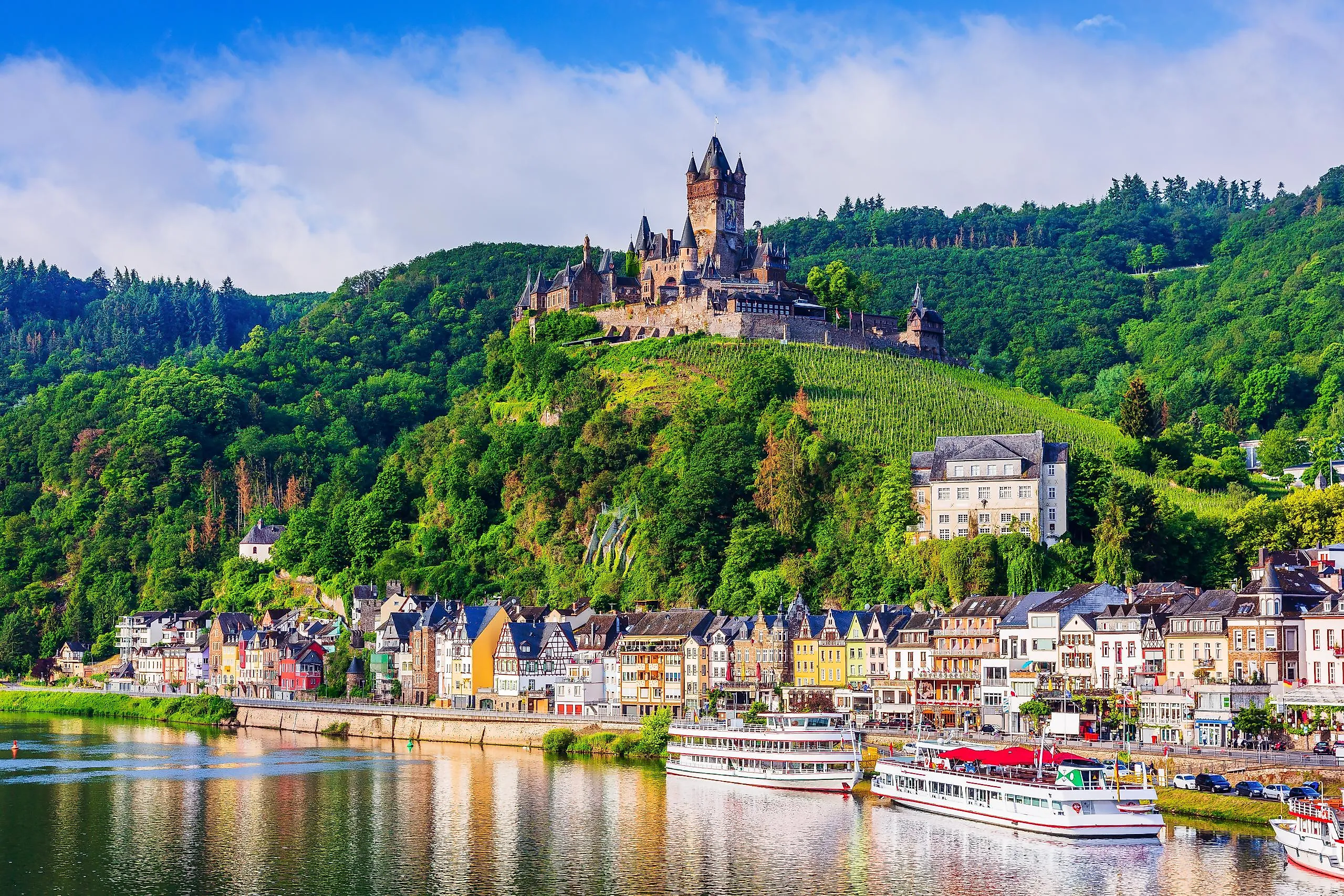
Lounging in the Moselle River valley near the borders of France and Luxembourg, the medieval town of Cochem welcomes visitors with a bevy of beautiful beverages. Renowned for its fresh and delicious wine along the "German Wine Route," Cochem flourished in the 13th and 15th centuries thanks to its many wineries in the rolling region. Reichsburg Cochem, which translates to “Cochem Imperial Castle,” has safeguarded the town’s vineyards and Moselle River valley for centuries, even though it has undergone several changes in management between France and Germany. Cochem was also a valuable location to store billions of Cold-War currencies in the Bundesbank Bunker Cochem. A handful of ruins dot the region, such as the old winery of Burgruine Winneburg and Burgruine Coraidelstein. For those who want to see more of Cochem or savor its timeless wine, do not forget to book a room at either the Hotel Hegenbarth´s or Ich Zeit - Apart Hotel.
In a medieval village like Cochem, where wine instead of Germany’s world-renowned beer is brewed, you will savor your experiences forever. In places straight from the Grimm Brothers’ pages, such as Rothenburg Ob Der Tauber and Füssen, you will be enchanted by the cultural ambiance, which is complemented by awesome mountains like the Bavarian Alps. And in towns like Quedlinburg and Lindau that continuously preserve their historic architecture, you will be mesmerized by the beauty and ingenuity of human genius. From a country renowned for its industrialism, patronage in the sciences and the arts, and a tentative dichotomy in human nature, Germany welcomes you with its many small towns rich in folklore and modernity.