The 10 Richest Cities In Germany
According to GDP per capita, the richest city in Germany is Wolfsburg, followed by Ingolstadt and Erlangen, with the finance hub Frankfurt only seventh and Berlin far down the national ranking. This list of the 10 richest cities in Germany, from Wolfsburg's €158,749 to Stuttgart's €87,513, shows where high-value economic activity is really concentrated.
GDP per capita captures how much economic output is generated per resident. It highlights places where globally competitive industries, research institutions, and skilled workers cluster together, from carmaking in Wolfsburg, Ingolstadt, and Stuttgart to science and space technology in Darmstadt, or biotech in Mainz. Strikingly, many of Germany's richest cities are mid-sized industrial and university centres rather than sprawling metropolises.
The 10 Richest Cities in Germany
| Rank | City | State | GDP/Capita in Euros (€) |
|---|---|---|---|
| 1 | Wolfsburg | Lower Saxony | 158,749 |
| 2 | Ingolstadt | Bavaria | 130,509 |
| 3 | Erlangen | Bavaria | 104,698 |
| 4 | Mainz | Rhineland-Palatinate | 104,441 |
| 5 | Schweinfurt | Bavaria | 99,130 |
| 6 | Coburg | Bavaria | 98,551 |
| 7 | Frankfurt am Main | Hesse | 97,270 |
| 8 | Regensburg | Bavaria | 90,529 |
| 9 | Darmstadt | Hesse | 88,497 |
| 10 | Stuttgart | Baden-Württemberg | 87,513 |
1. Wolfsburg - 158,749 €

Topping the list, Wolfsburg in Lower Saxony is Germany's richest city, with a GDP per capita of €158,749. Purpose-built in 1938 to house workers for the Volkswagen Beetle plant, it remains dominated by Volkswagen's global headquarters and one of the world's largest car factories. This auto powerhouse still underpins exceptional prosperity, high wages and strong public finances. Around the vast factory complex, modern attractions like the Autostadt car theme park, the Phaeno science centre and the Volkswagen Arena football stadium create additional jobs, drawing visitors and reinforcing Wolfsburg's image as a compact, high-tech city built on mobility and engineering today.
2. Ingolstadt - 130,509 €

Like Wolfsburg, Ingolstadt is a car city first: Audi and its suppliers lift GDP per capita to €130,509, the second-highest figure in Germany. This former Bavarian ducal residence still shows off a well-preserved medieval core on the Danube, but its fortunes today are firmly tied to high-tech manufacturing and research. Two universities, including the Technische Hochschule Ingolstadt, help feed skilled workers into local industry. With unemployment around 3% and a growing population, Ingolstadt illustrates how export-oriented engineering can sustain remarkable prosperity outside Germany's biggest metropolitan regions like Munich, Hamburg and Berlin.
3. Erlangen - 104,698 €

Further north in Bavaria, Erlangen channels Siemens, university research and medical technology into €104,698 of GDP per capita, Germany's third-highest figure. Together with Nuremberg and Fürth, it underpins a high-performing metropolitan region, attracting knowledge workers, start-ups and global engineering firms. Friedrich-Alexander University and major clinics feed talent and innovation into local industry, especially imaging, automation and healthcare. With unemployment low, strong purchasing power, and a long tradition of welcoming Huguenot refugees and later international professionals, Erlangen shows how a compact, research-intensive city can generate outsized prosperity while investing heavily in environmental protection and liveability.
4. Mainz - 104,441 €

On the Rhine, state capital Mainz turns wine, media and biotechnology into €104,441 of GDP per capita, placing it fourth among Germany's richest cities. As part of the Rhine-Main metropolitan region with Frankfurt and Wiesbaden, it benefits from dense transport links and a huge commuter catchment. Global firms such as BioNTech, glassmaker Schott and chemical group Werner & Mertz anchor a diverse industrial base, while ZDF and other broadcasters add high-value creative jobs. A longstanding wine and trade hub on the Rhine, Mainz combines export-oriented industry, research, and services with an attractive riverside centre that helps draw talent, tourism and international investment.
5. Schweinfurt - 99,130 €

Schweinfurt, a compact industrial city on the Main, converts its dense base of high-value manufacturers into €99,130 of GDP per capita, ranking fifth nationwide. Long a global centre for ball bearings, it hosts major plants for SKF, Schaeffler, ZF Friedrichshafen and Bosch Rexroth, plus Fresenius Medical Care and SRAM's European bike R&D hub. This heavy engineering base gives Schweinfurt one of Germany's highest employment densities and fastest productivity growth. A compact city on the Main, it has been reshaping former U.S. Army sites into the "i-Campus" and new mixed districts, pairing industrial strength with knowledge jobs and urban renewal.
6. Coburg - 98,551 €

Coburg, once a ducal residence and now a small regional centre in northern Bavaria, posts €98,551 of GDP per capita thanks to a mix of advanced industry and services that makes it Germany's sixth-richest city. Former capital of the Duchy of Saxe-Coburg and Gotha, it escaped major wartime damage, preserving landmarks like Veste Coburg and Ehrenburg Palace that now underpin a thriving tourism sector. The modern economy is dominated by automotive supplier Brose, insurer HUK-Coburg, Kaeser Kompressoren and precision-engineering firms such as Waldrich-Coburg. This network of export-oriented, mid-sized companies supports high productivity, low unemployment and robust municipal finances, giving this small former ducal seat outsized economic weight in the German landscape.
7. Frankfurt am Main - 97,270 €

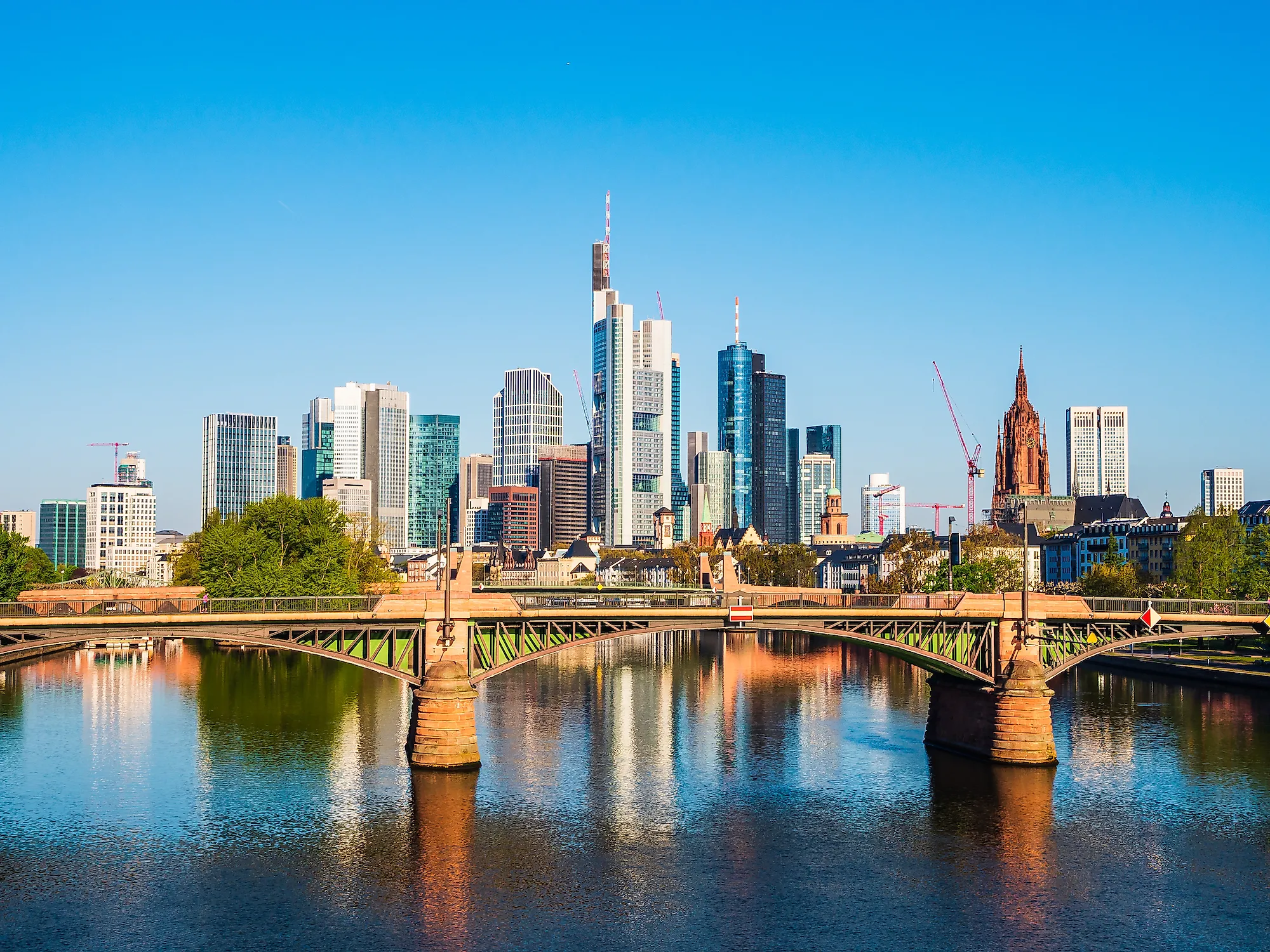
Germany's closest thing to a global city, Frankfurt am Main leverages its role as a financial and transport hub to generate €97,270 in GDP per capita, placing it seventh on this list. Home to the European Central Bank, Deutsche Bundesbank and Frankfurt Stock Exchange, it anchors one of Europe's leading banking districts, nicknamed "Mainhattan". The city's role as an air, rail and road hub, via Frankfurt Airport, Central Station and the Frankfurter Kreuz interchange, underpins its productivity and attracts global corporations, trade fairs and high-net-worth individuals. A diverse, highly skilled population and strong service, tech and creative sectors further reinforce Frankfurt's position among Germany's richest cities.
8. Regensburg - 90,529 €
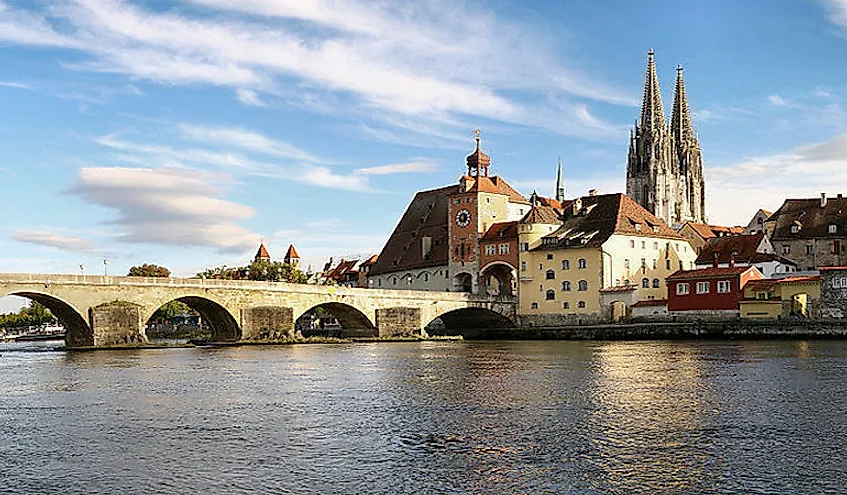
In eastern Bavaria, Regensburg blends a UNESCO-listed medieval core with a high-tech industrial base that lifts GDP per capita to €90,529 and secures eighth place in Germany's wealth rankings. A former Roman fort and medieval trading hub, its well-preserved Old Town is now a UNESCO World Heritage Site that sits at the heart of a thriving tourism sector. Since the 1960s, global manufacturers such as BMW, Siemens, Infineon and Osram have transformed Regensburg into a powerhouse for automotive, electronics and semiconductor production. Universities, biotech firms clustered in the BioPark and a growing IT start-up scene add innovation and skilled jobs, keeping productivity and living standards high and household prosperity for its residents.
9. Darmstadt - 88,497 €

Branded Germany's "City of Science," Darmstadt combines historic ducal prestige with cutting-edge research to reach €88,497 in GDP per capita, ranking ninth among German cities. It hosts ESA's European Space Operations Centre, EUMETSAT and the GSI ion research centre, where the element darmstadtium was discovered. Global players like Merck and Software AG anchor strengths in pharmaceuticals, chemicals, IT and telecoms, supported by TU Darmstadt and a major University of Applied Sciences. Art Nouveau heritage at Mathildenhöhe, now a UNESCO World Heritage Site, plus abundant parks and festivals, help attract skilled workers and sustain its affluent, innovative city profile.
10. Stuttgart - 87,513 €

Capital of Baden-Württemberg, Stuttgart pairs vineyard-fringed hillsides with one of Germany's most productive economies, generating €87,513 in GDP per capita. Global giants Mercedes-Benz, Porsche and Bosch underpin a powerful automotive and engineering ecosystem, supported by dense research networks, six Fraunhofer institutes and leading universities. The city also hosts Germany's second-largest stock exchange and major financial institutions, reinforcing its role as a high-income business centre. Set in a vineyard-fringed basin, Stuttgart combines industrial might, innovation capacity and strong export performance to deliver one of the highest overall standards of living in Germany.
Taken together, the 10 richest cities in Germany show how wealth concentrates in specialised, export-oriented hubs rather than just in global names like Berlin or Hamburg. From Wolfsburg, Ingolstadt and Erlangen to Frankfurt and Stuttgart, high GDP per capita follows carmaking, engineering, biotech, finance and research intensity. For investors, workers and policymakers, Germany's richest cities by GDP per capita highlight where future growth, innovation and high-value jobs are most likely to cluster.
German Cities Ranked By GDP/Capita
| Rank | City | State | GDP/Capita in Euros (€) |
|---|---|---|---|
| 1 | Wolfsburg | Lower Saxony | 158,749 |
| 2 | Ingolstadt | Bavaria | 130,509 |
| 3 | Erlangen | Bavaria | 104,698 |
| 4 | Mainz | Rhineland-Palatinate | 104,441 |
| 5 | Schweinfurt | Bavaria | 99,130 |
| 6 | Coburg | Bavaria | 98,551 |
| 7 | Frankfurt am Main | Hesse | 97,270 |
| 8 | Regensburg | Bavaria | 90,529 |
| 9 | Darmstadt | Hesse | 88,497 |
| 10 | Stuttgart | Baden-Württemberg | 87,513 |
| 11 | Düsseldorf | North Rhine-Westphalia | 87,338 |
| 12 | Munich | Bavaria | 86,529 |
| 13 | Braunschweig | Lower Saxony | 82,448 |
| 14 | Bonn | North Rhine-Westphalia | 81,997 |
| 15 | Ulm | Baden-Württemberg | 81,955 |
| 16 | Aschaffenburg | Bavaria | 78,658 |
| 17 | Koblenz | Rhineland-Palatinate | 76,899 |
| 18 | Ludwigshafen am Rhein | Rhineland-Palatinate | 76,182 |
| 19 | Karlsruhe | Baden-Württemberg | 72,016 |
| 20 | Hamburg | Hamburg | 70,620 |
| 21 | Passau | Bavaria | 70,466 |
| 22 | Mannheim | Baden-Württemberg | 69,151 |
| 23 | Wiesbaden | Hesse | 68,556 |
| 24 | Würzburg | Bavaria | 68,164 |
| 25 | Emden | Lower Saxony | 66,872 |
| 26 | Bamberg | Bavaria | 66,543 |
| 27 | Bayreuth | Bavaria | 64,820 |
| 28 | Memmingen | Bavaria | 64,737 |
| 29 | Amberg | Bavaria | 64,142 |
| 30 | Ansbach | Bavaria | 63,112 |
| 31 | Nürnberg | Bavaria | 62,997 |
| 32 | Köln | North Rhine-Westphalia | 61,845 |
| 33 | Landshut | Bavaria | 60,954 |
| 34 | Heilbronn | Baden-Württemberg | 60,292 |
| 35 | Weiden in der Oberpfalz | Bavaria | 59,307 |
| 36 | Münster | North Rhine-Westphalia | 59,294 |
| 37 | Freiburg im Breisgau | Baden-Württemberg | 59,259 |
| 38 | Heidelberg | Baden-Württemberg | 58,819 |
| 39 | Straubing | Bavaria | 56,345 |
| 40 | Speyer | Rhineland-Palatinate | 55,513 |
| 41 | Baden-Baden | Baden-Württemberg | 55,158 |
| 42 | Kassel | Hesse | 54,884 |
| 43 | Rosenheim | Bavaria | 54,850 |
| 44 | Bremen | Bremen | 54,826 |
| 45 | Kempten (Allgäu) | Bavaria | 53,778 |
| 46 | Osnabrück | Lower Saxony | 53,267 |
| 47 | Zweibrücken | Rhineland-Palatinate | 52,606 |
| 48 | Salzgitter | Lower Saxony | 51,738 |
| 49 | Leverkusen | North Rhine-Westphalia | 51,375 |
| 50 | Kiel | Schleswig-Holstein | 50,531 |
| 51 | Oldenburg | Lower Saxony | 50,342 |
| 52 | Kaiserslautern | Rhineland-Palatinate | 50,158 |
| 53 | Augsburg | Bavaria | 49,771 |
| 54 | Neumünster | Schleswig-Holstein | 48,380 |
| 55 | Jena | Thuringia | 48,349 |
| 56 | Hannover region | Lower Saxony | 47,884 |
| 57 | Lübeck | Schleswig-Holstein | 47,354 |
| 58 | Essen | North Rhine-Westphalia | 46,673 |
| 59 | Landau in der Pfalz | Rhineland-Palatinate | 46,270 |
| 60 | Hof (Saale) | Bavaria | 46,228 |
| 61 | Saarbrücken region | Saarland | 45,776 |
| 62 | Wilhelmshaven | Lower Saxony | 45,522 |
| 63 | Potsdam | Brandenburg | 45,378 |
| 64 | Pforzheim | Baden-Württemberg | 45,080 |
| 65 | Berlin | Berlin | 45,074 |
| 66 | Trier | Rhineland-Palatinate | 44,678 |
| 67 | Erfurt | Thuringia | 44,425 |
| 68 | Bielefeld | North Rhine-Westphalia | 44,263 |
| 69 | Schwerin | Mecklenburg-Vorpommern | 44,150 |
| 70 | Flensburg | Schleswig-Holstein | 43,541 |
| 71 | Dresden | Saxony | 43,302 |
| 72 | Krefeld | North Rhine-Westphalia | 43,194 |
| 73 | Dortmund | North Rhine-Westphalia | 41,880 |
| 74 | Worms | Rhineland-Palatinate | 41,419 |
| 75 | Frankfurt an der Oder | Brandenburg | 40,710 |
| 76 | Rostock | Mecklenburg-Vorpommern | 40,656 |
| 77 | Aachen region | North Rhine-Westphalia | 40,647 |
| 78 | Leipzig | Saxony | 39,695 |
| 79 | Pirmasens | Rhineland-Palatinate | 39,428 |
| 80 | Eisenach | Thuringia | 39,041 |
| 81 | Fürth | Bavaria | 38,951 |
| 82 | Kaufbeuren | Bavaria | 38,914 |
| 83 | Remscheid | North Rhine-Westphalia | 38,689 |
| 84 | Frankenthal (Pfalz) | Rhineland-Palatinate | 38,661 |
| 85 | Schwabach | Bavaria | 38,430 |
| 86 | Offenbach am Main | Hesse | 38,328 |
| 87 | Cottbus | Brandenburg | 38,284 |
| 88 | Chemnitz | Saxony | 38,199 |
| 89 | Magdeburg | Saxony-Anhalt | 38,074 |
| 90 | Wuppertal | North Rhine-Westphalia | 38,056 |
| 91 | Bochum | North Rhine-Westphalia | 37,650 |
| 92 | Duisburg | North Rhine-Westphalia | 37,053 |
| 93 | Mülheim an der Ruhr | North Rhine-Westphalia | 37,019 |
| 94 | Bremerhaven | Bremen | 36,855 |
| 95 | Mönchengladbach | North Rhine-Westphalia | 35,770 |
| 96 | Hagen | North Rhine-Westphalia | 35,665 |
| 97 | Suhl | Thuringia | 35,137 |
| 98 | Brandenburg an der Havel | Brandenburg | 34,695 |
| 99 | Solingen | North Rhine-Westphalia | 34,246 |
| 100 | Halle an der Saale | Saxony-Anhalt | 34,244 |
| 101 | Weimar | Thuringia | 33,837 |
| 102 | Gelsenkirchen | North Rhine-Westphalia | 33,754 |
| 103 | Dessau-Roßlau | Saxony-Anhalt | 33,156 |
| 104 | Neustadt an der Weinstraße | Rhineland-Palatinate | 32,851 |
| 105 | Gera | Thuringia | 32,115 |
| 106 | Hamm | North Rhine-Westphalia | 30,863 |
| 107 | Oberhausen | North Rhine-Westphalia | 28,246 |
| 108 | Herne | North Rhine-Westphalia | 27,745 |
| 109 | Delmenhorst | Lower Saxony | 25,320 |
| 110 | Bottrop | North Rhine-Westphalia | 24,562 |