Countries With the Most UNESCO Heritage Sites
UNESCO’s World Heritage List has grown to more than 1,200 sites since the program started in 1978. Some countries dominate the list. Italy alone holds 61 sites, more than entire continents. China is right behind at 60. Together, the top ten countries account for roughly a third of the entire list. The ten below are where to start if you want to see as many World Heritage Sites as possible in one trip.
What Makes a World Heritage Site?
UNESCO uses ten criteria to evaluate candidate sites, with six for cultural properties and four for natural ones. A site must meet at least one criterion to qualify, demonstrating what UNESCO calls “Outstanding Universal Value to humanity.” Cultural criteria cover masterpieces of human creative genius, places that show important exchanges of values across cultures, sites that bear unique testimony to a tradition or civilization, outstanding examples of buildings or human settlements, and tangible associations with significant events or beliefs. Natural criteria cover superlative natural phenomena, major stages of Earth’s history, ongoing ecological or biological processes, and significant habitats for the conservation of biodiversity. Of the current sites on the list, the large majority are cultural, around 235 are natural, and roughly 40 are mixed properties combining both.
What Countries Have the Most UNESCO World Heritage Sites?
Italy: 61

Italy has held the top spot since the early years of the World Heritage Convention. The country’s 61 sites break down to 54 cultural, 6 natural, and 1 mixed, including 7 transnational properties. The standouts run from the Archaeological Areas of Pompeii, Herculaneum, and Torre Annunziata to the Historic Centre of Rome, the Amalfi Coast, and Venice and its Lagoon. The Dolomites are the headline natural site, a dramatic subrange of the Alps. Italy’s most recent addition, inscribed in 2025, is the Domus de Janas of Sardinia, a network of rock-cut tombs carved between roughly 4000 and 2000 BCE that get their name (literally “houses of the fairies”) from Sardinian folklore.
China: 60

China sits a single site behind Italy at 60, with 39 cultural sites, 14 natural, and 4 mixed. The cultural list is anchored by the Great Wall, the Mausoleum of the First Qin Emperor with its terracotta army, and the Imperial Palaces of the Ming and Qing in Beijing and Shenyang (the Forbidden City). On the natural side, the giant panda sanctuaries of Sichuan, the karst landscapes of South China, and the red cliffs of China Danxia all deliver scenery beyond the imperial-era highlights. The 2025 inscription was the Xixia Imperial Tombs, the cemetery complex of the Tangut-led Western Xia dynasty (1038-1227 CE), a state that ruled what is now northwest China for nearly 200 years before being destroyed by the Mongols.
Germany: 55

Germany hits 55 properties with 52 cultural, 3 natural. The cultural list runs from the Baroque-style Margravial Opera House in Bayreuth (1748) to the Caves and Ice Age Art in the Swabian Jura, where some of the earliest figurative art in the world (33,000 to 43,000 years old) has been recovered. Bad Kissingen made the list as part of The Great Spa Towns of Europe, a transnational inscription. The natural sites include the Messel Pit Fossil Site (a wealth of Eocene-era fossils in remarkable preservation) and the Wadden Sea (the largest unbroken system of intertidal sand and mud flats in the world). Germany’s 2025 addition was the Palaces of King Ludwig II of Bavaria, including the famous Neuschwanstein Castle that inspired Walt Disney.
France: 54

France holds 54 sites: 47 cultural, 6 natural, and 1 mixed. The Cathedral of Notre-Dame, Former Abbey of Saint-Rémi, and Palace of Tau in Reims remains the cultural anchor. Notre-Dame de Paris reopened to the public in December 2024 after the devastating 2019 fire and an extensive restoration. The Ancient and Primeval Beech Forests of the Carpathians and Other Regions of Europe is a transnational natural property shared by France, Germany, Italy, and over a dozen other countries. France’s sole mixed entry is the Pyrénées-Mont Perdu, shared with Spain. The 2025 addition was the Megaliths of Carnac and shores of Morbihan, a complex of more than 3,000 standing stones in Brittany erected roughly 5,000 to 7,000 years ago.
Spain: 50

On the Iberian Peninsula, Spain holds 50 World Heritage Sites: 44 cultural, 4 natural, and 2 mixed. The Routes of Santiago de Compostela (both the Camino Francés and the Routes of Northern Spain) draw pilgrims and hikers from around the world, ending at the cultural site of the Old Town of Santiago de Compostela. The Burgos Cathedral is another major cultural entry. Spain’s natural sites cluster in three national parks: Doñana on the Atlantic wetlands, Garajonay in the Canary Islands, and Teide on Tenerife. The second mixed property is the island of Ibiza, listed for its combined biodiversity and culture.
India: 44

India reached 44 World Heritage Sites in 2024 after the Moidams of Charaideo (Ahom royal burial mounds in Assam) joined the list. The Taj Mahal headlines the 35 cultural sites, a 17th-century white marble mausoleum that UNESCO calls “the jewel of Muslim art in India.” Just over a mile away in Agra stands another World Heritage site, the Red Fort Complex. The Mahabodhi Temple Complex at Bodh Gaya marks the spot where the Buddha is said to have attained enlightenment. On the natural side, the Great Himalayan National Park Conservation Area protects extraordinary biodiversity, while Khangchendzonga National Park, anchored by the third-highest mountain in the world, is one of India’s mixed-criteria entries combining natural and cultural value.
Mexico: 36

Mexico is the only Latin American country in the top ten, with 36 sites. The 27 cultural entries include the Pre-Hispanic City of Teotihuacan, the Historic Centre of Mexico City and Xochimilco, and the Historic Centre of Puebla. Mexico’s natural list includes the Monarch Butterfly Biosphere Reserve, where hundreds of millions of butterflies overwinter each year, and the Whale Sanctuary of El Vizcaíno, a vital gray whale breeding ground in Baja California Sur. Two mixed entries highlight pre-Columbian heritage: the Ancient Maya City and Protected Tropical Forests of Calakmul in Campeche, and Tehuacán-Cuicatlán Valley, which UNESCO describes as one of the earliest sites of plant domestication in Mesoamerica.
United Kingdom: 35

The United Kingdom holds 35 sites, anchored by some of the most recognizable cultural properties anywhere: Stonehenge and Avebury, the City of Bath, the Old and New Towns of Edinburgh, and the English Lake District. The four natural entries are the Dorset and East Devon Coast (often called the Jurassic Coast), the Giant’s Causeway and Causeway Coast in Northern Ireland, the South Atlantic islands of Gough and Inaccessible, and Henderson Island in the South Pacific. The UK’s only mixed property is St. Kilda, a volcanic archipelago with stone houses dating back nearly 2,000 years. Liverpool’s waterfront was famously delisted in 2021, making it one of only three sites ever to lose World Heritage status.
Russia: 33

The Russian Federation is the largest country in the world and holds 33 sites, 21 cultural and 12 natural. The cultural list is anchored by the Kremlin and Red Square in Moscow and the Historic Centre of Saint Petersburg with its connected monuments. On the natural side, the Western Caucasus protects Mount Elbrus, the highest peak in Europe and one of the “Seven Summits.” Lake Baikal is the oldest and deepest lake in the world and contains around 20% of the planet’s surface freshwater. The Wrangel Island Reserve, far above the Arctic Circle, is one of the most biodiverse high-Arctic regions on Earth.
Iran: 28

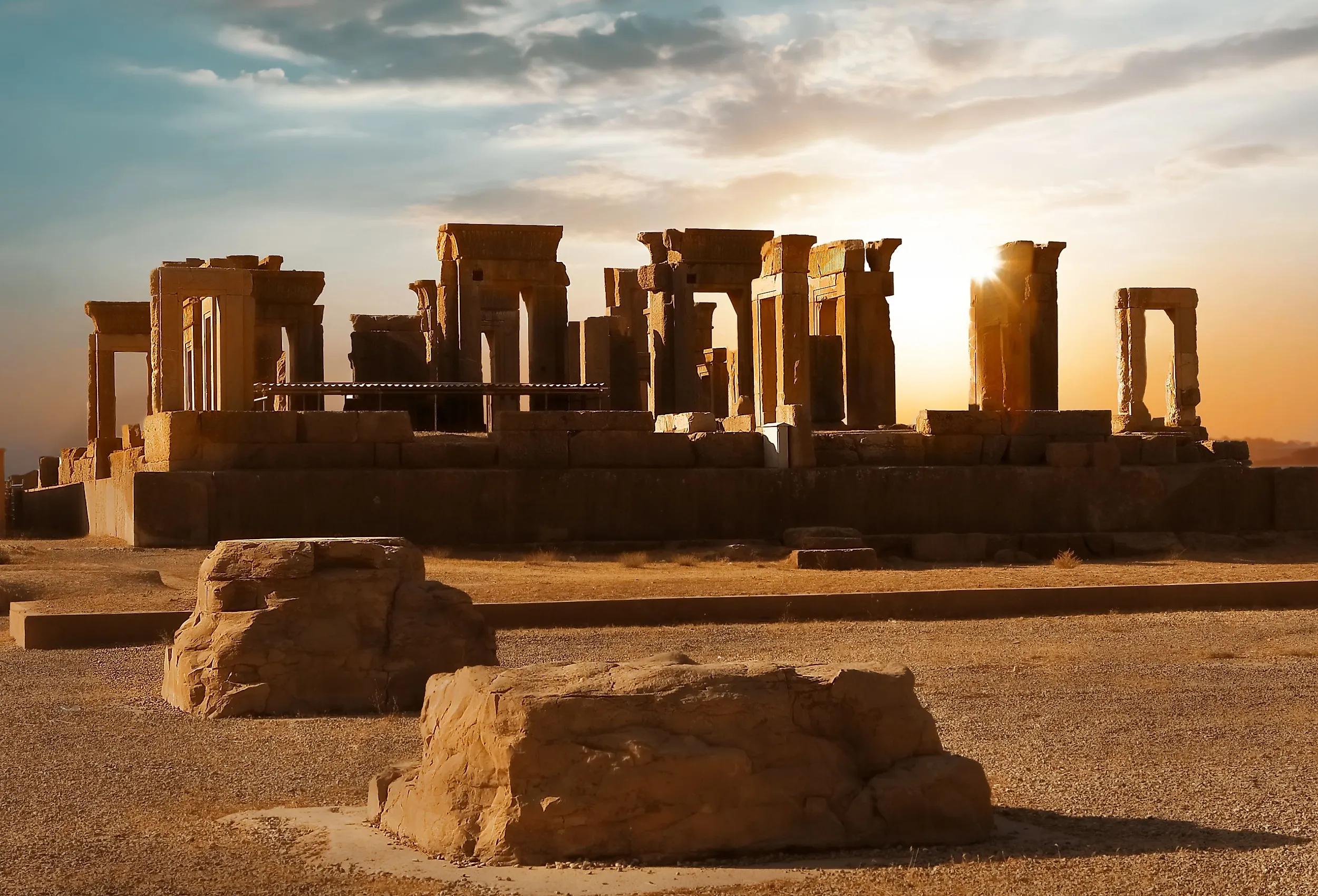
Iran closes the top ten with 28 sites. The country was once home to the Achaemenid Empire (better known as the Persian Empire), one of the largest empires of the ancient world, and held a major section of the Silk Road. Iran inscribed three of its earliest sites at the 1979 UNESCO session: Persepolis (the ceremonial capital of the Achaemenid Empire), Tchogha Zanbil (a 13th-century BCE ziggurat of the Elamite kingdom), and Meidan Emam in Esfahan (a 17th-century plaza surrounded by Shah Abbas I’s mosques). Iran’s two natural sites are no less remarkable: the Hyrcanian Forests, a 25-to-50-million-year-old temperate forest band running along the southern Caspian, and the Lut Desert (Dasht-e Lut), one of the hottest places on Earth, with land surface temperatures recorded above 70°C.
Time for an Adventure
UNESCO World Heritage Sites draw attention to the planet’s best cultural and natural legacies and add legal protections to keep them around for future visitors. Each of the 1,200-plus properties offers a window into the past, a piece of the planet’s geological story, or a habitat critical to some of the world’s rarest species. The ten countries above are the places to start if you want to see as many of those windows as possible.