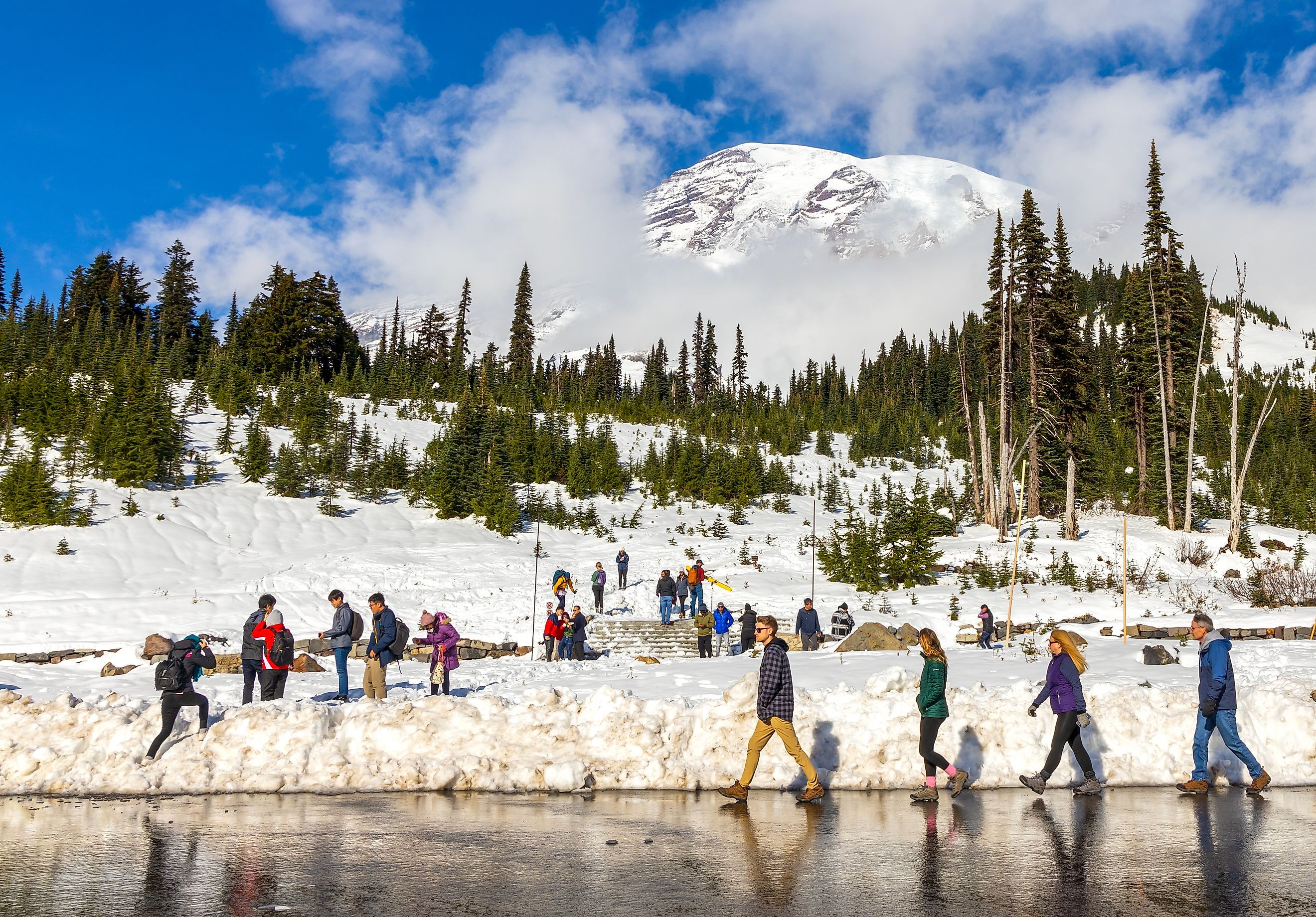
The Snowiest National Park In America
More snow falls on Mount Rainier than on any other national park in the country. In the Paradise area, on the mountain's south slope, the official weather station logs an average of about 639 inches a year, or roughly 53 feet. That is more than any populated measuring site in the Lower 48, and in the record winter of 1971 to 1972 the total reached 1,122 inches. The 14,410-foot volcano is the tallest peak in the Cascade Range, and its snowpack is the source of much of what lies below it, including the alpine meadows at Paradise and the waterfalls farther down. The sections that follow explain why so much snow lands here and what happens to it.
Why Mount Rainier Receives So Much Snow

Geography and weather combine to bury the mountain each winter. Rainier stands roughly 65 miles inland from Puget Sound, close enough to the Pacific that winter storms still arrive carrying heavy loads of moisture when they reach the Cascade Range. Those storm systems then run straight into the tall wall of peaks across western Washington.

A process called orographic lift takes over from there. Warm, moisture-filled air rises over the mountains and cools quickly as it climbs. The moisture condenses into cloud and then falls as rain lower down or snow at higher elevations. Because Rainier reaches so high, an exceptional amount of precipitation falls out of each passing system, and high-altitude winds keep driving Pacific storms into the region, so snow accumulates on the upper slopes all winter.
The Park's Most Famous Destination

Paradise, at 5,400 feet on the southern slope, is the most visited spot in the park. From the overlooks there, you can see the surrounding glaciers, the subalpine meadows, and the neighboring peaks. Through the warmer months the snow melts back to uncover the wildflowers, and the lupine, paintbrush, and avalanche lilies turn the slopes into a run of color.
The historic Paradise Inn, built in 1916 from Alaska yellow cedar, dates to the early era of national park tourism. In winter, visitors use it as a base for snowshoeing, cross-country skiing, and photography. Because the snowpack is so deep, patches often linger into spring and even early summer, and people keep skiing and hiking at Paradise long after lower ground has thawed.
Exploring the Historic Longmire District

Forest and history replace mountain vistas at Longmire, 6.5 miles east of the Nisqually Entrance at an elevation of 2,761 feet. James Longmire built his homestead here in the 1880s, and after the park was established in 1899 the site became its first headquarters. Several structures survive from the rustic park architecture of the 1920s. The original 1916 headquarters building now houses the Longmire Museum, with exhibits on the park's early history. Across the road, the Trail of the Shadows loops past the mineral springs, a reconstructed log cabin, and remnants of that first settlement.
A Higher Perspective at Sunrise

At about 6,400 feet, Sunrise is the highest point in the park a car can reach, and the mountain scenery from there is hard to beat. The overlooks open onto the glaciers and deep valleys along the horizon on clear days.

The elevation makes Sunrise a popular trailhead for routes that range from short nature walks to demanding backcountry treks. In summer the meadows fill with wildflowers, and mountain goats turn up regularly on the rocky slopes above. Deep snowfall keeps the Sunrise Road closed most of the year, so it usually opens only for the summer months before winter shuts it again.
The Link Between Snow And Waterfalls

Rainier's snow does not simply vanish when the weather warms. Meltwater from the deep snowpack runs off into the park's streams and rivers, which feed a string of waterfalls. One of the most photographed is Narada Falls, where the Paradise River drops 168 feet down a near-vertical andesite face in the main tier of a two-step, 188-foot descent. A short paved trail runs down to viewpoints below the falls.

Nearby, a stone-faced arch bridge built in the late 1920s frames Christine Falls, with the water dropping beneath the span and on through the forest below. Roadside access is easy, which makes it one of the park's most popular photo stops.
Come For The Snow, Stay For The Blooms
The snow at Rainier does far more than set a winter scene. With an annual average above 50 feet at Paradise, the snowpack melts through spring and summer, and the runoff supplies the rivers, waterfalls, alpine meadows, and the ecosystems below them across the park. That same snow determines when the roads open, how long the hiking season lasts, and what winter recreation is possible, so no two visits look quite the same depending on the month. That yearly cycle is the reason Rainier stands as the snowiest national park in America.