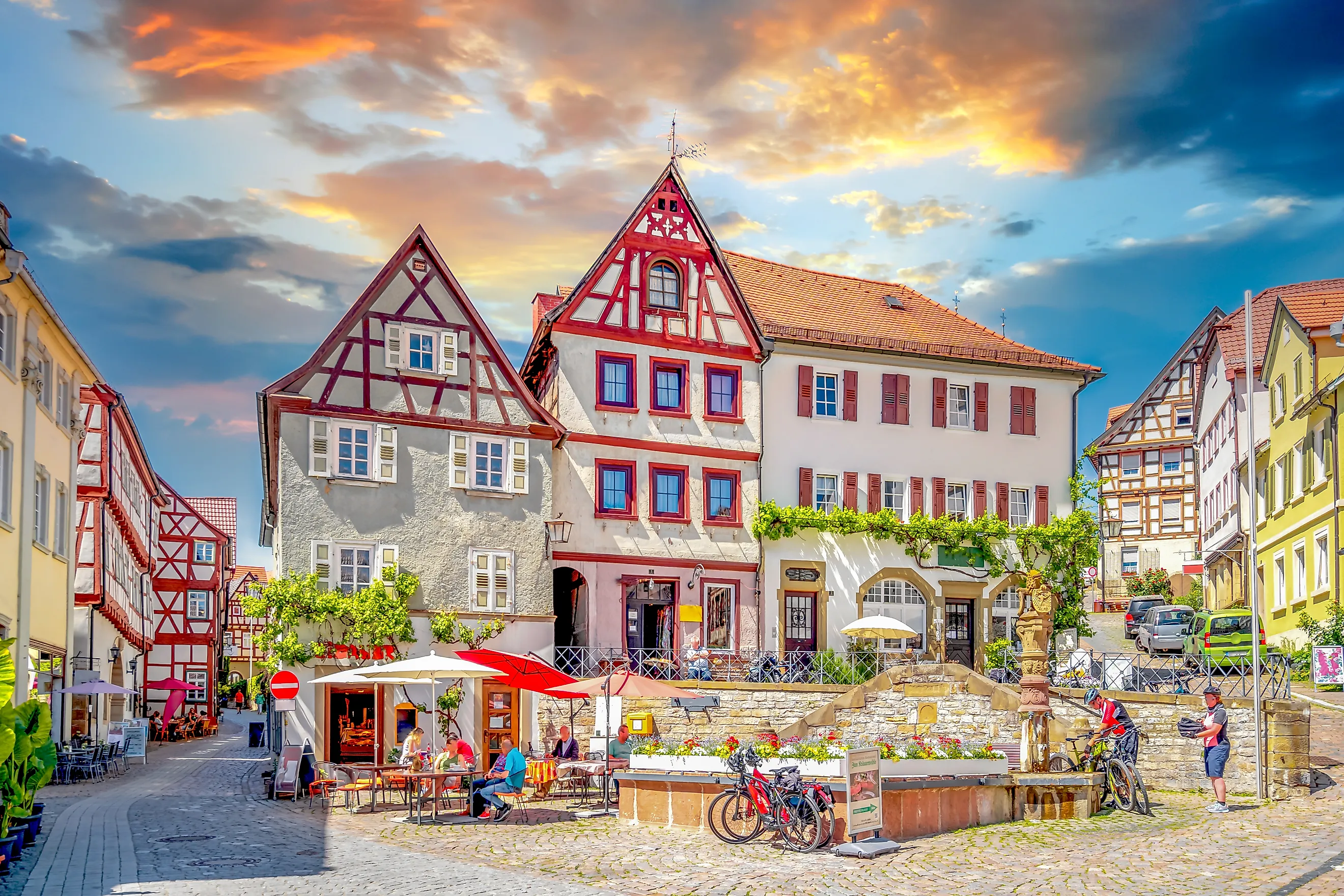
These Towns In Germany Have The Best Main Streets
Seven German towns where the historic main street is the actual draw, not a decorative detail. Quedlinburg has the largest concentration of standing timber-framed houses in Germany. Rothenburg ob der Tauber still runs its full 3.4-kilometer medieval town wall. Bad Wimpfen holds the largest preserved Hohenstaufen-era imperial palace in the country. Wittenberg's Collegienstrasse runs the actual physical path Martin Luther walked between his house and the church door where he posted the 95 Theses on October 31, 1517. Each main street works as a half-day or full-day walk on its own.
Quedlinburg

Quedlinburg sits at the northern foothills of the Harz Mountains in Saxony-Anhalt and holds the largest contiguous concentration of half-timbered (Fachwerk) houses in Germany. Around 1,300 timber-framed buildings stand in the UNESCO-inscribed core, spanning roughly eight centuries of construction. UNESCO added the old town, castle hill, and collegiate church to the World Heritage List in 1994.
The main commercial streets (Marktstraße, Steinweg, and Breite Straße) thread through the timber-framed core. The Schlossberg (Castle Hill) rises in the middle of town with the 12th-century Romanesque Collegiate Church of St. Servatii (Stiftskirche St. Servatii) at the summit. Queen Mathilde, widow of King Henry I, and her son Emperor Otto I founded the women's collegiate convent here in 936 CE after Henry's death (Henry held his royal palace at Quedlinburg, which gave the convent its founding endowment). The current church is the third building on the site. The treasury holds significant medieval reliquaries and manuscripts.
Cochem

Cochem sits on a bend of the Moselle River in Rhineland-Palatinate with Reichsburg Cochem on the cliff above town. The castle (also called Cochem Castle, just two names for the same structure) was first documented around 1000 CE, destroyed by French forces in 1689 during the Nine Years' War, and rebuilt in dramatic neo-Gothic style between 1868 and 1877 by Berlin merchant Louis Ravené, who bought the ruins for 300 gold marks. The reconstructed silhouette on the hill is largely Ravené's 19th-century romantic vision, not the original medieval castle.
The main street runs from the Marktplatz, where the late-19th-century town hall and the Baroque Church of Saint Martin face the central square, down to the Moselle Promenade along the river. Steep terraced vineyards rise on both banks (the Moselle valley is one of the oldest wine regions in Germany, with Riesling as the dominant grape). Local wine taverns line the river side of the old town and pour the regional vintages glass by glass.
Rothenburg ob der Tauber

Rothenburg ob der Tauber sits on a plateau above the Tauber River in Franconia and still keeps its full medieval town wall: 3.4 kilometers of complete fortifications, including 42 towers and gates. Visitors can walk a roofed wall-walk most of the way around. The town stopped growing economically after the Thirty Years' War (1618-1648), which left it impoverished but preserved its 16th-century streetscape almost unchanged into the 19th and 20th centuries.
The Marktplatz at the center holds the Rathaus (town hall), with its 60-meter Gothic tower open for climbing (220 steps to a view of the entire walled town and the surrounding countryside). The Plönlein (the small forked-street view with the Siebersturm and Kobolzeller Tor in frame) is one of the most-photographed corners in Germany. The Medieval Crime and Justice Museum (Mittelalterliches Kriminalmuseum) on Burggasse holds one of Europe's largest collections of medieval legal artifacts. Käthe Wohlfahrt's year-round Christmas village on Herrngasse runs out of a 16th-century townhouse.
Bad Wimpfen

The Hohenstaufen emperors built their largest German imperial palace (Kaiserpfalz) at Bad Wimpfen between roughly 1180 and 1230, and substantial portions still stand on the high ground above the Neckar River. The Blauer Turm (Blue Tower, climbable, 58 meters tall), the Roter Turm (Red Tower), the Steinhaus, and the Pfalzkapelle palace chapel arcade are the major surviving Hohenstaufen elements. No other German town has preserved this much of a 12th-13th-century imperial residence.
The main street (Hauptstraße) runs through the upper old town past the timbered Late Gothic and Renaissance houses that filled in around the imperial palace after the Hohenstaufens left. The Stadtkirche (Town Church) on Marktplatz dates to the 13th century. The town's later spa history (it gained the "Bad" prefix in 1930 after the discovery of saltwater springs) feeds the present-day Kurpark and the local saltwater bath. The Birkensee park and the riverbank promenade run the lower town along the Neckar.
Bacharach

Bacharach sits on the left bank of the Rhine in the Upper Middle Rhine Valley, the 65-kilometer Rhine gorge stretch between Bingen and Koblenz that UNESCO inscribed as a World Heritage cultural landscape in 2002. The town's main street, Oberstraße, runs parallel to the river through a row of timber-framed merchant houses, the most photographed of which is the Altes Haus from 1368.
Stahleck Castle (Burg Stahleck) sits on the hill directly behind town and has operated as a Deutsche Jugendherbergswerk youth hostel since 1925. The ruined Wernerkapelle, a late-13th and 14th-century Gothic chapel on the slope above the old town, was built as a pilgrimage site associated with the 1287 antisemitic blood-libel killings of Jewish residents in the region; the Vatican removed the associated cult from the Roman Catholic calendar in 1963. The town walls and the Postenturm tower remain accessible. The Rhine Gorge passenger trail (Rheinsteig) runs above town with viewpoints over the river bend.
Lindau

Lindau's old town sits on a small island in the eastern end of Lake Constance (Bodensee), connected to the Bavarian mainland by a 19th-century railway causeway and a road bridge. The island measures about 950 meters long by 350 meters wide. The harbor at the south end frames the 33-meter Neuer Leuchtturm (New Lighthouse, built 1856, climbable with 139 steps to the top) and the Bavarian Lion statue marking the entrance from the lake.
Maximilianstraße, the island's main shopping street, runs from the harbor through pastel-painted merchant houses. The Altes Rathaus (Old Town Hall) on Reichsplatz dates to 1422 and holds painted facade reliefs telling the town's history. Lake Constance itself sits at the junction of Germany, Austria, and Switzerland; on a clear day the Austrian Alps are visible across the water from the harbor promenade. Passenger ferries to Bregenz (Austria) and the Swiss shore towns depart from the harbor multiple times daily.
Wittenberg

Martin Luther posted the 95 Theses on the door of the Schlosskirche (Castle Church) in Wittenberg on October 31, 1517. The act, whether or not Luther physically nailed the document (historians dispute the specifics), launched the Protestant Reformation from this town. UNESCO inscribed Wittenberg's Luther sites as a World Heritage Site in 1996, and the town now officially carries the name Lutherstadt Wittenberg.
The Collegienstraße main street runs the route Luther walked daily between his home (the Lutherhaus, a former Augustinian monastery and now the largest Reformation museum in the world) and the Schlosskirche at the western end of town. The late-Gothic Schlosskirche (built 1490-1509) was reconstructed in the 19th century after Napoleonic-era damage; the current bronze door carries the text of the 95 Theses. The Stadtkirche (Town Church) on the central marketplace is where Luther preached most of his sermons. The Cranach houses (home and workshop of painter Lucas Cranach the Elder, who lived in Wittenberg and produced the major Reformation-era portraits of Luther) sit on the same street. The Middle Elbe Biosphere Reserve (a UNESCO biosphere reserve under the Man and Biosphere Programme, distinct from World Heritage Sites) runs along the Elbe River south of town and holds a recovering population of European beavers.
What Anchors the Seven
Each town's main street runs on a specific historical anchor that has held the street layout in place for centuries. Quedlinburg has the 1,300 timber-framed houses and the 936 CE convent founding. Cochem has the 1689 destruction and 1868-1877 neo-Gothic Ravené rebuild. Rothenburg has the complete 3.4-kilometer medieval wall preserved by post-war economic stagnation. Bad Wimpfen has the largest preserved Hohenstaufen imperial palace in Germany. Bacharach has the 1368 Altes Haus and the position inside the Upper Middle Rhine Valley UNESCO landscape. Lindau has the island geography at the meeting point of three countries. Wittenberg has the route Luther walked between the Lutherhaus and the Schlosskirche on October 31, 1517.