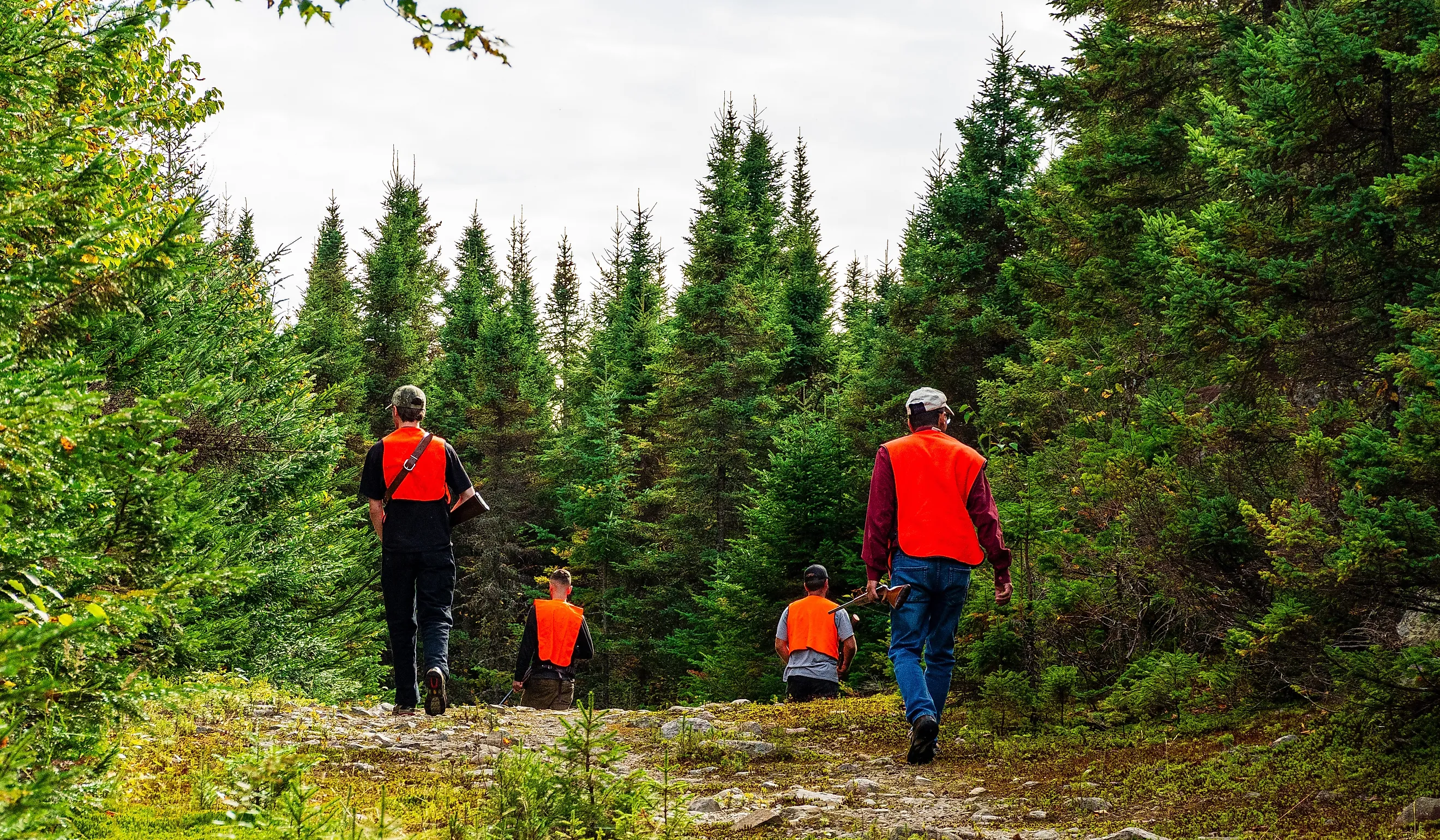
The State Parks Where You Share The Trail With Hunters
Many visitors assume that a state park open to hiking is closed to hunting, but across much of the East and Midwest, that is not the case. New York allows deer hunting in 65 state parks and historic sites, and a Wisconsin state law that took effect in 2013 opened nearly every Wisconsin state park to hunting and trapping. In some of the busiest state parks, hunters and hikers use the same woods on the same days.
Deer are the usual reason state parks open to hunters. Park managers in New York point to decades of over-browsing that left forests severely degraded, and Minnesota's Department of Natural Resources says too many deer in one place harm native plants and animals. However, how each park handles it varies widely. One allows hunting only on weekdays. Another opens for hunters eight days a year. A third draws the line at a county border. The eight parks here show that range, and each section explains when and where hunters are out and what it means for anyone on the trail.
Harriman State Park, New York

For most of its history, the core of Harriman State Park was closed to hunters. That changed on November 3, 2025, when New York State Parks and the Palisades Interstate Park Commission opened a weekday deer hunt in an effort to restore forests damaged by over-browsing. A 2018 study by SUNY Environmental Science and Forestry and the U.S. Geological Survey found that nearby forests where deer are hunted had substantially recovered. Harriman's had not, and the two agencies eventually took action.
Harriman is the second-largest park in New York's state park system. In 2026, about 20,000 acres at the northern end of the park are open on weekdays from November 2 to December 16 and December 26 to 31. Visitors enjoy weekends, Veterans Day, and Thanksgiving hunt-free. The park issues 500 lottery permits for bows, crossbows, shotguns, and muzzleloaders. Rifles and handguns are banned. Hunters must abide by the park's hunting rules, which treat trails as safety zones: hunters may walk them to reach their zone but cannot shoot on or across the trails. Hunting is also barred within 500 feet of shelters, buildings, and parking lots.
The rest of the park, including about 28,000 acres and 118 miles of marked trails, stays closed to hunting. In the program's first season, the hunt zones also took in the stretch of the Appalachian Trail between Interstate 87 and the Palisades Interstate Parkway.
Ricketts Glen State Park, Pennsylvania

Ricketts Glen State Park is best known for one route: the Falls Trail through the Glens Natural Area, a National Natural Landmark where 21 of the park's 22 named waterfalls line the path. Ganoga Falls, the tallest, drops 94 feet.
Few visitors realize how much of the surrounding park belongs to hunters in season. Of the park's 13,193 acres, about 10,287 are open to hunting, trapping, and dog training during established seasons. Deer, turkey, grouse, bear, and coyote are common game, and another 83,000 acres of state game lands border the park to the west and north. The state's own hunting page for the park puts it plainly: other visitors use the park during hunting seasons. In season, firearms may be uncased only in authorized hunting areas.
Pennsylvania's calendar has also shifted to accommodate hunters. Act 36 of 2025 repealed the state's long-standing ban on Sunday hunting and gave the Pennsylvania Game Commission the power to decide which Sundays to open. In the 2025-26 season, state parks allowed Sunday hunting on three November dates. For hikers who once treated Sunday as the safest day to walk in deer season, that may no longer hold.
High Point State Park, New Jersey

High Point State Park boasts the highest elevation in New Jersey. The lofty locale is crowned by the High Point Monument, built to honor the state's war veterans. Anthony and Susie Dryden Kuser gave the land, and it was dedicated as a park in 1923. Today, its main hunt window is one of the shortest on this list: eight days.
Each November, hunters with a special Zone 67 permit may hunt deer with muzzleloaders only in designated areas of the park. In 2026, the hunt runs November 2 to 5 and November 9 to 12. The rules favor thinning the herd. A hunter's first deer must be antlerless, and any buck taken must carry at least three points on one antler. The park also allows winter bow hunting in a designated area.
During the 2025 hunt, the park stayed open to everyone else, but its overnight facilities closed for the duration. Hunters were not allowed in the park before 6 a.m. or after 6 p.m., and hunting was not allowed along the shoreline of Lake Rutherford, or at Lake Marcia and the surrounding day-use area roads.
New Jersey law forbids shooting or trapping birds at any time on the grounds of High Point State Park and the New Jersey Veterans Memorial, with an exception only for vermin removed by authorized state staff.
Grayson Highlands State Park, Virginia

Visitors often come to Grayson Highlands State Park for a glimpse of its wild ponies, and they generally start at the same spot: the Massie Gap parking area. This is where the short Rhododendron Trail connects to the Appalachian Trail and the open high country where the ponies graze. About 100 wild ponies live in the park and the neighboring Mount Rogers National Recreation Area, close to Mount Rogers, the highest peak in Virginia and in this part of the Appalachian Mountains.
Massie Gap is also one of two access points for the park's open hunting area. Virginia State Parks allow open hunting in designated areas of just four parks. At Grayson Highlands, that area covers 1,117 acres in the northern section of the park, next to the national recreation area. Hunters reach it from Massie Gap and the Seed Orchard Trail. All Virginia Department of Wildlife Resources regulations apply, and hunting with off-leash dogs is not allowed. The park also runs reservation-only managed deer hunts.
Statewide park rules prohibit hunting within 100 yards of park buildings and roads, and state law requires hunters to wear at least a blaze orange or blaze pink cap or vest. For hikers, the practical point is simple: be aware that the trailhead for the park's best-known walk also serves as a hunter access point.
Devil's Lake State Park, Wisconsin

Devil's Lake State Park is Wisconsin's most-visited state park, with more than 2.5 million visitors a year. It is also open to hunters for several weeks each fall and spring.
Back in 2012, Wisconsin Act 168, the Sporting Heritage Act, opened nearly all of the state's parks to hunting and trapping beginning in 2013. Before the law, state parks were closed to hunting unless the Department of Natural Resources wrote a rule for a specific park, and Devil's Lake was one of the parks that already had a hunting zone. The change was controversial. The prospect of months of hunting at parks such as Devil's Lake drew hundreds of upset residents to public hearings, and the Natural Resources Board narrowed the open-hunt dates.
Today, gun and archery hunting and trapping are allowed in designated areas of most state parks from November 15 to December 15, with archery continuing through the Sunday nearest January 6. A spring window runs from April 1 through the Tuesday nearest May 3. Each park publishes a hunting map showing which areas are open.
The park stays open to all visitors during these periods, and local guides urge hikers to wear blaze orange. A separate state Ice Age Trail parcel that shares the Devil's Lake name is closed to hunting and trapping entirely.
Porcupine Mountains Wilderness State Park, Michigan

Lake Superior is the backdrop of Porcupine Mountains Wilderness State Park, known as the Porkies, which covers about 60,000 acres of old-growth forest, waterfalls, rivers, and ridges. It is Michigan's largest state park, and 47,671 acres of it are a legally dedicated wilderness area.
The park's wilderness designation rules out motorized vehicles, new roads, and logging, but not hunting. Michigan's Department of Natural Resources lists hunting as allowed in the park and asks hunters to check with the park office about special rules. Hunters comb the same backcountry as hikers and backpackers.
State law limits where they can shoot. No one in Michigan may hunt with a firearm within 450 feet of an occupied structure without permission. The Porkies rents rustic cabins and yurts across its backcountry, and the state's list of covered structures specifically includes cabins. Michigan hunters must also wear hunter orange during firearm deer season, and savvy hikers do the same. Wonder where the hunters will be? Check with the park office or the Porcupine Mountains Wilderness Visitor Center before setting out.
Itasca State Park, Minnesota

Minnesota's oldest state park is Itasca State Park, established in 1891 to protect the forest and waters around the headwaters of the Mississippi River. The argument over whether deer hunters belong there goes back decades. A University of Minnesota report dating back to 1956 examined whether the park should be opened or closed to deer hunting.
Today, Itasca holds managed deer hunts that the Minnesota DNR classifies as "limited." That means the park stays open to visitors and hunters at the same time, or divides into areas for each. In 2026, the firearms hunt runs November 7 to 15, and the muzzleloader hunt runs November 28 to December 13. Since 2021, muzzleloader hunters have needed a special permit, a change the park's resource specialist said was meant to reduce problems between hunters and other park users.
The DNR's stated reason for the hunts is ecological. Too many deer in one area, it says, harm the park's native plants and animals.
The headwaters themselves sit about 800 feet from the parking lot at the Mary Gibbs Mississippi Headwaters Center, and the park still draws visitors in November. The DNR's advice for anyone in a park during a hunt is to wear blaze orange or other bright clothing, check in at the park office, and follow hunt-related signs.
Golden Gate Canyon State Park, Colorado

At Golden Gate Canyon State Park, a county line decides where hunters go. The park, about an hour from Denver, sits in both Jefferson and Gilpin counties, and hunting is allowed only on the Jefferson County side. On the Gilpin County side, it is never permitted.
On the Jefferson County portion, big and small game hunting runs from the Tuesday after Labor Day through the Friday before Memorial Day, covering most of the year. However, hunters must reserve a day up to 14 days in advance, with a cap of 20 hunters per day, and register at the Golden Gate Canyon Visitor Center.
The park's Green Ranch section works differently. Colorado acquired the roughly 3,500-acre property in 1995, and since 1997, its only allowed public use has been a limited elk hunt held from September through November. Up to 10 hunters a season are drawn by lottery, and each must attend an orientation.
The rest of the park's more than 12,000 acres in the Rocky Mountains foothills stays open to hikers during hunting season. The park has 35 miles of trails, and Panorama Point offers a 100-mile view of the Continental Divide. September and October rank among the park's busiest months. Colorado Parks and Wildlife asks hikers to wear bright fluorescent clothing, keep dogs leashed, and make noise on the trail. It also reminds everyone that intentionally interfering with hunters is illegal.