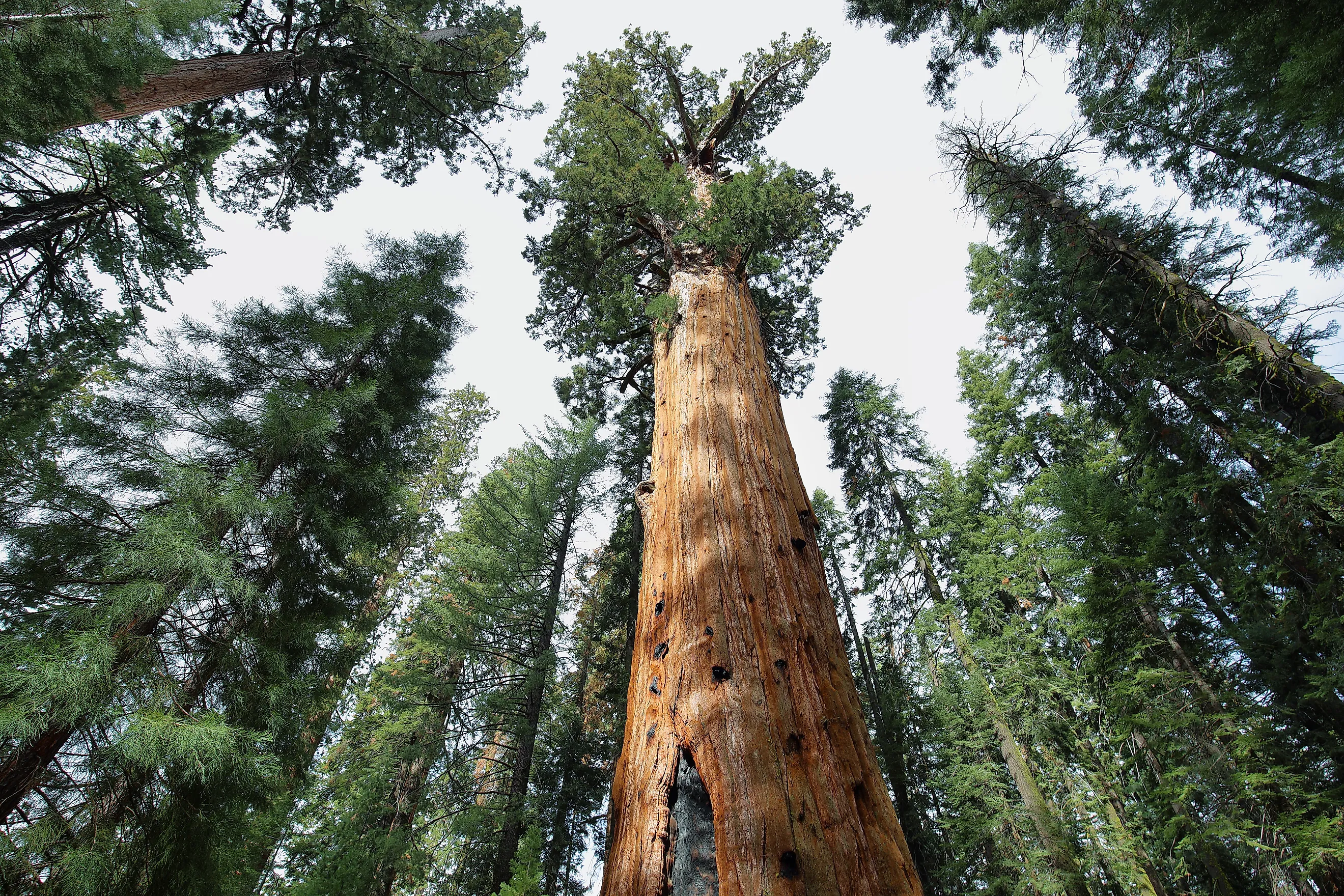
The Largest Tree By Volume On Earth
A single giant sequoia can hold more wood than entire acres of forest in the Pacific Northwest. This fast-growing and fire-resistant evergreen conifer has an enormous trunk that never stops growing.
Due to their exceptional longevity, these Sierra Nevada natives also have the potential to grow for millennia. The largest giant sequoia in the world is thought to be about 2,200 years old and is still growing as of 2026. While taller and wider species exist, the giant sequoia tree is unmatched in volume.
The World's Largest Tree

General Sherman is the world's largest tree by volume. The 274.9-foot giant sequoia was officially recognized as the world's largest living single-stem tree in 1931.
Today it grows inside Sequoia National Park in California. According to modern measurements, it has a ground circumference of nearly 103 feet and a 14-foot diameter 180 feet above its base.
According to Sequoia & Kings Canyon National Parks, General Sherman's estimated trunk volume is a whopping 52,500 cubic feet.
For context, this tree alone has enough lumber to build about 120 average-sized homes. If scientists were to weigh its trunk, it would register at roughly 1,400 tons, about the equivalent of 15 adult blue whales.
How Giant Sequoias Are Measured

The giant sequoia is neither the tallest nor the widest tree species on Earth. Instead, they earn the title of world's largest trees because of their massive trunk volume. Foresters and ecologists calculate this by measuring the trunk's diameter and height.
Diameter
Forest ecologists use a specialized tape measure to find a giant sequoia's diameter. A small hook anchors one end of the tape measure to the tree's bark, preventing slippage and increasing accuracy. The numbers on this tape measure are also calibrated to directly measure diameter instead of circumference.

Most trees are measured using diameter-at-breast height (DBH). In the United States, DBH is 4.5 feet above ground level. Using this standardized measurement helps avoid the tree's base swell and ensure consistency between data.
Giant sequoias are frequently measured using DBH, though California State Parks adjusts this to six feet to account for the giant sequoia's larger-than-average flared base.
Height
Giant sequoias are not the tallest tree in the world, but these evergreen conifers will still make you crane your neck. Many grow between 250 and 300 feet high, and the tallest recorded giant sequoia measured 314 feet. To put this into perspective, a standard American football field is roughly 300 feet long.

In the past, it was common for forest ecologists to measure a giant sequoia by climbing it. Once at the top, they would drop a weighted measuring tape. Because of potential tree damage and the logistical difficulty of climbing trees this tall, most modern height measurements for giant sequoias are done using laser-based methods and technologies.
How Are Giant Sequoias So Big?

Extreme Lifespan
Giant sequoias are the third longest-lived tree species in the world, and their exceptional lifespan means these trees have plenty of time to grow. Many live for over 2,000 years, and the oldest known giant sequoia is roughly 3,200 years old.

This ancient sequoia, also known as the President Tree, grows in Sequoia National Park and is still growing as of 2026. Unlike many tree species that grow slowly in maturity, the giant sequoia accelerates its wood production even in old age.
Rapid Growth
Rapid growth is another reason giant sequoias are so large. In its first 50 to 150 years, the tree will grow roughly two feet in height annually. However, the truly remarkable increase is tied to its trunk volume. Under optimal growing conditions, a young giant sequoia can gain a 1-inch diameter every year. This rate exceeds other trees and can continue or even increase when its trunk reaches or surpasses a 100-foot circumference.
Continuous Volume

In theory, giant sequoias could live and grow forever. Unlike humans or animals, the tree lacks a programmed biological death known as senescence. They do not technically "die" of old age the way that we do, and therefore have the capacity to live and expand indefinitely.
That being said, they are not immune to external forces. The longer a giant sequoia lives, the more likely it is to experience damage from its environment, including storms, erosion, and fire.
Fire Resistance

Many giant sequoias achieve massive size because they are equipped to withstand external forces like fire. The species is naturally fire-adapted and can survive low-to-moderate wildfires. The bark of a giant sequoia is fibrous and spongy, growing up to two feet thick.
Additionally, the bark has low flammability. Without the sticky resins many other trees produce, this dry protective layer generally chars instead of bursting into larger flames. Moreover, the species is self-pruning. By dropping its lower branches as it grows, the giant sequoia reduces the risk of fire using its limbs as a ladder.
Massive Root Systems

Like all trees, the giant sequoia relies on its roots for growth and stability. However, the majority of sequoia roots are threadlike and shallow, running only 4 to 5 feet deep. This presents a surprising contrast to their colossal trunks and begs the question: how are these delicate roots supporting the largest trees in the world?
The giant sequoia develops extensive rootage early in its growth cycle to absorb moisture during dry seasons. The larger a giant sequoia grows, the wider its roots reach, eventually stretching 100 to 200 feet from its base and interlocking with other trees. This widespread, woven base provides the structural stability giant sequoias need to support their massive size and weight. It also helps them withstand extreme winds.
True To Its Name
Rapid growth and exceptional longevity help giant sequoias reach their record-breaking size. With growth only halted by external forces, the tree's natural makeup is also designed to keep it alive. Fire-resistant bark and self-pruning branches help preserve giant sequoias from wildfires.
Underground, an enormous root system stabilizes the tree and helps it survive lengthy droughts. Each of these characteristics is integral to the giant sequoia's identity, but as a whole, this species is defined by its titanic trunks.