The US Waters Where Flesh-Eating Bacteria Have Been Found
Roughly 150 to 200 Americans a year are diagnosed with Vibrio vulnificus, the bacterium behind almost every "flesh-eating bacteria" headline you have seen. Set against hundreds of millions of trips to the coast, that is a vanishingly small number, and most healthy people with unbroken skin are not the ones getting sick. The reason it gets attention anyway is the outcome: CDC surveillance recorded 727 cases over five years, 87 percent of patients were hospitalized, and about one in five died, sometimes within a day or two. The other reason is that the map has moved. A study in Scientific Reports tracked the northern edge of these infections climbing the Atlantic coast at about 30 miles a year, and cases now turn up in water that was too cold for the bacterium a generation ago.
Here is where it has actually been found, what the numbers look like in 2026, and who is genuinely at risk.
First, What It Is And What It Is Not
Vibrio vulnificus does not eat flesh. It produces toxins that can trigger necrotizing fasciitis, a rapid destruction of skin and the soft tissue underneath. The distinction matters because it explains who gets hurt and how fast.
Three other things worth having straight. It is not contagious and does not pass between people. It is a bacterium, not a virus, which means antibiotics work and early treatment changes outcomes dramatically. And it occurs naturally in warm brackish and coastal salt water, so it is not a contamination event or an outbreak in the usual sense. It lives there.
There are two routes in: an open wound exposed to seawater, or eating raw or undercooked shellfish, oysters in particular. Infections cluster between May and October when water is warmest.
The Louisiana Coast

Louisiana is having the worst year of any state relative to its own baseline. As of August 2026, the state health department had confirmed nine cases and five deaths. Over the previous decade Louisiana averaged about seven cases and one death per year.
The detail that matters most is in the case histories. All nine patients were hospitalized, all nine were infected through wounds exposed to seawater rather than through food, and all nine had underlying health conditions. That is not incidental. It is the pattern the entire disease follows.
Louisiana had already recorded 26 cases and five deaths in 2025, well above its own average.
Florida's Gulf And Atlantic Coasts

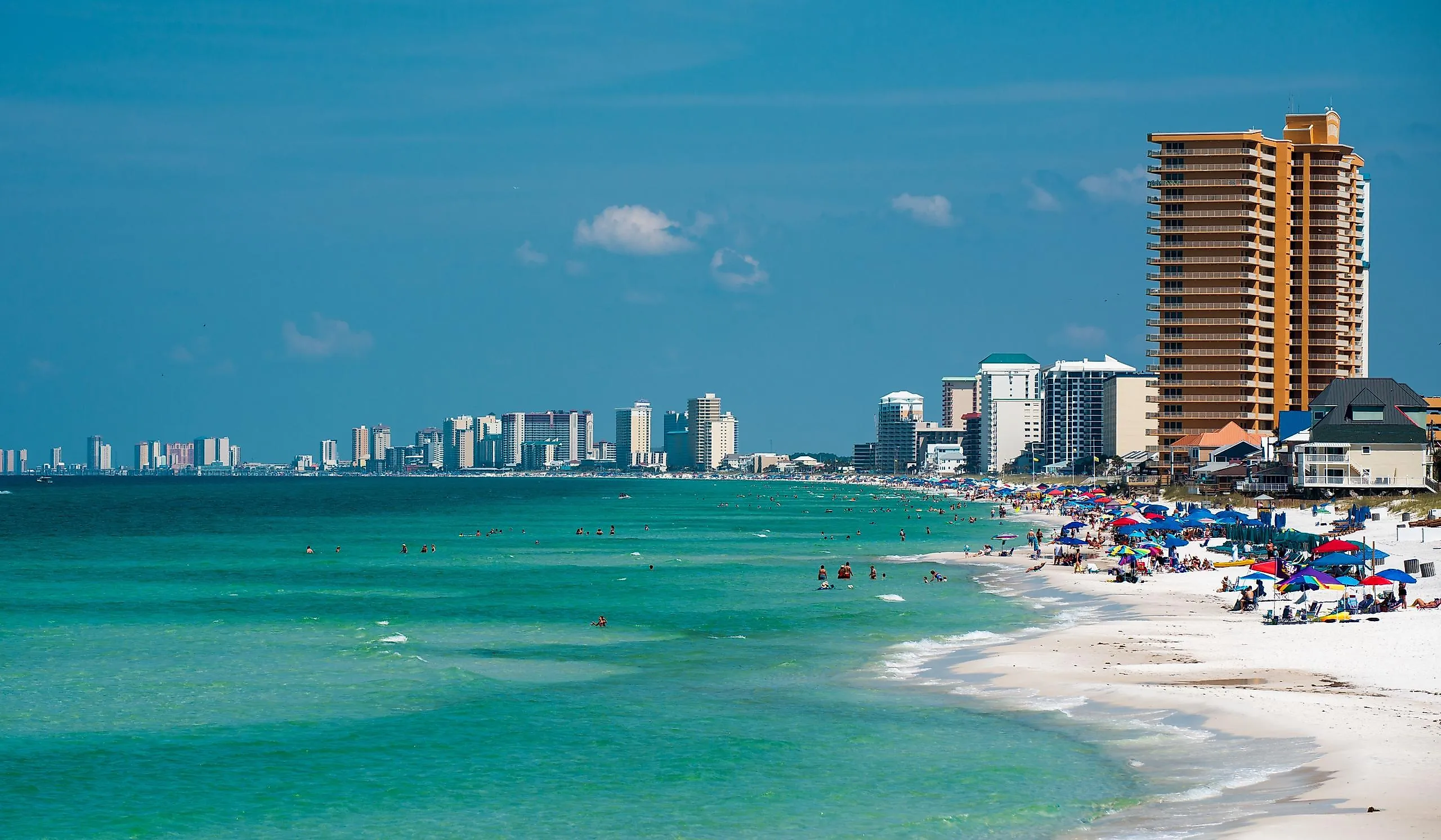
Florida reports more V. vulnificus than any other state and has the longest run of published data. Since 2016 it has recorded 448 cases and 100 deaths.
The year-to-year swing is the story. In 2024 Florida logged 82 cases and 19 deaths, its worst on record, which state health officials tied directly to Hurricane Helene and the floodwater it pushed inland. In 2025 the total fell back to 33 cases and five deaths. By mid-August 2026 the state had 14 cases and two deaths, spread across Bay, Hillsborough, Lee, Marion, Miami-Dade, Okaloosa, Palm Beach, Polk and St. Johns counties.
Storms are the multiplier. Hurricanes push warm brackish water into places people wade through afterward, often with cuts they got during cleanup.
Alabama, Mississippi And The Texas Coast

The rest of the Gulf reports smaller numbers but the same conditions. Mississippi's health department listed seven Vibrio infections statewide in 2026 as of July, one of them V. vulnificus, with no deaths. Mobile County in Alabama announced its first vibriosis case of the year in April.
Texas has long been part of the historic range, and the researchers tracking the northward expansion have been explicit that this is not a migration. Cases are still occurring in Texas. The range is getting bigger at the top, not sliding.
The Carolinas

North Carolina is where the older southern range and the newer northern edge overlap, and it produced some of the clearest recent evidence.
During the July and August heat waves of 2023, the CDC documented severe V. vulnificus infections across three eastern states. North Carolina accounted for three waterborne wound cases plus two more in people cut while handling raw seafood. Across the group of patients, four went into septic shock and five died. Every patient who died had at least one underlying condition.
Chesapeake And Delaware Bays

Warm, shallow and brackish is the exact profile this bacterium prefers, and the Chesapeake is the largest estuary in the country. Maryland and Virginia both record cases in most years.
The Delaware estuary marks the current northern boundary of the established range. The Scientific Reports team put the present-day upper limit at roughly the latitude of Philadelphia, around 40 degrees north. In the late 1980s, cases north of Georgia were rare.
Long Island Sound And Southern New England

New Haven Lighthouse, built in 1847, at the Lighthouse Point Park of the Eastern Beachfront of New Haven Harbor in Connecticut, United States
This is the part that is genuinely new. In summer 2023, New York and Connecticut each reported V. vulnificus infections tied to coastal water exposure, alongside North Carolina, during a stretch of unusual heat. Connecticut reported another V. vulnificus case in February 2026, that one linked to oysters harvested elsewhere.
These are small numbers. They are also occurring in water that, thirty years ago, essentially did not support this organism during the swimming season.
Why The Map Keeps Moving North

The best evidence is the 2023 Scientific Reports paper by Elizabeth Archer and colleagues, built on 30 years of CDC surveillance data covering the Gulf and Atlantic coasts.
Between 1988 and 2018, V. vulnificus wound infections along the eastern United States rose eightfold, from about 10 a year to about 80. Over the same period the northern limit of cases moved north by roughly 48 kilometers, about 30 miles, every year. Water temperature was the strongest predictor in the model, ahead of every other variable tested.
Their projections are conditional rather than certain. Under a lower-emissions pathway, the range extends about as far as Connecticut. Under a medium-to-high pathway, it reaches Connecticut, New Hampshire and southern Maine, and by 2041 to 2060 the range could take in the New York area with annual case numbers roughly doubling. Notably, the researchers attribute only part of that projected increase to climate: for the lower pathway about half the change comes from population growth and aging rather than warming.
That last point deserves weight. An older population with more chronic illness is a larger susceptible group, independent of what the water does. A separate 2025 analysis found V. vulnificus cases rose about 70 percent between the early 2000s and the 2018 to 2022 period.
Who Is Actually At Risk

Severe V. vulnificus infection is overwhelmingly a disease of people who are already vulnerable, and the case records bear that out with unusual consistency.
The highest-risk groups are people with liver disease, especially cirrhosis, along with diabetes, cancer, HIV, recent stomach surgery, or anyone on immunosuppressive therapy. In Louisiana's 2026 cluster, every patient had an underlying condition. In the CDC's 2023 investigation, every patient who died had at least one.
Anyone can be infected through a wound. But a healthy adult with intact skin swimming at a Gulf beach is facing a risk far smaller than the coverage implies.
What Actually Reduces The Risk

The CDC's guidance is short and it is mostly about wounds, not about avoiding the ocean.
Stay out of salt and brackish water if you have an open cut, scrape, piercing or recent tattoo, or cover it with a waterproof bandage. Wash any wound with soap and clean water after exposure. Take the same care handling raw shellfish, since a cut from a shell counts. If you are in a high-risk group, avoid raw oysters, and understand that hot sauce and lemon do not sterilize anything.
The single most useful thing on this page is what to do if something goes wrong. Redness, swelling and pain around a wound that get dramatically worse over hours rather than days, especially after saltwater exposure, warrant emergency care immediately, and it is worth telling the clinician about the water. This organism moves faster than most, and the difference between early antibiotics and late ones is measured in outcomes, not comfort.