How Deep Whales Can Actually Dive
A whale can disappear beneath the ocean's surface and remain underwater for more than three hours. Some can descend nearly two miles (3.2 km), entering darkness under pressure that would be fatal to a human without specialized equipment. The Cuvier's beaked whale, found in oceans worldwide, including off the US coast, holds the documented mammalian records for both dive depth and duration. Not all whales dive to such extremes. Their abilities vary by species, body structure, feeding habits, and the prey they pursue. Sperm whales routinely hunt at great depths, while blue whales often feed much closer to the surface. The deepest dives reveal how whales store oxygen, manage pressure, and find food in parts of the ocean that humans rarely see.
Cuvier's Beaked Whales Dive Nearly 2 Miles Deep
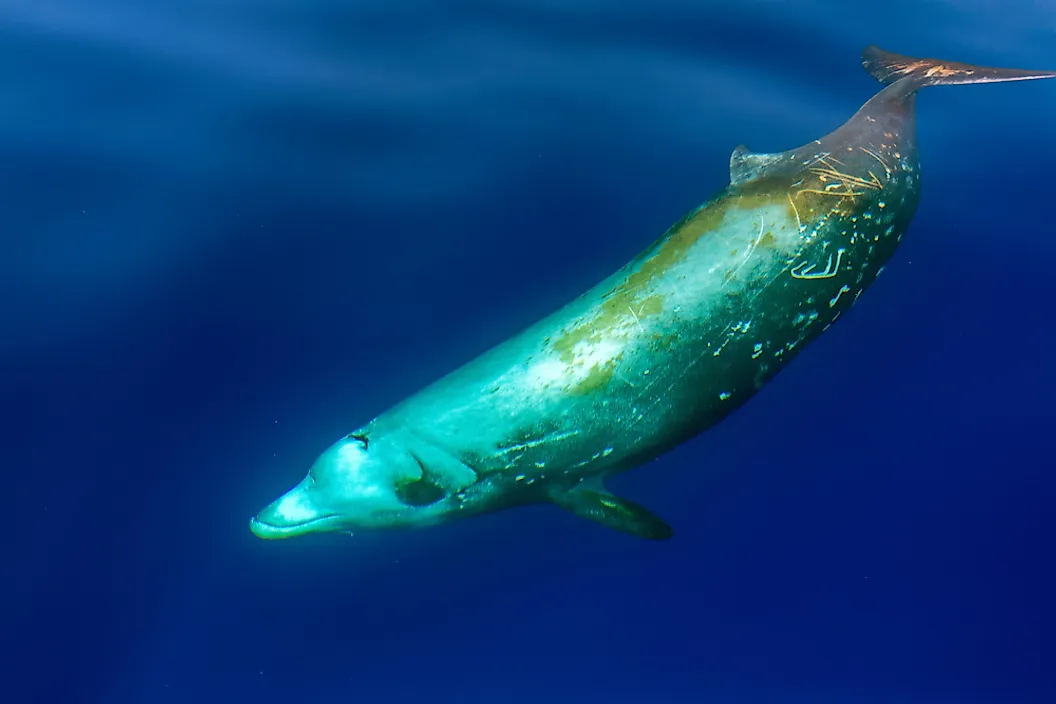
Cuvier's beaked whales (Ziphius cavirostris) are among the most capable divers in the animal kingdom. In a study published in 2014, researchers used satellite-linked tags to track eight whales off Southern California. One reached a depth of 9,816 feet (2,992 m), while another recorded dive lasted 137.5 minutes. At the time, both measurements set records for mammals.
Research off Cape Hatteras, North Carolina, later revealed just how long these whales can remain submerged. In a study published in 2020, scientists analyzed thousands of dives recorded from 23 Cuvier's beaked whales. One whale completed a dive lasting 222 minutes, or 3 hours and 42 minutes, setting the documented record for the longest mammalian dive. The depth record remains the separate 9,816-foot dive recorded off California.
These records do not represent the depth or duration of every dive. In the North Carolina study, the median duration of presumed foraging dives was 59 minutes, and only 5% exceeded approximately 78 minutes. The whales typically alternate long, deep dives with shorter dives and periods at the surface. Their exceptional records demonstrate what they can achieve, rather than what they do on every trip underwater.
Cuvier's beaked whales feed mainly on squid and other cephalopods, along with some fish and crustaceans. Their deep dives allow them to hunt prey in dark water far below the zone reached by most familiar marine animals. Because the whales spend relatively little time at the surface and rarely display conspicuous behavior, researchers have had to rely on tagging technology to understand their movements.
Sperm Whales Hunt In Deep Water
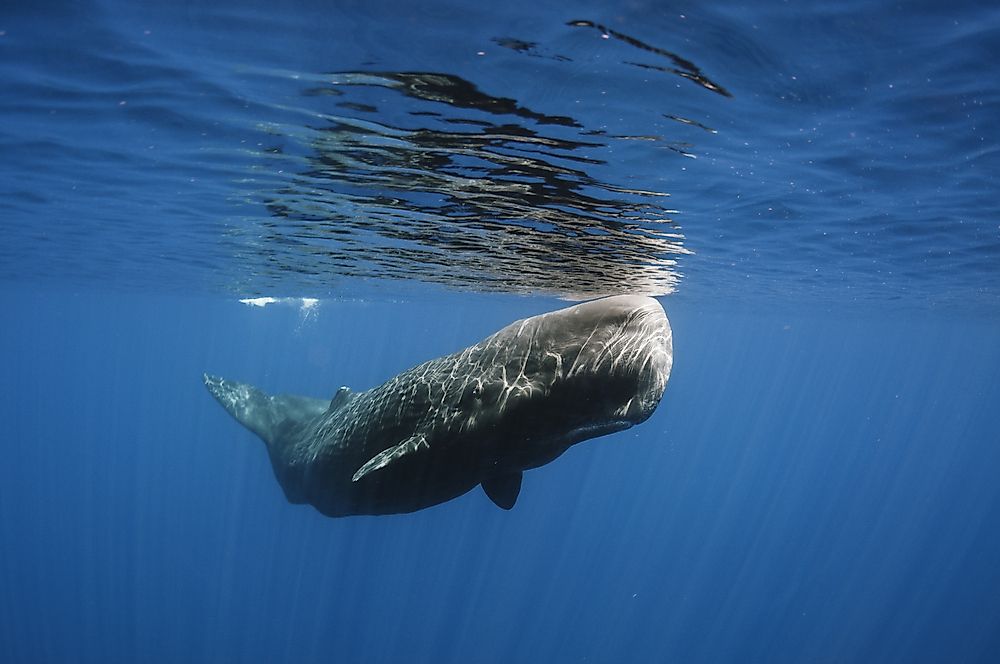
Sperm whales are another group of exceptional divers. They inhabit oceans worldwide, including deep waters off the continental US, where they search for squid and other prey. Their dives commonly reach well over 1,000 feet, and some descend to around 6,562 feet (2,000 m) or more. Typical foraging dives last roughly 40 to 45 minutes, although some documented dives have lasted up to about two hours.
Their enormous heads contain structures associated with producing and directing sound, which sperm whales use for echolocation. Clicks help them detect prey in dark water where sunlight cannot provide useful illumination. This ability is particularly important because their favored prey can move through deep water, making visual hunting impractical.
Compared with Cuvier's beaked whales, sperm whales are much larger, with adult males growing substantially longer than 50 feet (15 m). Their bodies are adapted for extended dives, but size alone does not determine diving ability. Different species face different feeding demands, and researchers continue to investigate how body composition, oxygen reserves, and behavior shape their underwater limits.
How Whales Survive Crushing Water Pressure

Pressure increases rapidly with depth. In seawater, every 33 feet (10 m) adds approximately one atmosphere of pressure. At 9,843 feet (3,000 m), the surrounding pressure is roughly 300 times that at the surface. A human body cannot withstand such conditions without protection, but whales have anatomical features that allow them to dive far beyond human limits.
One important adaptation is a flexible chest. As pressure increases, a whale's rib cage can compress, and its lungs can collapse in a controlled way. This helps protect the lungs as pressure rises and limits gas exchange with the blood at depth. Whales do not simply carry a huge reserve of air in their lungs. Instead, their bodies rely heavily on oxygen stored in blood and muscle tissue.
Whales also have high concentrations of myoglobin, a protein that stores oxygen in muscles. Their blood contains oxygen-carrying hemoglobin, while changes in circulation help preserve oxygen for organs that need it most. During a dive, the heart rate can slow, and blood flow to some tissues decreases. These adjustments conserve oxygen while the whale searches for prey.
Even with these adaptations, a dive is not unlimited. Researchers studying Cuvier's beaked whales have found that extended deep dives are often followed by longer intervals before the next one, suggesting that the recovery period is an important part of their overall diving strategy.
Not Every Whale Needs To Dive Deep

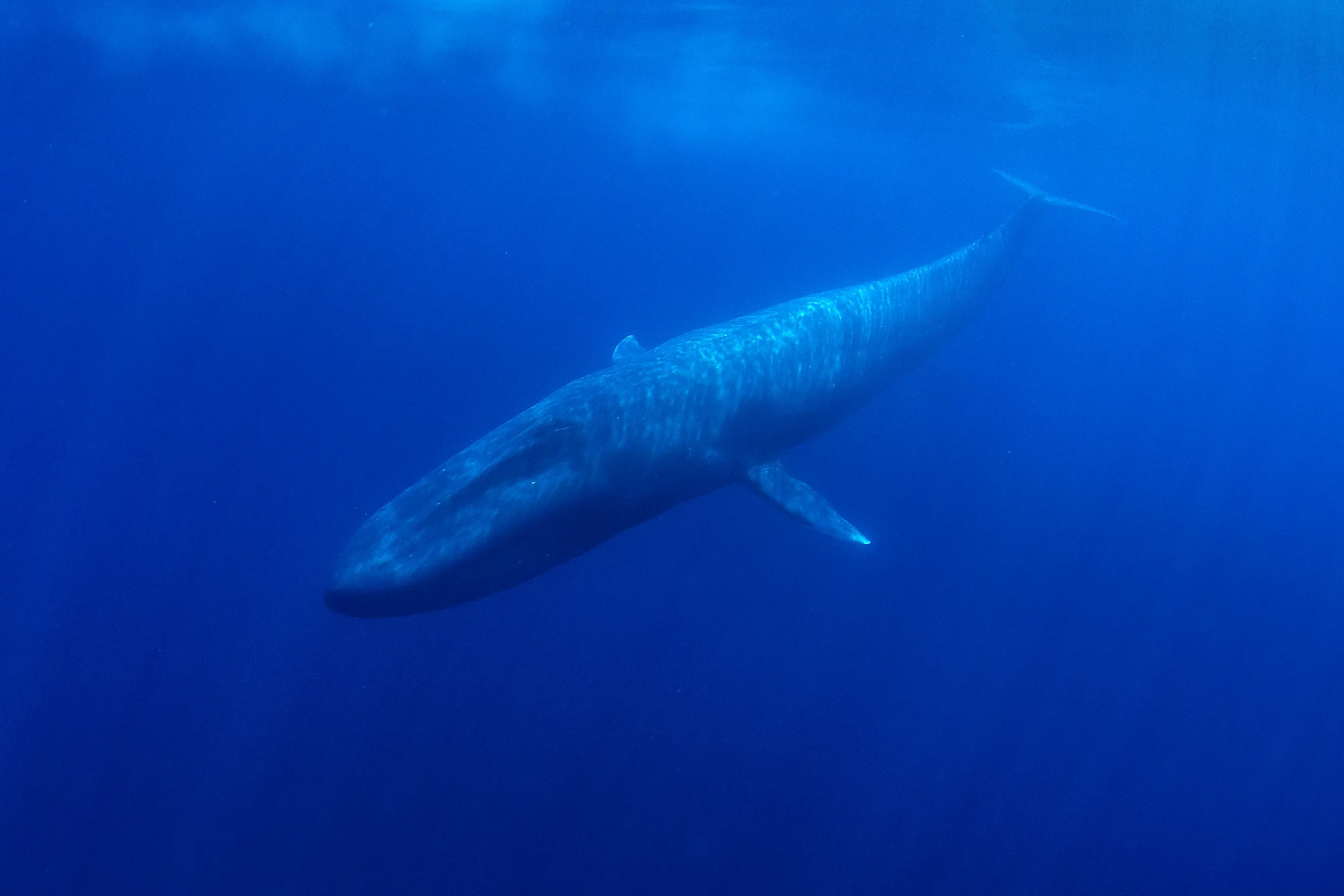
The deepest-diving whales are not necessarily the largest. Blue whales, the largest animals known to have lived on Earth, often feed on krill in comparatively shallow water. Their feeding technique involves taking large mouthfuls of prey-rich water and filtering out the krill with baleen plates. Because this process requires considerable energy, their dives tend to reflect the location and availability of food rather than the pursuit of extreme depth.
In a 2019 study led by Jeremy Goldbogen, researchers attached a heart-rate and depth recorder to an adult male blue whale in Monterey Bay, California. Its foraging dives reached 604 feet (184 m) and lasted up to 16.5 minutes. Those figures are far below the records set by beaked whales, but they suit a different feeding strategy. A whale hunting for squid in the deep ocean faces different demands from one filtering dense patches of krill nearer the surface.
Gray whales also make dives suited to their feeding habits. Along the US West Coast, they can feed in relatively shallow coastal waters, including areas where they search the seafloor for small invertebrates. Humpback whales often feed in surface waters or at moderate depths, depending on prey distribution. These examples show why there is no single depth that defines a whale's diving ability.
What Researchers Still Do Not Know
Scientists cannot observe most whale dives directly, especially when an animal descends hundreds or thousands of meters. Satellite-linked tags and electronic recorders help fill that gap by measuring depth, duration, movement, and sometimes sound. However, studies often track a limited number of individuals over a particular period, so the results may not capture the full range of behavior across a species.
The record dives also raise questions about how whales manage oxygen use and recovery. A dive lasting several hours requires more than a large oxygen reserve. It depends on the balance between energy use, prey capture, and the time needed to recover at the surface. Scientists continue to study these factors to understand how whales remain underwater so long without breathing.
Research has practical importance beyond setting animal records. Cuvier's beaked whales are particularly sensitive to some forms of underwater noise, and scientists have documented strandings associated with certain naval sonar activities, although the mechanisms behind those events are not fully understood. Better knowledge of their diving behavior can help researchers assess how human activity affects whales in deep-water habitats.
Understanding where deep-diving whales feed and how they respond to disturbance can help scientists identify risks to these animals and the habitats they depend on.