The Deepest Blue Hole In American Waters
About 50 miles west of Sarasota, Florida, a giant hole in the ocean floor plunges approximately 425 feet below the surface of the Gulf of Mexico. Its name is Green Banana, and it's among the deepest blue holes scientists have explored in US offshore waters. The opening begins 155 feet underwater, so there's no dramatic dark circle to spot from a passing boat, and getting a proper look requires specialized diving equipment and an appetite for adventure. Scientists who descended into Green Banana found sharks near its entrance, strange chemical changes near the bottom, and signs of water moving through the cavern. The big question is whether anything deeper exists nearby. Many of the Gulf's underwater sinkholes remain unexplored, so for now Green Banana stands among the deepest well-documented blue holes in American waters.
Green Banana Blue Hole, Florida

Green Banana has a rather cheerful name for a place that descends into near darkness. According to NOAA, its opening sits approximately 155 feet below the Gulf's surface, with the bottom reaching around 425 feet. That puts roughly 270 feet of the formation below the surrounding seafloor. The hole has an unusual hourglass shape, with walls that change width as they descend. The U.S. Geological Survey reports a slightly shallower total depth of approximately 410 feet, reflecting differences between published estimates. Either measurement places Green Banana well beyond ordinary recreational diving limits.
Its name comes with a peculiar story. An early exploration account published in Advanced Diver Magazine describes a fisherman who reportedly spotted a floating case of green bananas while retrieving his lines. Nobody has conclusively established the name's origin, but the story has survived for decades. Divers were exploring Green Banana long before the major scientific expedition of 2020. Today, its location remains far offshore, and the dangerous depths make it unsuitable for casual sightseeing. The best views come courtesy of technical divers who have carried cameras into the cavern.
How Did A Giant Hole Form Beneath The Gulf?
To understand Green Banana's origins, picture Florida during the last ice age. Around 20,000 years ago, global sea levels were nearly 400 feet lower than today. Vast stretches of the continental shelf lay exposed, and the Florida peninsula extended much farther into what is now the Gulf of Mexico. Beneath that landscape were thick deposits of limestone, a rock that slowly dissolves when exposed to slightly acidic water. Rainwater and groundwater worked through cracks, widening underground passages over thousands of years. When unsupported rock collapsed, it could leave enormous openings in the ground. As glaciers melted and seas rose, many of these limestone depressions disappeared underwater. Woods Hole Oceanographic Institution identifies this process as a common explanation for marine blue holes. Green Banana belongs to the same broad family of karst formations, although its precise age and formation history remain uncertain. The limestone walls now sit beneath water that covers a landscape once exposed to the open air.
The Divers Who Reached 420 Feet

Getting scientists into Green Banana was no ordinary scuba outing. On August 31, 2020, a research team departed Sarasota to investigate the hole. The expedition brought together Mote Marine Laboratory, Florida Atlantic University, Georgia Tech, and the U.S. Geological Survey. NOAA supported the project, which required technical divers trained to operate at extreme depths.
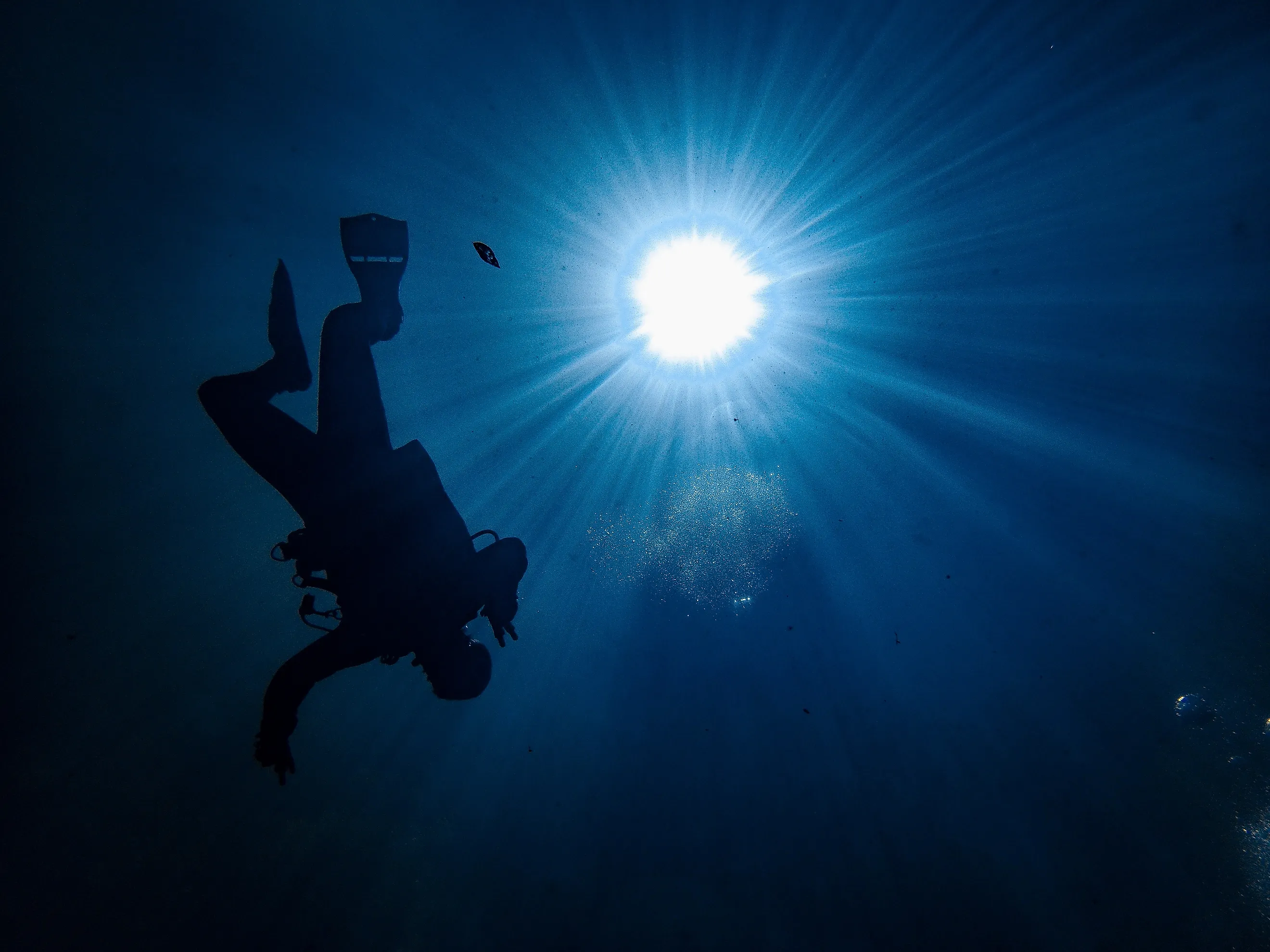
The descent had its share of nasty surprises. Visibility deteriorated inside the cavern, and abandoned fishing line posed an entanglement hazard. Divers eventually reached approximately 420 feet, where they helped position a 500-pound scientific platform called a benthic lander. Its instruments recorded water chemistry and collected samples near the sediment-covered bottom. The divers also recovered sediment cores and filmed the surrounding walls.
Scientists returned to the area for additional research in May 2022. The equipment allowed them to study conditions that divers could observe for only a limited time. Some instruments recorded chemical measurements every few seconds, capturing changes that a single water sample might miss. Those readings revealed that Green Banana behaves quite differently from another blue hole just 20 miles closer to Sarasota.
A Surprisingly Busy Entrance

Sharks patrol the waters around Green Banana, while corals and sponges occupy the rocky edges. Fish gather near the opening, taking advantage of habitat that differs sharply from the surrounding seafloor. During their expeditions, researchers documented similar communities around nearby Amberjack Hole. NOAA describes these underwater depressions as ecological hotspots, and the concentration of animals around their rims explains why. The holes provide rocky surfaces and sheltered spaces in areas where suitable habitat can otherwise be limited. Early reports of their locations frequently came from fishermen who had noticed the abundance of fish.
Follow the walls downward, however, and the scene changes. Sunlight becomes scarce, dissolved oxygen drops, and fewer large animals appear. Organic debris collects at the bottom, where microbes break it down and release chemical compounds. Scientists found sediments rich in carbon and nutrients, including nitrogen and phosphorus. The decomposition also produces hydrogen sulfide, a gas that can be toxic to many organisms. Green Banana's crowded entrance and chemically unusual depths occupy the same vertical cavern, separated by just a few hundred feet of water.
The Strange Water Movement Inside Green Banana
Something unusual was happening inside Green Banana when the 2020 expedition arrived. Divers reported feeling vertical water movement, and their cameras captured particles that appeared to travel upward. Chemical instruments offered another clue. Hydrogen sulfide, which forms as microbes break down organic material, appeared only intermittently in the water column. At Amberjack Hole, by comparison, researchers had observed a more stable layer of sulfide-rich bottom water. Green Banana's changing readings suggested that water was periodically being flushed or mixed within the cavern. Researchers considered several possible causes, including tides and groundwater flowing through underground limestone passages. Florida Atlantic University later reported evidence suggesting a possible connection to groundwater beneath mainland Florida. If confirmed, that connection could allow changes in the aquifer to influence the offshore ecosystem. Scientists have not yet established the precise route or mechanism responsible for the observed movement.
What Happens Inside The Hole After Sunset?
Green Banana delivered another surprise when scientists examined its daily chemical measurements. The concentration of chlorophyll near the bottom increased tenfold within approximately 30 minutes after sunset. Chlorophyll is the pigment used by photosynthetic organisms to capture light, so finding such a dramatic nighttime change at depth was unexpected. The readings dropped again after sunrise, creating a daily pattern that caught researchers' attention.
Florida Atlantic University scientist Jordon Beckler proposed that microscopic organisms might spend daylight hours nearer the surface, then descend to obtain nutrients at night. This remains a hypothesis, but the measurements offer a fascinating glimpse into activity far below the sunlit sea. Green Banana's sediments release nutrients that may eventually escape into surrounding Gulf waters. Researchers are investigating whether that movement helps support nearby plankton populations. They have also raised questions about possible connections to harmful algal blooms, including Florida red tide. No direct causal connection has been established, but the sunset observations give scientists a specific phenomenon to investigate.
Amberjack Hole, Florida's Other Underwater Surprise

About 30 miles west of Sarasota, Amberjack Hole provided scientists with an earlier opportunity to investigate the Gulf's submerged sinkholes. Its opening lies approximately 100 feet below the surface, considerably shallower than Green Banana's entrance. The USGS describes a dome-shaped depression extending about 130 feet beneath the surrounding seafloor. NOAA-supported teams explored Amberjack in May and September 2019, using technical divers and a specially designed benthic lander.
One discovery was particularly startling. Divers found two dead smalltooth sawfish near the bottom. These extraordinary rays have long, flattened snouts lined with teeth and are protected under the Endangered Species Act. One specimen, a male approximately 12 feet long, was recovered for scientific examination. The animals had no obvious external injuries, and researchers suspected that oxygen-poor water might have contributed to their deaths.
Amberjack also contained an unusual community of microorganisms. Mote Marine Laboratory reported that one poorly understood group of archaea accounted for roughly 60% of the microbial community in bottom samples. Scientists were puzzled because its genetic characteristics did not resemble those expected of organisms living in such oxygen-poor, sulfide-rich conditions. Amberjack's relatively stable bottom-water chemistry also contrasted with Green Banana's apparent periodic flushing.
Is Green Banana Really America's Deepest Blue Hole?
Green Banana reaches approximately 425 feet beneath the Gulf's surface, but that figure does not make it a confirmed national record holder. NOAA's 2022 research report describes Gulf blue holes exceeding 130 meters in depth, or about 427 feet. Many have received little scientific attention, and researchers still lack a complete survey of these formations. Green Banana also lies approximately 50 miles offshore, inside the US exclusive economic zone but outside the country's 12-nautical-mile territorial sea. It is therefore best described as one of the deepest explored blue holes in U.S. offshore waters.
Beyond the United States, the depth record becomes even more astonishing. In Mexico's Chetumal Bay, scientists lowered instruments into the Taam Ja' Blue Hole in December 2023. Their equipment reached 423.6 meters, approximately 1,390 feet, without touching the bottom. A 2024 study published in Frontiers in Marine Science identified Taam Ja' as the deepest known blue hole worldwide. Green Banana is much shallower, but its exploration has already revealed an impressive amount of underwater activity. With so many Gulf sinkholes awaiting detailed surveys, there may be another extraordinary descent waiting beneath Florida's offshore waters.