6 Snake-Filled Waters In Michigan
With water comprising close to 42 percent of its total area, Michigan is the most aquatic state in America. This distinction is largely due to the Great Lakes, four of which border Michigan, the only state to touch so many, as well as 26,266 major inland lakes and 120 major rivers, totaling more than 37,000 square miles. Michigan also claims 18 species of snakes, most of which live near water. Some live in water. This combination of extensive waterways and semi-aquatic reptiles makes certain lakes and rivers notable for their snake populations.
Lake Huron

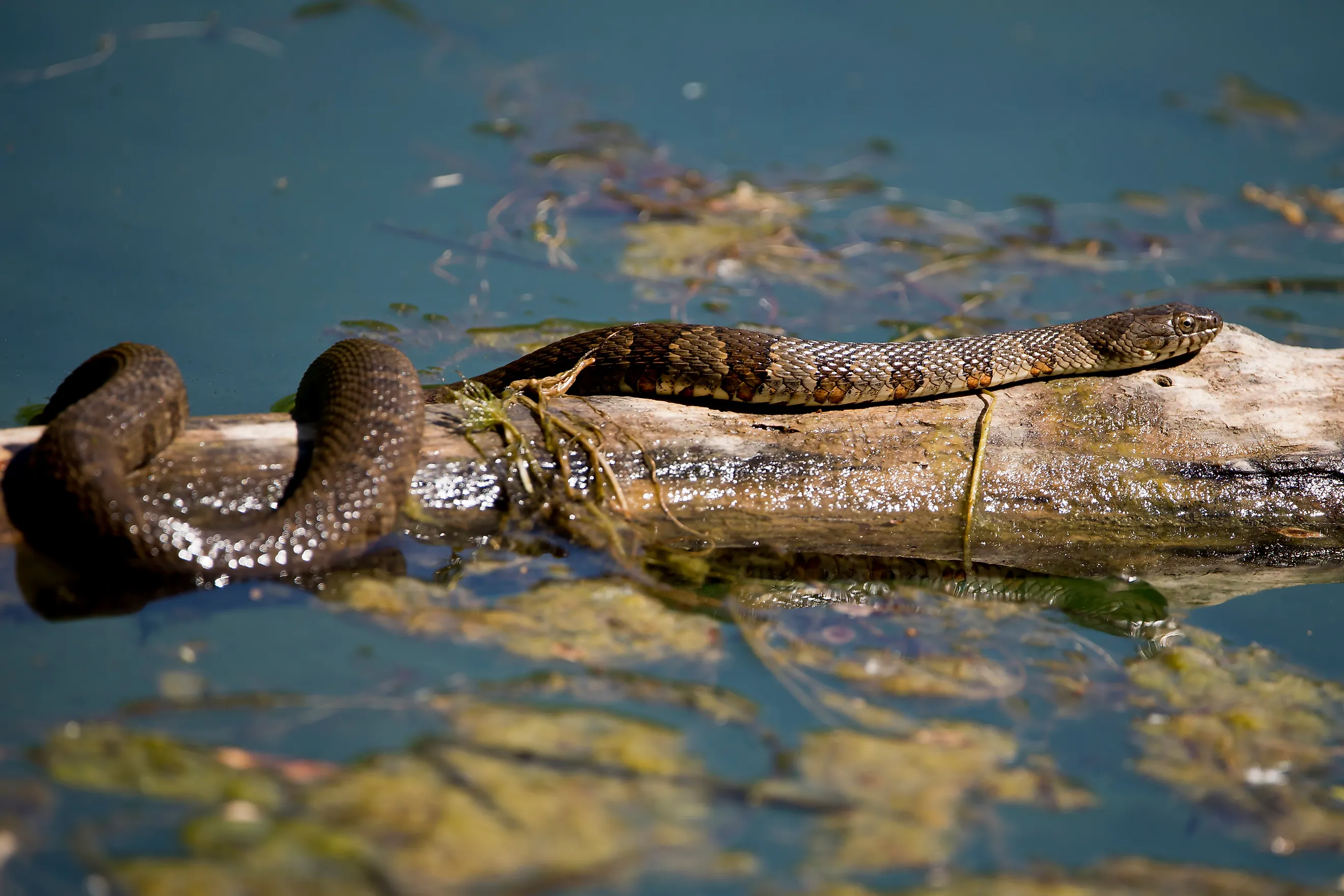
The first of Michigan's Great Lakes, known for its snake populations, is Lake Huron. Filling roughly 850 cubic miles and bordering Canada to the northeast and Michigan to the southwest, Huron supports a strong population of the common water snake (Nerodia sipedon). True to its name, this is the most common water snake species in Michigan. The only other water snake in the state, the plain-bellied water snake (Nerodia erythrogaster), is confined to the extreme south.

The common water snake is especially common around Presque Isle Harbor and across the aquatic international border on Ontario's Bruce Peninsula. Other species common around, but not necessarily in, Lake Huron include the northern water snake, common garter snake (Thamnophis sirtalis), smooth green snake (Opheodrys vernalis), DeKay's brown snake (Storeria dekayi), and eastern milk snake (Lampropeltis triangulum).
Huron River

Despite its name, the Huron River does not connect to Lake Huron. It emerges from Huron Swamp in southeastern Michigan and makes a less-than sign shape for roughly 130 southward miles before emptying into Lake Erie. Snake hotspots occur along much of its course.
At Huron Swamp, which is partly preserved as Indian Springs Metropark, the eastern massasauga (Sistrurus catenatus) survives as Michigan's only venomous snake and a federally protected rattlesnake species. At Hudson Mills Metropark, the common water snake hunts fish and frogs and is the dominant aquatic snake in this stretch of the river. Around Ann Arbor, the queen snake (Regina septemvittata) feeds almost exclusively on crayfish. At Lower Huron Metropark, the eastern hognose snake (Heterodon platirhinos) produces a mild, toad-targeted venom that can cause localized swelling in humans. Near Lake Erie, especially within the Pointe Mouillee State Game Area, the eastern fox snake (Pantherophis gloydi) finds refuge as a statewide threatened species.
Detroit River

Few people associate Detroit with snakes, but the Detroit River and its watershed support several species. Among the snakes found in the area are the common water snake, DeKay's brown snake, red-bellied snake (Storeria occipitomaculata), and Butler's garter snake (Thamnophis butleri). The Butler's garter snake is distinguished by irregularly placed stripes that set it apart from the common garter snake, which also inhabits Detroit.
The Detroit River runs for 28 miles from Lake St. Clair to Lake Erie and forms part of the border between Detroit and Windsor, Ontario. Certain stretches are designated for wildlife conservation, most notably the Detroit River International Wildlife Refuge, which covers approximately 5,800-5,900 acres. Co-managed by the United States and Canada through the U.S. Fish and Wildlife Service, the refuge provides important habitat for the eastern fox snake.
Lake Michigan

Filling roughly 1,180 cubic miles, Michigan's namesake lake is larger than Lake Huron, Lake Erie, and Lake Ontario, though it is smaller than the largest of the Great Lakes. Lake Michigan’s several hundred miles of western Michigan shoreline support a range of snake species.

The common water snake is found on Beaver Island, a 56-square-mile island with a notable snake population. On the mainland, the common garter snake occurs around Grand Traverse Bay, while the common ribbon snake (Thamnophis saurita) extends south through Ludington State Park. Along the southern shore, where Lake Michigan reaches into Indiana, larger species such as the North American racer (Coluber constrictor) and gray rat snake (Pantherophis spiloides) are present. Both species are harmless if left alone.
Straits of Mackinac

Michigan consists of a Lower Peninsula and an Upper Peninsula. The Straits of Mackinac separate the two peninsulas and connect Lake Huron with Lake Michigan. Though the straits are relatively narrow, they border two islands with substantial snake populations, Mackinac Island and Bois Blanc Island.

Mackinac Island spans 4.35 square miles and supports 10 species of snakes, including the common garter snake, smooth green snake, eastern milk snake, and ring-necked snake (Diadophis punctatus). Bois Blanc Island is larger, at about 34 square miles, and supports the eastern massasauga rattlesnake. Bois Blanc is widely considered the only location in the Upper Peninsula where wild rattlesnakes occur, although a recent sighting on nearby Mackinac Island has introduced some uncertainty.
Lake Superior

Lake Superior, the largest of the Great Lakes and the world’s largest freshwater lake by surface area, borders Michigan’s Upper Peninsula and supports several snake species. Some, including the smooth green snake and eastern milk snake, are typically found along the shoreline.

Other species, such as the common garter snake and red-bellied snake, occupy Isle Royale. The island lies about 56 miles from mainland Michigan and 15 miles from mainland Canada. Although many snakes, including semi-aquatic garter snakes, are capable swimmers, they are unlikely to travel such distances. The snakes on Isle Royale likely descend from individuals that reached the island long ago by drifting or via a land bridge. Evidence of long-term isolation is visible in their coloration, which ranges from cream to red-orange to deep blue. According to Isle Royale National Park, these color variations have been documented since 1928.
Snakes and Michigan’s Waterways
The Great Lake State could also be described as a state defined by its snake habitats. While Michigan does not match the reptile diversity of states such as Arizona or Florida, its extensive lakes and rivers support a wide range of snake species. From the common water snake along Lake Huron to the eastern fox snake near the Detroit River and the garter snakes found around Lake Superior, snakes are closely tied to Michigan’s waterways. Lakes and rivers shape where these species live, making water a central factor in the state’s snake distribution.