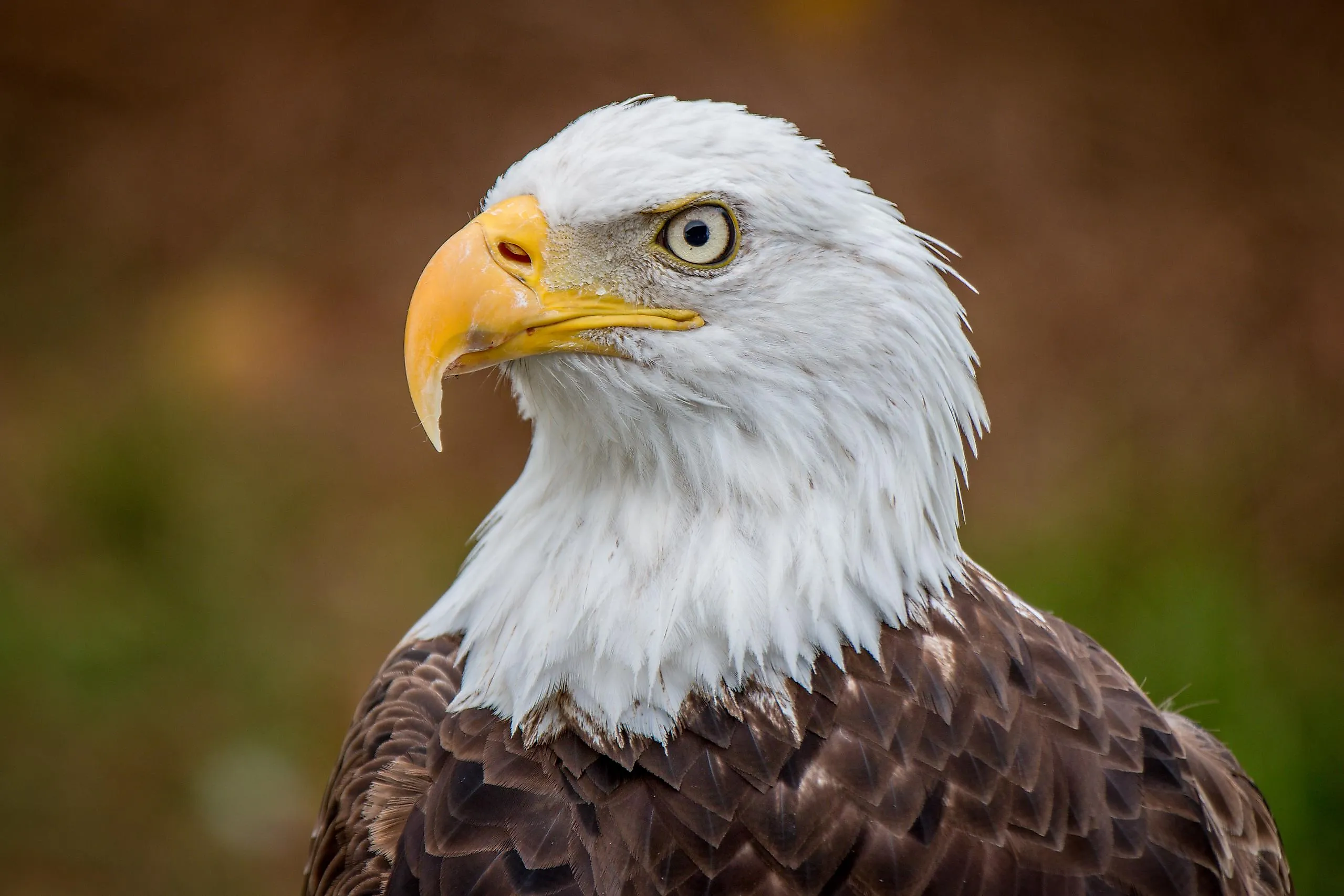
Bald Eagle
The bald eagle (Haliaeetus leucocephalus) needs no introduction. It is a North American bird of prey and the only sea eagle whose range is confined entirely to this continent. It belongs to the order Accipitriformes and the family Accipitridae, a grouping that includes hawks, kites, and Old World vultures. Within the genus Haliaeetus, the bald eagle shares a close evolutionary relationship with the white-tailed eagle (Haliaeetus albicilla) of Eurasia. These two birds form a recognized species pair, filling equivalent ecological roles on their respective continents. The bald eagle also belongs to a broader clade that includes H. leucoryphus (Pallas's fish eagle) and H. pelagicus (Steller's sea eagle).
Range and Habitat

The bald eagle's natural range encompasses most of Canada and Alaska, all of the contiguous United States, and the northern reaches of Mexico. It is a habitat generalist in many respects, found across an extraordinary diversity of landscapes. Northern populations tend to be migratory, moving south as winter sets in, while southern populations are largely year-round residents that remain on their breeding grounds throughout the year. Water is the central organizing feature of bald eagle habitat. During the breeding season, the species gravitates toward wetland environments, including coastlines, large rivers, lakes, and marshes, with a preference for water bodies large enough to sustain reliable fish populations.

That said, the species has shown notable adaptability, and eagles are increasingly turning up in drier, more developed landscapes, including farmland and suburban areas situated well away from traditional water sources. Alaska supports the largest concentration of bald eagles in the United States, with a population estimated at roughly 30,000 birds. The Chilkat River valley is a particularly significant wintering area, and the Alaska Chilkat Bald Eagle Preserve was formally established in 1982 to protect the large seasonal gatherings that occur there.
Physical Description

Few birds anywhere in the world are as immediately recognizable as an adult bald eagle. Mature individuals of both sexes carry a deep chocolate-brown plumage across the body and wings, offset by a brilliant white head, neck, and tail. The eyes are pale yellow, and both the feet and the large hooked beak share the same vivid yellow coloration. Body weight ranges from roughly 6.5 to 14 pounds, and the wingspan can reach up to 8.5 feet. Females run noticeably larger than males, and birds from northern latitudes tend to be bigger than their southern counterparts.

Young birds look nothing like their parents. Juveniles are a mottled mix of brown and white, and their beaks begin as dark rather than yellow. The transition to full adult plumage, including the white head and tail, is a gradual process that takes approximately five years to complete. In areas where bald and golden eagles share territory, the bald eagle can be distinguished by the absence of feathering on the lower legs. In flight, bald eagles typically show paler inner underwings, whereas golden eagles appear more uniformly dark and have fully feathered legs. A lesser-known fact is that the bird's common name has an often-misunderstood etymology. It was coined by early American colonists, using the Old English word "balde" in its original sense, meaning white rather than the modern meaning of hairless.
Food

The bald eagle is a highly opportunistic carnivore with a documented prey spectrum of more than 400 species. Across 20 food-habit studies conducted throughout its range, fish accounted for roughly 56% of the diet at active nests, followed by birds at 28%, mammals at 14%, and other prey making up the remainder. While fish are the dietary cornerstone, with species such as salmon, herring, shad, and catfish among the most commonly taken, bald eagles also pursue birds, reptiles, amphibians, crustaceans like crabs, and mammals, including rabbits and muskrats. Prey is taken live, freshly killed, or as carrion, depending on availability.

Hunting techniques also vary with the circumstances. Eagles typically scan from altitude or a fixed perch and can have 20/4 or 20/5 vision, meaning they can see four or five times farther than the average person. In fact, a bald eagle is capable of detecting prey up to three miles away, then folding into a high-speed dive of up to 100 mph. The species is also an unabashed food pirate. Bald eagles routinely harass ospreys until the smaller bird releases its catch in midair, and have been observed snatching fish directly from an osprey's grip in flight. When food is plentiful, eagles may consume far more than an immediate meal requires, storing the excess and digesting it over several days. Conversely, they are capable of enduring extended fasting periods lasting days, and in some cases, longer.
Behavior

Outside of the breeding season, bald eagles are largely solitary, though they will gather in numbers wherever food is reliably available. Territorial behavior intensifies during the breeding season. The dramatic aerial "cartwheel" displays for which the species is known, in which two birds lock talons and tumble in a spiraling descent, can be either a courtship ritual or a territorial dispute. Migration patterns vary considerably across the continent and are shaped by factors including age, breeding latitude, climate, and the seasonal movements of prey. In the Pacific Northwest and Alaska, many eagles time their movements to coincide with salmon runs.

Young eagles that have not yet reached breeding age lead a remarkably wide-ranging existence during their first four years, covering significant ground, often in a single day. Florida-hatched birds have been recorded as far north as Michigan, while California birds have turned up in Alaska. Longevity in the wild is substantial: the oldest confirmed wild individual was at least 38 years old at the time of its death in New York in 2015, having first been banded in the same state in 1977.
Reproduction

While courtship involves aerial and perched displays, including wing flapping and tail pumping by the male, breeding activity is timed to local climate and latitude, with active nesting occurring broadly between October and May across the species' range.
Nests are typically constructed in tall, structurally sound conifers that stand clear of the surrounding canopy, giving the birds unobstructed flight paths and broad sightlines across the landscape. These structures grow over time into some of the most impressive avian constructions on earth. Bald eagle nests hold the record for the largest tree nests built by any animal species, with documented examples reaching more than 13 feet in depth, 8 feet in width, and weighing up to a metric ton. Nests are returned to and enlarged each year. One celebrated nest in Vermilion, Ohio, took on the shape of a wine glass over decades of use, eventually weighing close to two metric tons before the supporting tree finally fell. It had been in continuous use for 34 years.

Clutch size is typically two eggs, with incubation shared between both parents over a period of 34 to 36 days. In the early weeks after hatching, at least one parent remains at the nest at nearly all times, with the female taking the majority of brooding duties while the male does most of the hunting. Sibling competition after hatching is intense, and the younger, smaller chick frequently does not survive. Eaglets that do make it fledge after approximately 75 days and, as stated, will not reach full adult plumage or reproductive maturity for another four to five years.
Importance to the World

The bald eagle's significance reaches well beyond its status as a national symbol. As an apex predator, it occupies the top tier of the food chain, actively hunting prey from the air and consuming carrion as an opportunistic scavenger. By keeping fish and small animal populations in check, bald eagles contribute directly to the stability of aquatic and terrestrial ecosystems. Their role as scavengers also carries a public-health dimension, as consuming carrion reduces the potential for disease to spread through an environment.
The cascading consequences of losing this species would be severe. Research around the Chesapeake Bay illustrates the point. This region has the largest concentration of bald eagles, including nesting pairs, anywhere outside of Alaska, and a significant drop would remove a key check on fish numbers, allowing those populations to expand and overgraze the aquatic vegetation that filters and sustains the bay. The loss of those plants could and has triggered eutrophication in the past, a process that can render an entire ecosystem uninhabitable and devastate the fishing and tourism industries that depend on it.

Bald eagles also function as an indicator species, meaning that shifts in their population can signal broader changes in environmental health, giving scientists a useful window into ecosystem conditions that might otherwise be difficult to measure. For example, the catastrophic decline of bald eagles in the mid-20th century was itself instrumental in revealing just how broadly DDT and heavy metals had spread through the environment.
On a cultural level, the species carries deep meaning to many groups and peoples, and it is the official national bird of the United States of America.
Threats and Conservation Efforts

The arc of the bald eagle's recent history is one of dramatic collapse followed by equally dramatic recovery. At the time of the species' adoption as the national symbol in 1782, estimated nesting populations across the country may have reached 100,000 pairs. By the mid-20th century, that population had been driven toward collapse by a combination of habitat loss, direct killing, and widespread pesticide contamination. At the species' lowest point, in 1963, only 417 known breeding pairs remained.
DDT proved especially destructive. The chemical concentrated in eagles' tissues through bioaccumulation in the food chain, interfering with calcium metabolism and producing eggshells too thin to survive incubation, which caused widespread reproductive failure across the population. Legislative responses came in stages. Congress passed the Bald Eagle Protection Act in 1940, prohibiting the killing or commercialization of the species, and a 1962 amendment extended those protections to the golden eagle as well. The federal ban on DDT and the habitat safeguards introduced by the Endangered Species Act then provided the conditions necessary for a genuine recovery to take hold.

The species was formally listed as endangered across the lower 48 states in 1967, reclassified as threatened in 1995 as populations improved, and ultimately removed from the endangered and threatened species list in June 2007. It is currently assessed as Least Concern on the IUCN Red List. Despite delisting, the bald eagle remains protected under both the Migratory Bird Treaty Act and the Bald and Golden Eagle Protection Act, which together prohibit any harm to the birds, their nests, or their eggs.
Ongoing threats are real, if less acute than they once were. Lead poisoning from ammunition fragments ingested through scavenged carcasses, collisions with vehicles and man-made structures, and the continued loss of mature shoreline forest to development all pose measurable risks to the population. Even so, the bald eagle stands as a rare and genuine success story in American conservation history.