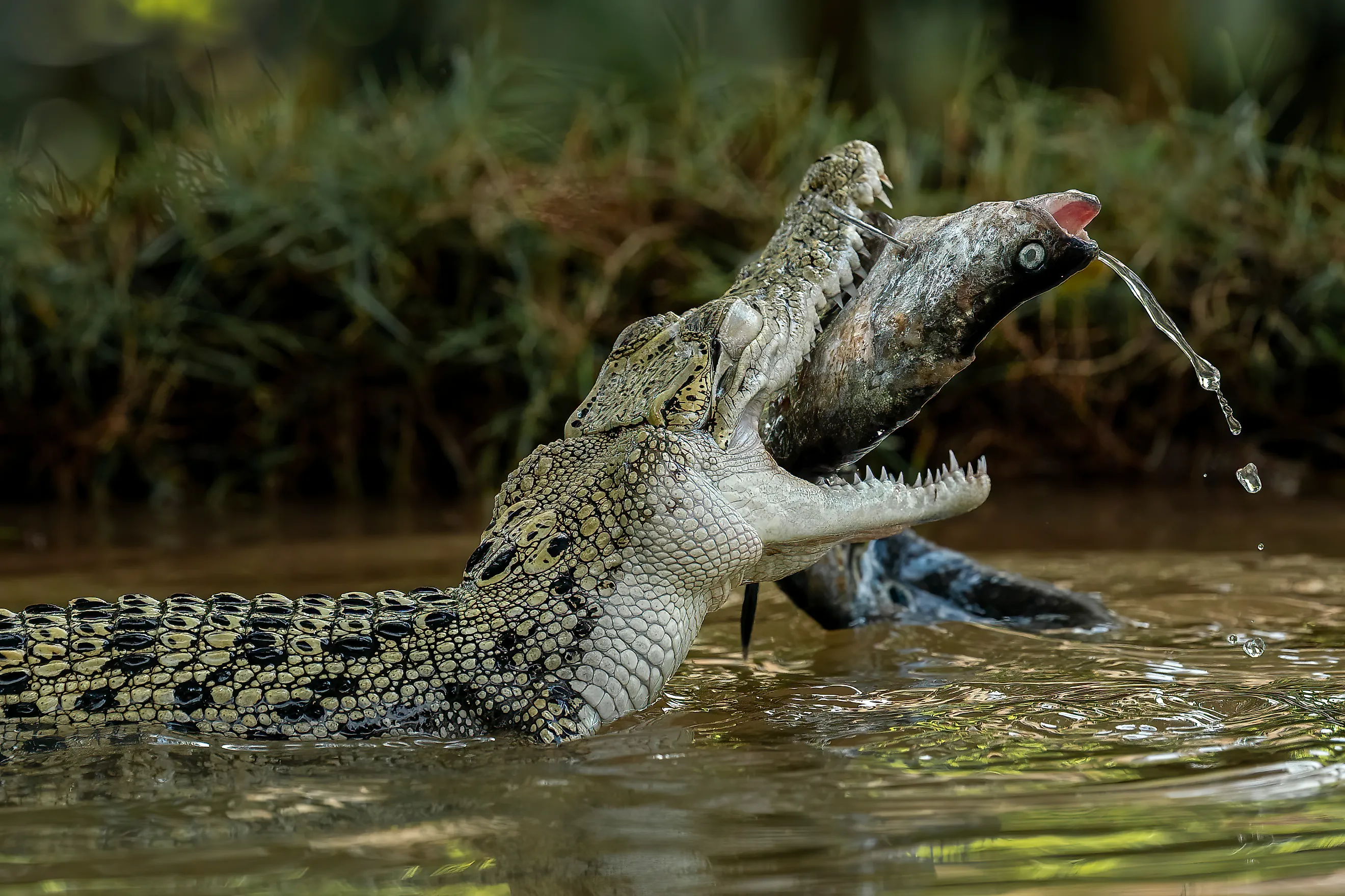
Crocodile
Crocodiles are the largest living reptiles on the planet, the closest things to a living dinosaur most of us will ever encounter, and a textbook example of a body plan that has survived 80 million years without needing major redesign. The saltwater crocodile (Crocodylus porosus) is the heavyweight of the group and the largest reptile alive today; the dwarf crocodile of West Africa, at less than five feet long, is at the other end of the same family tree. There are crocodiles on five continents, in habitats from inland billabongs in Australia to brackish estuaries in Central America. They are routinely confused with their alligator cousins and have an outsized fearsome reputation, much of it earned but some of it not. The reality is more interesting: crocodiles are deeply social animals with elaborate courtship rituals, surprisingly attentive parenting, and physiological tricks (lingual salt glands, transparent eyelids, nighttime dental replacement) that have kept them at the top of the food chain since the Cretaceous.
Species And Distribution

The "true" crocodiles of the family Crocodylidae include 16 currently recognized species split across three genera: 12 species in the genus Crocodylus, two slender-snouted species in Mecistops, and two dwarf species in Osteolaemus. (Recent molecular work has proposed additional splits, so the count may rise as research continues.) The full reptilian order Crocodilia, which also covers alligators, caimans, and gharials, contains about 26 living species worldwide.

The American crocodile (Crocodylus acutus) ranges from southern Florida and southern Mexico through Central America to northern South America, plus several Caribbean islands. South Florida is the only place on earth where American crocodiles and American alligators share a habitat. The Morelet's crocodile (Crocodylus moreletii) of southern Mexico, Belize, and Guatemala typically reaches about 10 feet. The Orinoco crocodile (Crocodylus intermedius), restricted to the Orinoco River basin in Colombia and Venezuela, is one of the largest American crocodilians: typical adults run 10 to 16 feet, and historical records describe individuals over 20 feet. Critically endangered after decades of skin hunting, the wild population is estimated at fewer than 250 mature animals, making it one of the rarest reptiles in the Americas. The Cuban crocodile (Crocodylus rhombifer), native to two swamps on Cuba, grows to about 7 feet and has perhaps the smallest natural range of any crocodile.

Africa hosts the smallest member of the family, the dwarf crocodile (Osteolaemus tetraspis), which tops out at about 5 feet, plus its slightly larger cousin Osborn's dwarf crocodile (Osteolaemus osborni) in the Congo Basin. The slender-snouted crocodiles of Mecistops, recently split into a West African (M. cataphractus) and a Central African (M. leptorhynchus) species, are fish-eating specialists that haunt rainforest rivers. The largest African species is the Nile crocodile (Crocodylus niloticus), a 16-foot, 1,650-pound predator distributed across most of sub-Saharan Africa and Madagascar. The West African crocodile (Crocodylus suchus), genetically distinct from the Nile but visually similar, is the species ancient Egyptians actually mummified by the thousands; recent DNA studies on temple mummies confirmed the identification.

Asia and Oceania hold several major species, including the Mugger crocodile (Crocodylus palustris) of the Indian subcontinent, the critically endangered Siamese crocodile (Crocodylus siamensis) of Southeast Asia, and the Philippine crocodile (Crocodylus mindorensis), which has fewer than 100 mature animals left in the wild. The New Guinea crocodile (Crocodylus novaeguineae) inhabits inland wetlands across the island, and the Australian freshwater crocodile (Crocodylus johnstoni) lives in northern Australian rivers, swamps, and billabongs.
Top of the size chart: the saltwater crocodile, ranging from eastern India through Southeast Asia, northern Australia, and the western Pacific. Adult males average about 17 feet long and 450 kilograms (1,000 pounds), with verified record specimens exceeding 20 feet and 1,000 kilograms. Females are roughly half the size. Saltwater crocodiles will eat almost anything they can grab, and verified prey records include sharks. The largest specimen ever measured, a 20.2-foot saltwater crocodile named Lolong, was captured in the Philippines in 2011 after a series of fatal attacks; he died in captivity two years later.
Crocodiles Versus Alligators

Alligators and crocodiles are members of the same order (Crocodilia) but separate families (Crocodylidae for crocodiles, Alligatoridae for alligators and caimans). Telling them apart is mostly a matter of looking at four things.

First, the snout. Crocodile snouts are narrow and V-shaped; alligator snouts are wider and U-shaped. Second, the teeth. When a crocodile closes its mouth, the lower fourth tooth on each side sticks up outside the jaw line and is fully visible; in an alligator, the upper jaw is wider and the lower teeth tuck inside, hidden when the mouth is closed. Third, the salt glands. True crocodiles have functional salt-secreting glands on the tongue that let them tolerate brackish and saltwater habitats; alligators lack working versions of these glands and are confined almost entirely to fresh water. Fourth, the geography. Crocodiles live in the Americas, Africa, Asia, and Australia. Alligators live in only two places: the southeastern United States (the American alligator) and a small region of eastern China (the critically endangered Chinese alligator).
Behaviorally, alligators tend to be the more docile of the two, with most attacks on humans the result of feeding-related habituation or close-range provocation. The most dangerous true crocodiles, especially Nile and saltwater, are more aggressive and far more likely to attack unprovoked.
Anatomy And Hunting

The crocodile is built for ambush. The snout, eyes, ears, and nostrils all sit on top of the head, which lets a submerged crocodile leave only those structures above the waterline while watching, listening, and breathing. The eyes have a transparent third eyelid, the nictitating membrane, which closes underwater so the animal can keep watching prey while submerged. Crocodiles also have specialized sensory pits along the jaws and head, called integumentary sense organs, that detect tiny pressure changes in the water and tell a hunting crocodile that a fish, bird, or thirsty mammal has approached. Hearing is sharp, with sensitivity from about 100 to 6,000 hertz, broadly comparable to a human's range.
The skin is the body's armor. The back is covered in keratinous scales reinforced from beneath by bony plates called osteoderms, which give the animal its ridged, prehistoric appearance. The belly scales are smoother, which is why crocodile leather has been so heavily traded.
Crocodile teeth are conical, sharp, and replaced continuously throughout life; a single saltwater crocodile may go through 8,000 teeth in a lifetime. The bite is the most powerful of any living animal: a saltwater crocodile can generate around 3,700 pounds per square inch (16,460 newtons) of bite force, easily enough to crush a turtle shell or splinter the bones of a wild boar. The muscles that close the jaw are enormous; the muscles that open it are weak enough that a person can hold a small crocodile's mouth shut with two hands. Once a crocodile catches large prey, it often performs the famous death roll, spinning its body rapidly along its long axis to subdue, drown, or twist limbs free. Crocodiles cannot chew; instead they tear chunks loose with the death roll or by jerking their heads, and swallow whole.
Crocodiles are apex predators across all of their ranges and are dietary generalists. Hatchlings start on insects and shrimp, juveniles graduate to frogs and small fish, and adults take whatever they can catch: fish, crabs, monitor lizards, birds, deer, antelope, livestock, and on the largest end (saltwater and Nile crocodiles), buffalo, sharks, and the occasional human.
Mating And Behavior

Crocodiles are far more social than their reputation suggests. Researchers have catalogued at least 20 distinct vocalizations across the family, ranging from low infrasonic rumbles (used in mating displays and communication between mothers and hatchlings) to bellows, hisses, growls, and the loud "head slap," in which the crocodile lifts its head out of the water and slams its lower jaw down to advertise size and territory. Pheromone signaling supplements the audio.
Hierarchies form by age and size, with the largest crocodiles claiming the best basking spots and the most productive hunting grounds. Most species are basically solitary outside the breeding season, but some, including the Cuban crocodile, show evidence of cooperative hunting behavior, with several individuals coordinating to herd fish toward shallow water.
Mating involves a sustained courtship: snout-rubbing, gentle bites, water dances, blowing bubbles, and synchronized swimming. A dominant male may breed with multiple females in a season; in some species, females actively choose mates based on the male's size, vocal performance, and head-slap displays. Copulation takes place in the water, with the male grasping the female's neck.
Parenting

Crocodile parenting is one of the surprises of reptile biology. After mating, the female builds a nest, either a mound of vegetation that uses fermentation heat to incubate the eggs (Nile crocodile, saltwater crocodile) or a hole excavated in sandbank earth (American crocodile, Australian freshwater). She lays between about 20 and 80 eggs depending on the species and size, then guards the nest aggressively, often refusing to eat for weeks while she stays nearby.
Crocodile sex is determined by incubation temperature, not chromosomes. Eggs held around 31 to 32 degrees Celsius produce mostly males; cooler or warmer temperatures produce mostly females. This is the same temperature-dependent sex determination found in turtles and is one reason climate change worries crocodile biologists.
When the eggs are ready to hatch, the babies make high-pitched chirps from inside the shell. The mother hears them, digs the nest open, and gently picks the hatchlings up in her mouth, sometimes carrying them to the water in a special throat pouch. In Nile crocodiles, the mother and sometimes the father continue to guard the young in a creche for up to two years, defending them from predators including monitor lizards, large birds, and other crocodiles. The hatchlings respond to a specific distress call from the mother and will swim to her if threatened. Compared with most reptiles, which abandon their eggs after laying, crocodile parental investment is extraordinary.
Crocodiles And People

Crocodiles kill people. The most authoritative estimate, from the CrocAttack global database, is that about 1,000 humans are killed by crocodilians each year, the great majority of those deaths in sub-Saharan Africa (mostly Nile crocodile attacks) and Southeast Asia and northern Australia (mostly saltwater crocodile attacks). Nile crocodiles cause more deaths annually than any other crocodilian, and possibly more than any other wild animal that preys on humans.
The risk is heavily concentrated in specific situations: people fetching water, washing clothes, fishing from low banks, or swimming in known crocodile habitat. Most attacks happen near the water's edge, often at dawn or dusk. Standard safety advice is straightforward: stay back from the water in known crocodile country, follow local warnings (which are usually accurate), keep dogs and children well away from riverbanks, and never wade or swim in waters identified as having large crocodiles. Where these basics are followed, the actual per-person risk is low.
The other side of the picture is that humans kill far more crocodiles than crocodiles kill humans. Hunting for skins drove most large species to the edge of extinction in the mid-20th century before international protections under CITES (Appendix I or II for all crocodile species) reduced legal trade and gave wild populations a chance to recover.
Conservation

Conservation status varies sharply across the family. American, Mugger, and dwarf crocodiles are listed as Vulnerable; Cuban, Orinoco, Philippine, Siamese, and West African slender-snouted crocodiles are Critically Endangered. The Philippine crocodile, with fewer than 100 mature individuals in the wild, is among the most endangered crocodilians on the planet. Threats include habitat destruction, illegal hunting for the leather trade, accidental drowning in fishing nets, dam construction that fragments rivers, and human-wildlife conflict on agricultural land.
Captive breeding and release programs have produced real recoveries. The American alligator, listed as endangered in 1967, was downlisted by 1987 after population numbers rebounded; the saltwater crocodile in northern Australia recovered from near-extinction in the 1970s to current populations of more than 100,000 wild animals. Cuban crocodiles have been bred at the Zapata Swamp captive facility and released into the wild. Siamese crocodiles have been reintroduced to Cat Tien National Park in Vietnam with documented breeding success. International cooperation through CITES, regional crocodile specialist groups, and NGO-run protected areas remains the core of crocodile conservation worldwide.
An Animal Older Than Most Of The Modern World
The basic crocodile body plan, the long jaws, the armored back, the four short legs, the powerful tail, has been around for tens of millions of years and has barely changed since the Cretaceous. Crocodiles outlasted the dinosaurs (their evolutionary cousins), survived the asteroid that ended the Cretaceous, and continue to occupy the same ambush-predator niche in tropical wetlands that their ancestors filled when mammals were still small and nocturnal. The image of a crocodile's eyes drifting at the waterline is genuinely ancient. Keeping these animals around, and the wetlands they need, is partly a question of biodiversity, partly of pragmatism (crocodiles regulate fish and mammal populations and reshape wetlands through their digging), and partly of preserving a working example of an ecological role that predates almost every other living thing in the system.