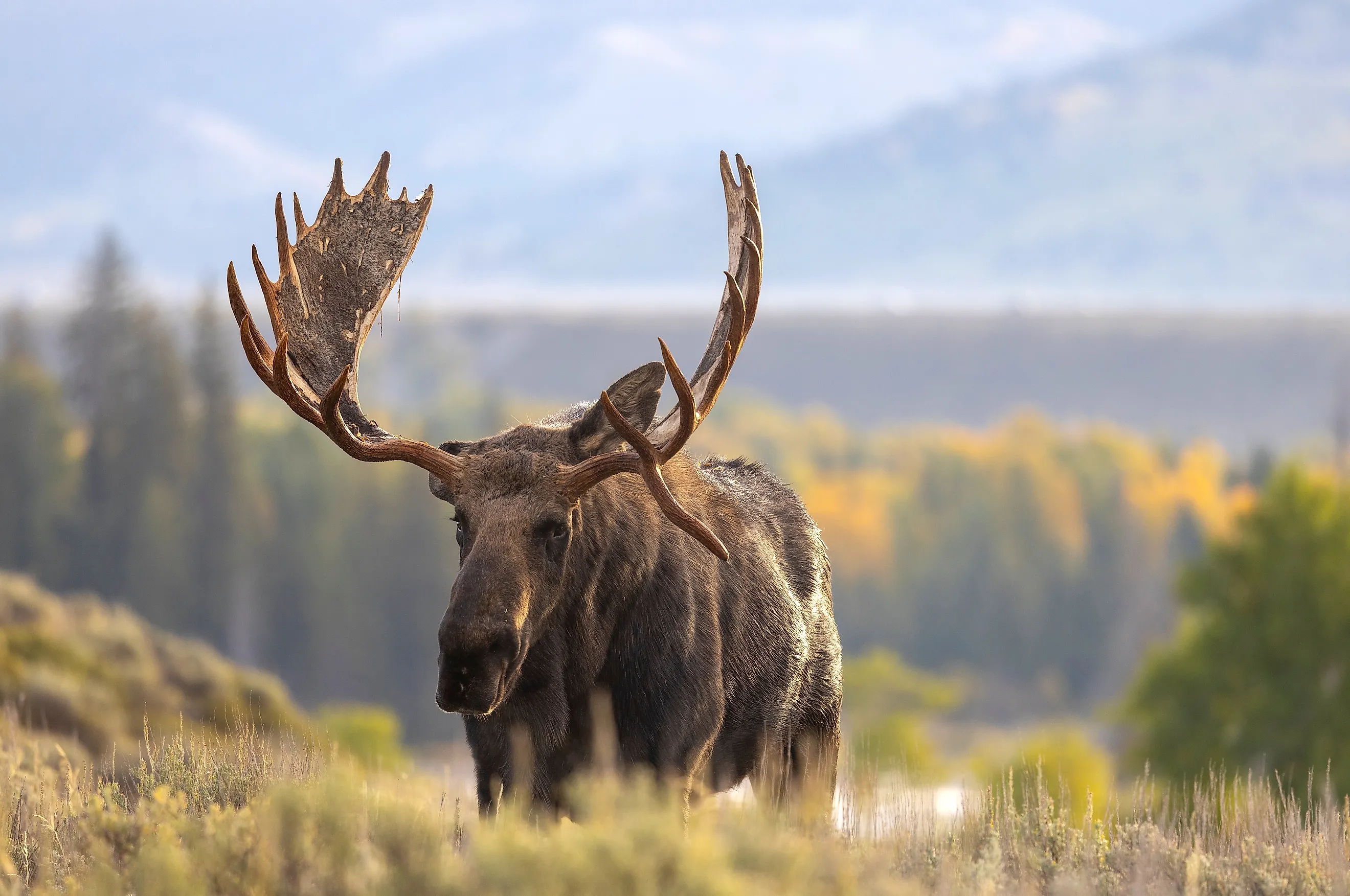
Moose
Moose are the largest members of the deer family and live in cold forested regions across the Northern Hemisphere. Their distribution across much of North America and Eurasia reflects a high tolerance for cold climates and boreal habitats. Adults can stand up to two meters at the shoulder. Males carry the species’ iconic flattened antlers that are shed and regrown each year. Despite their powerful stature they are strict herbivores feeding on aquatic vegetation in summer and woody browse during winter. They are also strong swimmers that frequently use wetlands and lakes as feeding areas.
Taxonomic Classification

The moose is most often classified as Alces alces, though some North American sources treat it separately as Alces americanus. It is a mammal and the largest living member of the deer family, Cervidae. It belongs to the order Artiodactyla, which generally includes hoofed mammals that bear weight evenly on two toes on each leg. Within Cervidae, moose are placed in the subfamily Capreolinae, also known as "New World deer," alongside species such as caribou, white-tailed deer, and roe deer.
Moose vary across their range, with North American populations often grouped into eastern, northwestern, Shiras, and Alaskan moose, while Eurasian populations are divided into other regional types. But even with this geographic variation, all moose share key anatomical traits, including elongated limbs, a pronounced shoulder hump, and broad, palmate antlers in males.
Physical Description

Being the biggest members of the deer family, moose stand out visually with their long legs, deep chests, and high shoulder humps formed by enlarged vertebrae and muscle. From ground to shoulder, they often stand at around 6 feet tall at full growth and can weigh over 1,000 pounds.
Adult males (bulls) are significantly heavier than females (cows) and carry wide, palmate antlers that can span over 1.5 meters. These antlers are shed and regrown annually. Moose also have large, splayed hooves that distribute weight on soft earth and act as effective paddles when swimming.

Their heads are also notably elongated, with large, overhanging noses and mobile lips that help them strip leaves, browse woody plants, and gather aquatic vegetation in shallow water. Moreover, a flap of skin called a dewlap, or “bell,” hangs from the throat in both sexes.
Their coats are often dark brown to nearly black, with lighter legs that can appear grayish or tan. They also have dense, hollow guard hairs that provide insulation against the cold climates they typically inhabit.
Range And Habitat
These hardy animals have a broad distribution across the northern regions of Europe, North America, and Asia. In North America, they are found throughout Alaska, much of Canada, and parts of the northern United States, including the Pacific Northwest, the upper Midwest, the Northeast, and parts of the northern Rocky Mountains. In Eurasia, their range extends across Scandinavia, Finland, Russia, and into sections of Eastern Europe and northeast China.

For the most part, moose occupy boreal forests, mixed woodlands, and subarctic environments where water sources are readily available. Wetlands such as marshes, ponds, swamps, and slow-moving rivers are especially important because they provide aquatic vegetation during spring, summer, and fall, while surrounding forests offer tree branches and other woody browse in winter. Dense forest cover also provides shelter from extreme weather and predators, while open areas such as meadows and clearcuts supply additional feeding space.

Many moose make seasonal movements between calving, rutting, and wintering areas, although the distance and regularity of these movements vary widely by region and habitat.
Behavior
Moose are primarily solitary, with adults maintaining loose, overlapping home ranges rather than fixed territories. Cows are typically accompanied by calves during their first year, while bulls, as with many Cervidae, remain alone outside the breeding season. During the autumn rut, however, bulls become more mobile and aggressive, using vocalizations and physical displays to compete for access to females. Antler clashes can occur at this time, but are usually brief. After mating, bulls return to solitary behavior.

Moose are also remarkably strong swimmers and regularly cross lakes and rivers, sometimes diving to feed on submerged vegetation. But whether on land or in water, activity peaks at dawn and dusk, with periods of feeding, resting, and rumination throughout the day as well.

In winter, movement frequency decreases as deep snow limits travel, and individuals conserve energy by restricting activity. During this season, moose rely heavily on stored fat while feeding on woody browse such as willow, birch, and aspen twigs. Note that given their immense size and strength, both male and female moose can become defensive and dangerous to humans, especially when cornered or protecting their young.
Food

Moose are strict herbivores, with a diet that shifts seasonally. In summer, they feed heavily on water-based plants such as pondweed, water lilies, and horsetail, often wading or submerging their heads to reach underwater growth. These plants provide a source of sodium and support rapid weight gain, vital in preparation for winter. They also nibble on leaves, grasses, and other herbaceous vegetation in their forested environments.
In autumn and winter, on the other hand, their diet transitions to woodier sources, including twigs and bark from willow, birch, and aspen. Their long legs give them access to high branches above snow cover.

In moose habitat, feeding sites often show clear signs of stripped bark and clipped shoots, especially in areas with higher concentrations during winter.
Moose are also ruminants, using a four-chambered stomach to break down fibrous plant material efficiently. This is important given that the daily intake can exceed 20 kilograms in peak feeding periods.
Reproduction

Moose tend to breed in the fall during a short rutting period, usually running from late August through October. Bulls compete for access to cows through various physical displays, vocalizations, and occasional antler clashes with other bulls. Dominant males may also guard receptive females for brief periods.

After mating, gestation lasts about 230 days, and calves are usually born in late spring or early summer. Cows most often give birth to a single calf, though twins are not uncommon in areas with abundant food. Newborn calves can stand and walk within hours, helping to reduce vulnerability to predators. They then remain with the mother for nearly a year, nursing for several months while gradually transitioning to solid food.
Female moose generally first breed at about 28 months old, although some may breed earlier when nutrition and habitat conditions are especially favorable.
Threats

Although moose are not considered globally endangered, their numbers are rising in some regions, stable in others, and declining in places where climate stress, parasites, habitat loss, or predation are especially intense. Predation is significant in some regions, particularly from gray wolves and brown bears, with calves most vulnerable during their first months. In North America, black bears have also been known to prey on young calves. Brainworm, or meningeal worm, is carried naturally by white-tailed deer and can infect moose when they accidentally consume infected snails or slugs while feeding on vegetation.

Climate change is another major pressure, especially at the southern edges of their distribution. Warmer temperatures can increase heat stress and help harbor higher populations of parasites such as winter ticks, which can cause severe hair loss and weakness. Furthermore, habitat alteration from logging, road development, and expanding human activity reduces available cover and increases the risk of deaths and injuries from vehicle collisions.
These combined pressures have led to localized declines in several regions, although some conservation efforts have made headway in protecting them. Across North America, wildlife managers increasingly monitor moose populations for the combined effects of habitat change, warming temperatures, winter ticks, and brainworm transmission linked to white-tailed deer, snails, and slugs. In Europe, some habitat-restoration and rewilding projects may benefit large mammals, but moose populations still differ widely from country to country and are declining in parts of the continent.
Importance To The World

These sizable creatures play an important ecological role in northern forest and wetland systems. As large herbivores, they influence vegetation structure by trimming down overgrowth of young trees and aquatic plants, which can shape forest regeneration patterns and maintain plant diversity. Their feeding activity also creates openings that affect habitat availability for other species, including birds and smaller mammals. Moreover, moose serve as prey for carnivores such as wolves and bears, supporting predator populations and the stability of the food web.
In areas where moose are present, changes in their health, range, and survival can offer clues about warming temperatures, parasite outbreaks, and the condition of local forests and wetlands. Moose have cultural and economic importance in these places too, as they are often deeply valued as a traditional food source for Indigenous communities and contribute to wildlife-based tourism and hunting economies.