Slow Loris
Slow lorises, named in part for their typically sluggish movements, are not just friendly-looking, but an important part of their native jungle ecosystems as well. Found across several parts of South and Southeast Asia, these mostly solitary critters are adapted to life in tropical woodlands where visibility is often low, and both prey and predators sit around every corner.
Their unique look is the result of a long evolutionary history within the primate order, marked by traits that we recognize in more well-known species like lemurs, bush babies, chimps, and even us humans. On the other hand, slow lorises also have some truly odd features, like night vision, and even venomous glands used for defense!
Read on to discover more about these cute yet resilient animals, and see how they have been important in many scientific studies about jungle life across the eastern hemisphere.
Taxonomic Classification

The slow loris is a primate, placing it alongside animals like lemurs, monkeys, and apes. It is more specifically part of the suborder Strepsirrhini, a group characterized by a reliance on smell, a moist rhinarium (skin lining the nostrils), and a dental toothcomb. Within this suborder, the slow loris is classified in the family Lorisidae, which includes a number of other slender and slow-moving nocturnal primates found in parts of Asia and Africa.
The genus Nycticebus contains most recognized slow loris species, including the Sunda, Bengal, Javan, Bornean, Bangka, and Kayan slow lorises, while the pygmy slow loris was moved into its own genus, Xanthonycticebus, in 2022. Members of these closely related genera are distinguished by their large forward-facing eyes, reduced tail, and strong grasping hands adapted for arboreal movement.
Physical Description

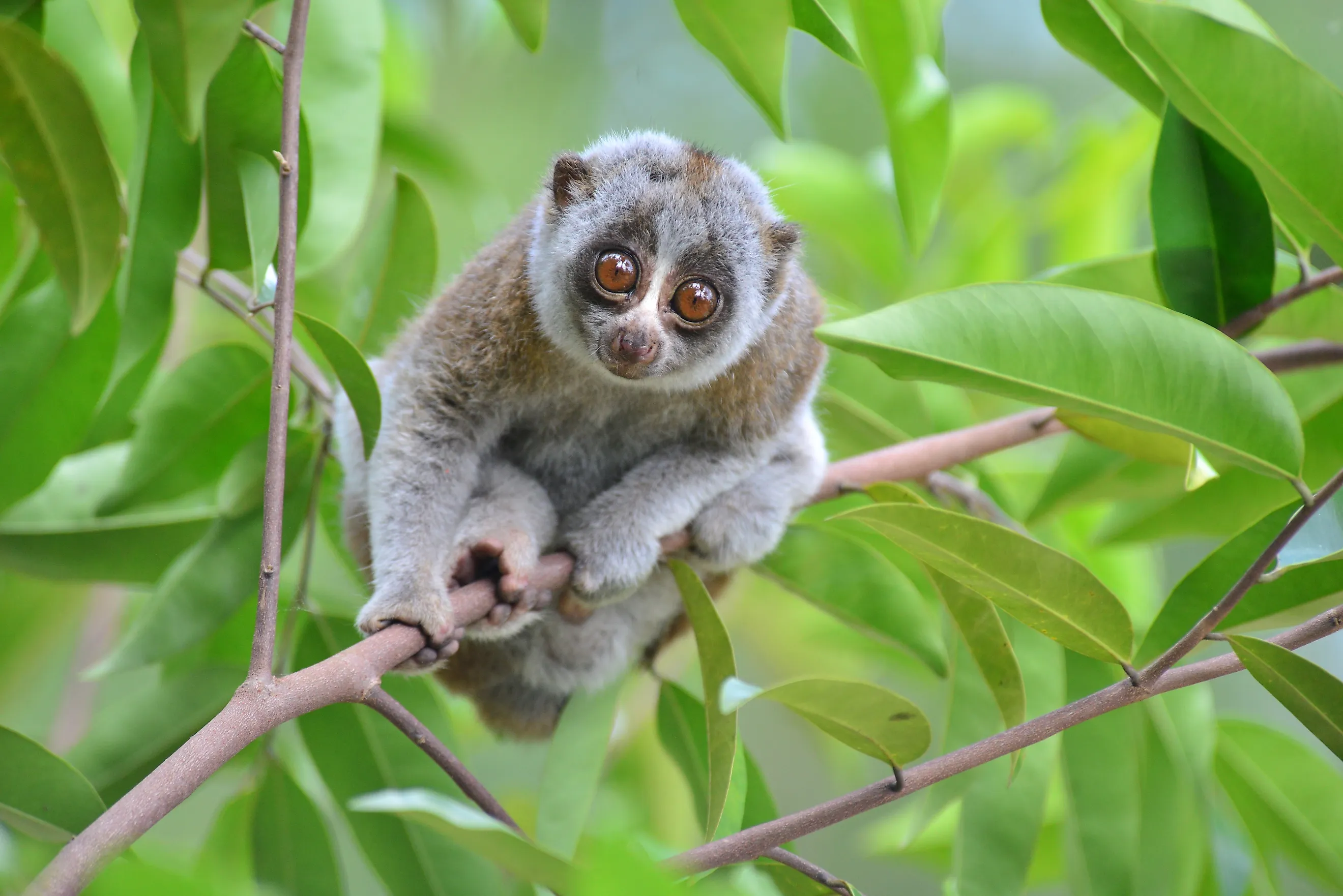
Slow lorises have relatively compact bodies and short limbs adapted for slow, deliberate movement, mainly in trees. Adults typically measure 18-38 centimeters in length, with a short or even absent tail depending on species. Furthermore, their hands and feet have measurably strong gripping ability, with opposable thumbs and toes allowing a firm grasp on branches.
Perhaps most uniquely, a toxin-producing gland is present in the inner elbow, used defensively by mixing the glandular oil with their saliva before biting whichever unlucky target is at the receiving end.
Their dense fur ranges from gray and brown to reddish tones to help blend with the woodland environment, as well as allowing them to better identify other individuals, often with a darker stripe along the spine, too.
Lastly, their heads are quite rounded with a short snout and small ears, mostly hidden in fur, and their notably large, forward-facing eyes help provide good vision at night.
Range And Habitat

These primates are native to South and Southeast Asia, where they occupy a wide but fragmented range. Species occur in countries including India, Bangladesh, southern China, Myanmar, Thailand, Laos, Cambodia, Vietnam, Malaysia, and Indonesia.
As you can maybe tell, they prefer to inhabit tropical and subtropical forests, ranging from lowland rainforests to montane and bamboo forests. With that, dense canopy cover is essential, as slow lorises are fully arboreal and rarely descend to the ground. They are also commonly found in secondary forests, plantations, and other degraded habitats, although survival in these areas is often reduced.
Nocturnal activity helps them avoid many of their predators, namely snakes and raptors, while moving through interconnected branches in search of food and shelter across forest canopies and vegetation layers.
Behavior

Nocturnal, the average slow loris spends most of its active hours moving gradually through the forest canopy in search of food. Knowing that, their slow and deliberate movements do serve a purpose, reducing noise and helping avoid detection by predators and prey alike. During the day, they like to sleep curled up in dense vegetation or tree hollows.
They are generally solitary, though some species may have overlapping home ranges and occasionally contact socially. When communication does occur, it is usually through scent marking, vocalizations, and body postures rather than constant physical interaction, as many other primates tend to do.
When threatened, slow lorises may either remain motionless or raise their arms as a defensive display, while territorial behavior varies by species, with individuals tending to maintain defined foraging areas within their forest habitats.
Food

Slow lorises are omnivorous, with a diet that varies seasonally and by environmental type. They feed primarily on tree gum, sap, and resin, which they extract by scraping bark with their specialized comb-like teeth. In addition to plant exudates, they consume a wide range of insects such as beetles, moths, and caterpillars, as well as small vertebrates, bird eggs, and occasionally fruit. Feeding also often occurs at night when insect activity is higher and competition is lower.
This flexible diet supports survival in a diversity of forest environments across their range, particularly in zones where seasonal changes affect food availability. This can be whether insect populations are low for whatever reason, or the availability of tree gum is likewise sparse, and other foods like eggs and fruit need to be sought out instead.
Reproduction

These creatures have a slow reproductive rate when compared to some other primates. Mating can occur throughout the year, though timing may vary by species and environmental conditions.
Females typically give birth to a single offspring after a gestation period of about five to six months, and twins are rare but can occur. Newborns are relatively well developed and cling to the mother’s fur immediately after birth. Mothers carry and nurse the young for several months, providing constant care and protection, in line with most primate species. Weaning then occurs gradually, and juveniles may remain with the mother until they are capable of independent foraging.
Sexual maturity is generally reached from around 9 months up to 20 months, depending on the species.
Threats

Slow lorises face multiple pressures across their range, most of which are human-driven. Habitat loss from logging, agricultural expansion, and infrastructure development has fragmented forests, reducing access to food and safe movement routes. This isolation, of course, increases vulnerability and limits breeding opportunities for this already slow-to-reproduce species.

They are also heavily impacted by the illegal wildlife trade. Seen by the public as "cute," lots of individuals are captured for use as pets. Some cultures even use them as traditional medicine, too, while in many regions, they are also hunted locally simply for food. During capture, however, many die due to stress, injury, or improper handling, and those sold as pets often suffer from inadequate care, especially since this species does not fare well indoors.
Combined, these factors have led to population declines worldwide, with conservation status varying by species but generally trending toward concern, unfortunately.
Importance To The World

As with most native species in any environment, slow lorises play a vital role in maintaining ecological balance within their home tropical forests. As consumers of insects, they help regulate populations of certain invertebrates, which can, in turn, influence plant health (with overpopulations of insects often decimating leaf cover) and other forest dynamics.
Their feeding on tree gums also contributes to natural pruning processes in some tree species, affecting nutrient cycling in localized ways. As part of a number of complex food webs, they further serve as prey themselves for larger nocturnal predators.
Given that, they also act as indicators of overall forest health, since their presence depends on intact canopy systems. With that, their conservation has highlighted broader issues of biodiversity loss in Southeast Asian woodlands.
Beyond ecology, slow lorises have scientific value in studies of primate evolution, nocturnal adaptation, and mammal venom systems, since they are among the few venomous mammals anywhere on the planet.