Sloth
At first glance, sloths seem notable mainly for being one of the slowest land-moving animals on earth and for having faces that strike people as either cute or vaguely unsettling, depending on who is asked. They are also remarkably specialized, with adaptations to their rainforest canopy that no other mammal has matched, and they play a subtle role in keeping those forests healthy. Every sloth has a slower metabolism than is typical for mammals their size, and the brown-throated three-toed sloth has the slowest metabolism of any non-hibernating mammal. That low metabolic rate dictates almost everything about how they live.
Physical Description

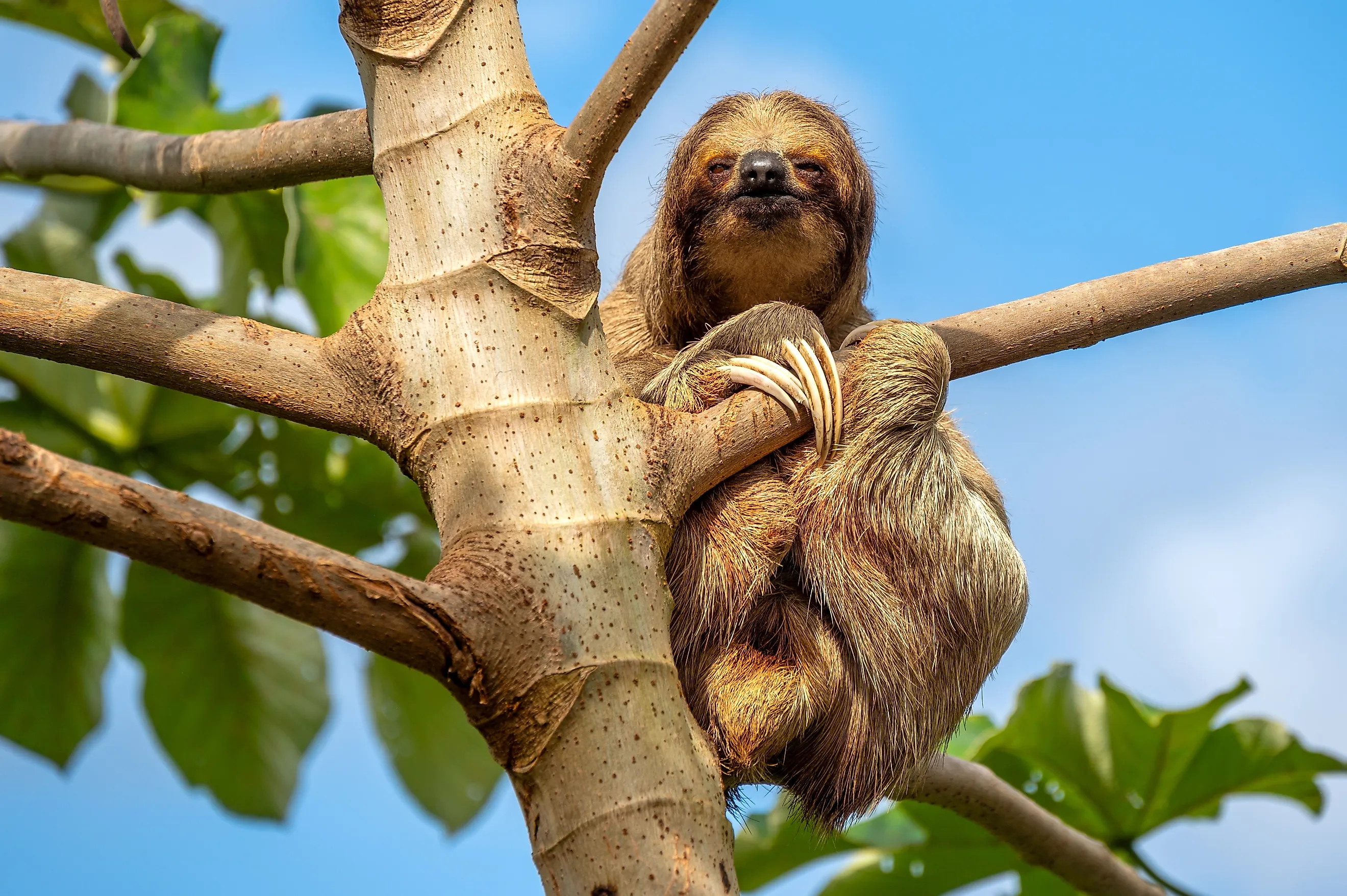
Sloths are tree-dwelling mammals with coarse, dark fur that is often tinged green by algae growing in cracks along each hair shaft. Their rounded heads have distinct faces and small, fur-covered ears, and their bodies end in stubby tails and long limbs capped with curved claws. The number of claws on the front feet is what distinguishes the two living families: two-toed sloths have two claws on each front foot, while three-toed sloths have three. Both groups have three claws on the back feet. Adults are typically two to two and a half feet long and weigh between 9 and 17 pounds, with the largest species (Linnaeus's two-toed sloth) sometimes reaching up to 20 pounds.
Taxonomy And Classification

Sloths are mammals, but the family resemblance to primates is misleading. Sloths belong to the superorder Xenarthra and the order Pilosa, which they share with anteaters and (within a sister group) armadillos. There are seven living species of sloths split across two families. They were once classified together, but research showed enough difference between the two-toed and three-toed groups to warrant separate families.

Two-toed sloths are placed in the family Choloepodidae and include Linnaeus's two-toed sloth (Choloepus didactylus) and Hoffmann's two-toed sloth (Choloepus hoffmanni). The remaining five species sit in the family Bradypodidae: the brown-throated sloth (Bradypus variegatus), the pale-throated three-toed sloth (Bradypus tridactylus), the pygmy three-toed sloth (Bradypus pygmaeus), the northern maned sloth (Bradypus torquatus), and the southern maned sloth (Bradypus crinitus). The southern maned sloth was recognized as a separate species only in 2022, when a Brazilian-led genetic and morphological study revived a name first proposed in 1850.
Range And Habitat

Sloths are found only in the tropical lowland and montane forests of Central and South America, with populations recorded in countries including Brazil, Peru, Bolivia, Venezuela, Panama, and Colombia. Some species have an extremely limited range. The pygmy three-toed sloth lives only on Isla Escudo de Veraguas, a small island off the Caribbean coast of Panama. Sloths are heavily adapted to closed-canopy forest, which makes them particularly vulnerable to habitat loss. They spend almost all of their time in the rainforest canopy, using their long claws to move slowly along branches and vines while feeding to support their low-output metabolism.
Diet And Metabolism

Sloths are primarily herbivores. Two-toed sloths take a wider diet that can include fruit, eggs, and the occasional insect, while three-toed sloths feed almost exclusively on leaves. Leaves are low in calories and difficult to digest, and a sloth's stomach has four chambers that ferment plant matter slowly with the help of resident gut microbes. A single meal can take several weeks to fully process. Sloths are also heterothermic, meaning their body temperature drifts with the surrounding air, and they often rely on the sun rather than internal heat to stay warm. The result is a mammal with very little energy to spare at any given moment, which is why their movements look as deliberate as they do.

Their slow behavior is reinforced by poor eyesight. Sloths are largely nocturnal, their eyes function poorly in bright light, and they are colorblind, so they rely heavily on smell and touch to find food and navigate the canopy. Every movement is carefully placed to conserve the small amount of energy available.

Although sloths have about two thirds the muscle mass of other mammals their size, the arrangement of their muscles gives them a grip strength roughly twice that of humans. Their internal anatomy also accommodates the upside-down lifestyle. Several of a sloth's organs, including the liver and stomach, are tethered to the rib cage so that the weight of the abdomen does not press on the diaphragm and lungs while the animal hangs from a branch.
Behaviour And Reproduction

Sloths are solitary, and adults of the same sex are typically aggressive toward each other. A sloth holds its own territory and leaves it only to mate, with most other activity (eating, sleeping, and giving birth) happening in the canopy itself. Coming down to the ground is rare and risky, since sloths are slow on flat terrain and exposed to predators such as jaguars, ocelots, and harpy eagles. They typically descend only to defecate or to move between trees that are not connected by branches.
Some species mate seasonally, with the female advertising her condition through a high-pitched call, while others can breed year-round. Pairs do not stay together after mating, and gestation length varies by species.

Three-toed sloths gestate for about six months, while two-toed sloths carry their young for closer to ten or eleven months. Females give birth in the trees, so a newborn must cling to its mother from the moment it is born. The young stay with their mother for several months to a year before each finds its own territory. Sloths reach full maturity at two to three years of age and have been recorded living 20 to 30 years in captivity.
Importance To The World And Threats

Sloths play a subtle but real role in their forest ecosystems. The grooved structure of each hair shaft holds water and supports two species of green algae that grow nowhere else, giving sloths a faint greenish tint that helps them blend into the canopy. The algae in turn feed a small community of insects that live in the fur, including beetles, mites, moths, and a sloth-specific species (the sloth moth) that depends entirely on these animals to complete its life cycle. Each sloth essentially carries a miniature ecosystem on its back.

Most sloth species are listed as Least Concern on the IUCN Red List, but three are flagged for conservation concern. The pygmy three-toed sloth is Critically Endangered due to its single-island range. The northern and southern maned sloths, both endemic to small fragments of Brazil's Atlantic Forest, were both reassessed as Endangered in 2024 following the species split.
Habitat loss from deforestation, road construction, and agricultural expansion is the largest threat to all sloths. Poaching is the second. Despite being deeply unsuitable as pets (they are slow to bond, easily stressed, and prone to fatal handling injuries), sloths remain in demand for the illegal pet trade thanks to their appearance in popular media.
Fun Facts

- Despite being painfully slow on the ground, sloths are surprisingly capable swimmers and can hold their breath for up to 40 minutes.
- Wild sloths fall out of trees about once a week on average. They have evolved unusually loose joints, dense bones, and tough skin, and they routinely survive falls of 100 feet or more.
- Today's sloths are small compared to their extinct relatives. Ground sloths of the Pleistocene grew to the size of elephants and weighed up to four tons. Some had a partly omnivorous diet. Most went extinct around 10,000 years ago, likely from a combination of climate change and hunting by early humans.
- Three-toed sloths are one of the few mammals (along with manatees and two-toed sloths) that break the rule that mammals have seven cervical vertebrae. They have eight or nine, which lets them rotate their heads up to 270 degrees.
- Linnaeus's two-toed sloth, the largest living sloth species, is named for Carl Linnaeus, the 18th-century Swedish biologist who created the system of taxonomic classification still in use today.