Why the Peloponnesian War Still Matters Today
The Peloponnesian War (431-404 BCE) was one of the defining conflicts of the ancient world. It occurred between the city-states of Athens and Sparta and fundamentally reshaped the Greek world. However, beyond its historical implications, the conflict offers key lessons on timeless topics such as the Thucydides Trap, political realism, and the tyranny of the majority, all of which are evident in modern geopolitics. For all these reasons, and more, the Peloponnesian War still matters today.
The "Thucydides Trap”

Perhaps the most relevant lesson from the Peloponnesian War is that of the "Thucydides Trap." Inspired by the Athenian historian Thucydides, the primary documentarian of the Peloponnesian War, the term itself was popularized by political scientist Graham Allison. He based it on Thucydides' observation that "the rise of Athens... instilled (fear in) Sparta that made war inevitable." To provide some context, the decades leading up to the Peloponnesian War saw Athens dramatically increase its power. Through the Delian League, an alliance initially established to defend against Persia, Athens accumulated wealth and military might via monetary payments and ship donations. This made the traditional hegemon in Greece, Sparta, anxious. Thus, fearful of Athens' rise, Sparta went to war with Athens.
Allison posited that this same trend, of a waning power feeling threatened by a rising power, is a major reason for many wars throughout history. He noted Portugal and Spain in the late 15th century, the Habsburgs and the Ottoman Empire in the 16th and 17th centuries, and Germany and the United Kingdom in the early 20th century, as examples of this phenomenon. Other political scientists also use the Thucydides Trap to warn against a future conflict between the United States and China. Xi Jinping, the Chinese leader himself, said in 2018 that "we all need to work together to avoid the Thucydides Trap (with the United States)." In short, Thucydides' observations, as honed and clarified by Allison, provide a lens for understanding some aspects of modern history and geopolitics.
Political Realism

The Thucydides Trap can be understood in the context of political realism, one of the pre-eminent theories of international relations. This theory asserts that states operate in an anarchic global system and thus primarily act in their own self-interest. This self-interest is informed by power and survival, rather than ideology.
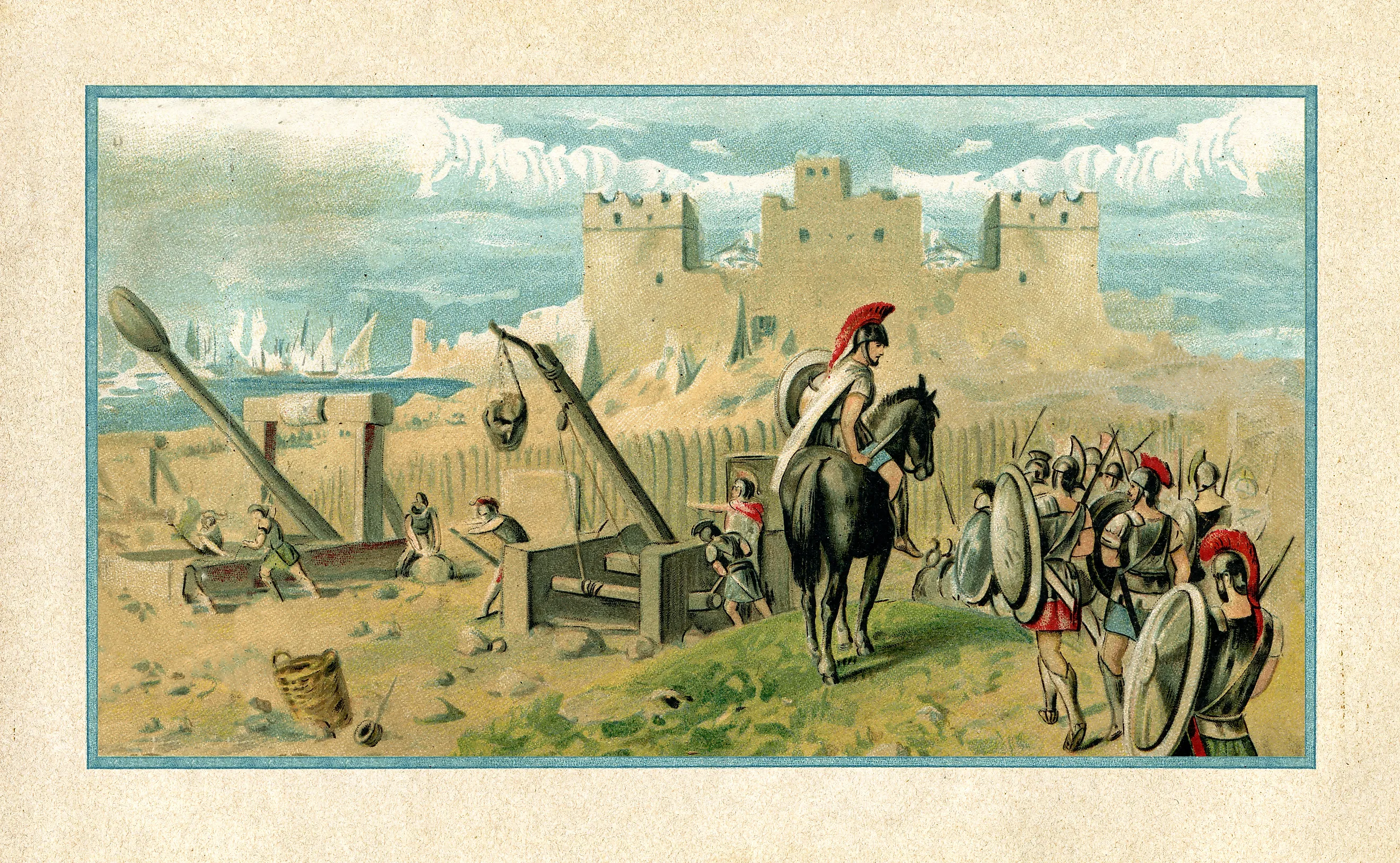
Apart from the outbreak of the war itself, the most famous example of political realism in action occurred in the Melian Dialogue, as detailed in Book Five of Thucydides' History of the Peloponnesian War. In 416 BCE, Athens confronted the small and neutral island of Melos. Athens demanded that Melos join its empire and threatened to destroy Melos if it refused. In response, the Melians argued that it was unjust to attack a neutral island and refused to join Athens. The Athenians rejected this argument and, after a siege, subjugated Melos by killing its men and enslaving its women and children.
Current Examples

The most well-known line from the Melian Dialogue: "the strong do what they can, and the weak suffer what they must", provides realist insights into geopolitics that remain relevant today. In fact, Canadian Prime Minister Mark Carney quoted it in his famous 2026 Davos speech, in which he described the changing world order. He also explicitly referenced the "fading rules-based order" and stated that "we live in an era of great power rivalry."
These statements, clearly rooted in realist thinking, are supported by geopolitical developments over the past ten years. Russia's annexation of Crimea in 2014, followed by its full-scale invasion of Ukraine in 2022, is a prime example in recent history of a major state asserting its influence for blatant power-political reasons. China has made incursions into the South China Sea for similar reasons. Finally, the United States, with its capture of Venezuelan President Nicholas Maduro and its war against Iran in 2026, has demonstrated that it too is now unabashedly operating under a realist mentality. Thus, political realism, as exemplified in the Melian Dialogue, offers a historical point of comparison with some of the fundamental features of modern-day geopolitics.
The Tyranny of the Majority

Finally, the Peloponnesian War can teach us key lessons about the tyranny of the majority. This concept was most clearly on display after the Battle of Arginusae in 406 BCE. Despite winning the battle, Athens lost thousands of sailors when a storm hit the area afterward. Outraged by the military leadership's inability to save the sailors, the Athenian public tried and executed six of eight key naval commanders whom they deemed responsible for the tragedy. This degraded the leadership of the Athenian military at a crucial point in the conflict, and likely contributed to Sparta's victory in the war almost two years later.
This instance of dubious justice helps explain why all major democratic countries have checks and balances to prevent pure democracy. For instance, the United States has three branches of government: the executive, legislative, and judicial. Countries like Canada and the United Kingdom have a merged legislature and executive; however, a non-elected upper house of the legislature provides checks on the elected majority. In many democratic countries, judges are appointed rather than elected. In the United States, for example, they are appointed at the federal level and elected at the state and local levels. Such practices intend to ensure that legal decisions are not left to mob rule. The aftermath of the Battle of Arginusae demonstrates why such measures are necessary.
Impact and Legacy

The Peloponnesian War remains indispensable for understanding the modern world. Indeed, Spartan anxiety about Athenian power gave rise to the notion of the Thucydides Trap, a lens through which one can understand past and future conflicts. Furthermore, the Melian Dialogue was an early illustration of political realism, a theory that has significant explanatory power for current geopolitical events. Finally, instances of mob rule throughout the war demonstrate the dangers of the tyranny of the majority, thereby explaining why democracies have checks and balances to prevent it.