Why the Peloponnesian War Changed Ancient Greece Forever
Perhaps no other event impacted Ancient Greece more than the Peloponnesian War (431 BCE to 404 BCE). A consequence of the competition between Athens and Sparta, the conflict led to Athens' decline and Sparta's temporary rise as Greece's main power. Moreover, it contributed to a more introspective culture, with many Greeks, and Athenians in particular, questioning the values that had led to such a destructive conflict in the first place. Finally, the weakening of many city-states during the war made it easier for a new power, such as Macedonia under Philip II, to establish hegemony over Greece.
Athenian Decline

In the years leading up to the Peloponnesian War, Greece was ruled by two main powers: Athens controlled the sea, whereas Sparta controlled the land. However, Athens' power was greatly diminished after the war, primarily due to the near-total destruction of its navy. This occurred in several disastrous military campaigns. The first of these was the Battle of Syracuse in 413 BCE, which saw the destruction of hundreds of ships and the deaths of thousands. Many Athenian allies also revolted after the battle, further weakening the city-state. The aftermath of the Battle of Arginusae in 406 BCE then weakened the Athenian military leadership. Indeed, although Athens won the battle, thousands of sailors were lost when a storm hit the area soon thereafter. The public subsequently tried and executed six of the generals deemed responsible for this event, thereby decapitating the military leadership at a key point in the war. Finally, the Battle of Aegospotami in 405 BCE saw the remaining Athenian fleet destroyed, making Athens itself vulnerable to a Spartan siege.
Temporary Spartan Dominance

Accompanying the Athenian decline was the rise of Sparta's navy, which was largely made possible due to financial aid from Persia. When combined with strong tactical maneuvers by commanders like Lysander, the Spartans rivaled Athenian naval power by the end of the war. All this meant that Sparta was finally able to force an Athenian surrender in 404 BCE.
After the war, Sparta effectively controlled all of Greece. It proceeded to install oligarchic governments in many city-states, even if they were traditionally democratic. In Athens itself, Sparta established a regime known as the Thirty Tyrants, which oversaw widespread political repression and killed about five percent of the entire population. Nonetheless, an uprising in 403 BCE resulted in the restoration of Athenian democracy after only eight months. This was indicative of Sparta's broader inability to run an empire. Indeed, it lacked administrative experience, and most of the traditionally democratic city-states resented Sparta. Once Persian support for Sparta ended around 387 to 386 BCE, its capacity to rule was further diminished. Hence, Sparta's dominance in Greece was temporary, effectively ending by the late 370s BCE.
Cultural Introspection

The aftermath of the Peloponnesian War saw the rise of cultural introspection in Greece, particularly in Athens. While Athenians had traditionally been proud of democracy, many blamed democratic decision-making on disasters like the Battle of Syracuse. Philosophers like Socrates (and his student Plato) increasingly criticized democracy for enabling persuasive speakers to sway the public into making poor decisions. This skepticism ultimately contributed to the environment in which Socrates himself was tried and found guilty on charges of impiety and corrupting the youth. Furthermore, writers, like the historian Thucydides, began writing about war in a more factual, critical, and rational manner, contrasting the earlier epic traditions like the Iliad and the Odyssey. Finally, art started to reflect this more complicated understanding of reality, with plays like The Trojan Women showing the impact of war from the perspective of the victims. In short, Greek culture fundamentally shifted after the Peloponnesian War into something more cynical, reflective, and critical.
The Rise of Macedonia

Despite a temporary period of Spartan domination, the overall impact of the Peloponnesian War was a widespread weakening of most Greek city-states. This enabled the rise of Macedonia. A state in the far north of Greece, it was traditionally considered politically and culturally "backwards" by the rest of the Greek world due to its monarchical system. However, now with Greece divided and weakened, Macedonia's leader, Philip II, began to expand the state's influence. While the bulk of this influence was achieved through the Macedonian military, the early days saw Philip II also exploit the Greek city-states by forming alliances through marriages and bribes.

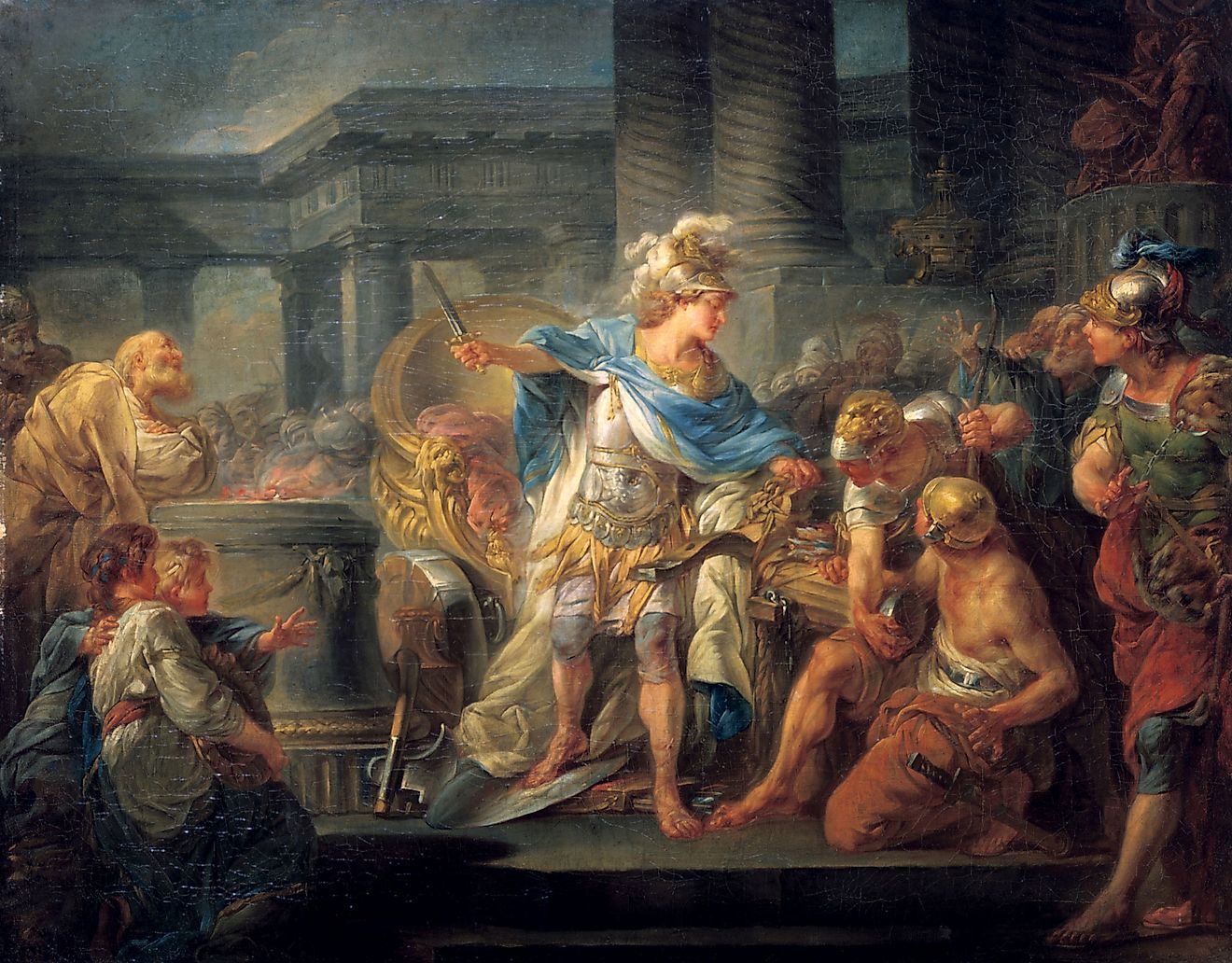
Thereafter, he began to move his army south and took control of northern Greek trading routes. All this culminated in the Battle of Chaeronea in 338 BCE, which saw the Macedonians defeat an Athenian and Theban alliance. Philip II then formed the Corinthian League, which united the Greek city-states and set the stage for nearly 200 years of Macedonian rule over Greece. With this, Philip II also established the groundwork for his son, Alexander the Great, to greatly expand Macedonia's empire.
Impact and Legacy
The Peloponnesian War fundamentally reshaped Greece. Indeed, it caused the decline of Athenian power and the temporary rise of Sparta as a hegemon. Furthermore, it led to a culture of introspection, with many Athenians now questioning the system of democracy that had arguably led to so much death and destruction. Finally, Sparta's decline in power in the 370s BCE was quickly followed by Macedonia's domination of Greece.