10 Important People From Ancient Rome
- One of the most important women in Roman history, Octavia was sister to Augustus, wife of Marc Antony, and ancestral grandmother to Emperors Claudius, Caligula, and Nero.
- Historians believe the city of Ancient Rome may have been home to up to 1 million people during its peak.
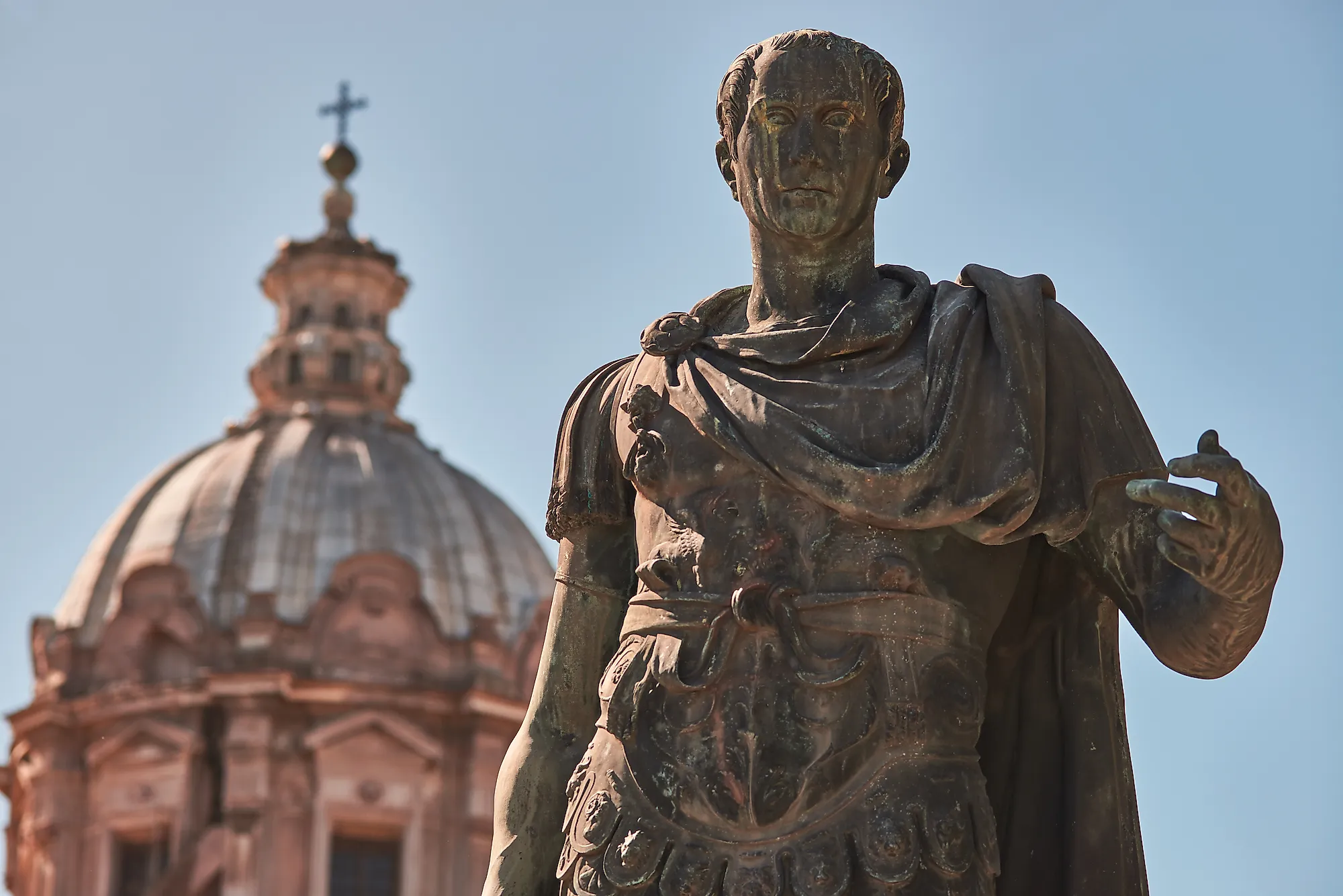
- The name Caesar has become a synonym for
Roman influence on Western civilization extends far beyond the surviving amphitheaters, aqueducts, and roads scattered across Europe, North Africa, and the Middle East. The political institutions, legal frameworks, military systems, literary traditions, calendar, and even the architectural vocabulary of much of the modern world descend from the work of a relatively small number of Romans whose decisions shaped the empire for centuries. The ten figures profiled below, presented in chronological order beginning with the legendary founders and ending with the philosopher-emperor Marcus Aurelius, are not necessarily the most powerful or the most famous Romans, but each made a contribution that continued to shape Rome long after their death and that remains visible in the institutions and culture of the modern world.
Romulus and Remus (Legendary Founders, traditional founding 753 BC)

Romulus and Remus are almost certainly legendary rather than historical figures, but the foundation myth Romans built around them is itself a fact of Roman history with significant political consequences. In the standard version of the story, the twins were the sons of the war god Mars and Rhea Silvia, a Vestal Virgin who was herself a princess of Alba Longa descended from the Trojan hero Aeneas. Set adrift on the Tiber River as infants by a usurping uncle, the twins were suckled by a she-wolf, raised by a shepherd, and as adults founded the city of Rome on April 21, 753 BC by traditional reckoning. A dispute over which of the seven hills should be the city's seat led Romulus to kill Remus.
The reason this myth matters historically is that elite Roman families used it to legitimize their political position. By tracing their lineage back through Aeneas (whose mother in the myth was the goddess Venus), patrician families such as the Julii claimed literal descent from the gods. Julius Caesar publicly invoked this descent during his political career, and Augustus made the Aeneas legend central to imperial ideology, commissioning Virgil's Aeneid as the foundational text of the new regime. The mythological frame around Rome's founding shaped how Romans understood political authority for over a thousand years.
Julius Caesar (100 BC - 44 BC)

Gaius Julius Caesar (100-44 BC) was the most consequential single figure in the transformation by which the Roman Republic gave way to the Empire. As a general, he conquered Gaul in a series of campaigns between 58 and 50 BC, extending Roman territory to the Rhine and the English Channel and producing the written account, Commentarii de Bello Gallico, that remains a standard Latin text. In January 49 BC he crossed the Rubicon River with his army in defiance of the Senate, initiating the civil war that destroyed the Roman Republic. He defeated his rival Pompey at the Battle of Pharsalus in 48 BC, was appointed dictator perpetuo (perpetual dictator) in early 44 BC, and was assassinated on the floor of the Senate on March 15 (the Ides of March) of that year by a group of senators led by Marcus Junius Brutus and Gaius Cassius Longinus.
Caesar's lasting influence operates on several levels. The Julian calendar that he introduced in 46 BC, with its 365.25-day year and leap-year intercalation, remained the basis of timekeeping in the West for over 1,600 years and survives today, with minor refinements, as the Gregorian calendar. His name became the generic title for monarchs in two later imperial traditions: tsar (or czar) in Russia and Kaiser in Germany. His political career inspired William Shakespeare's tragedy Julius Caesar and centuries of subsequent literature and political theory on dictatorship, civil war, and the death of republican government. The Empire he made possible would govern much of the Mediterranean world for the next five centuries.
Mark Antony (83 BC - 30 BC)

Marcus Antonius (83-30 BC), known in English as Mark Antony, served as Julius Caesar's principal lieutenant during the civil war against Pompey and as one of Caesar's two consular colleagues at the time of the assassination. After Caesar's death, Antony joined Octavian (Caesar's adopted heir, later Augustus) and Marcus Aemilius Lepidus in the Second Triumvirate, formalized by law in 43 BC, which divided the Roman world among the three men. In the eastern provinces assigned to him, Antony allied himself with Cleopatra VII of Egypt, with whom he fathered three children.
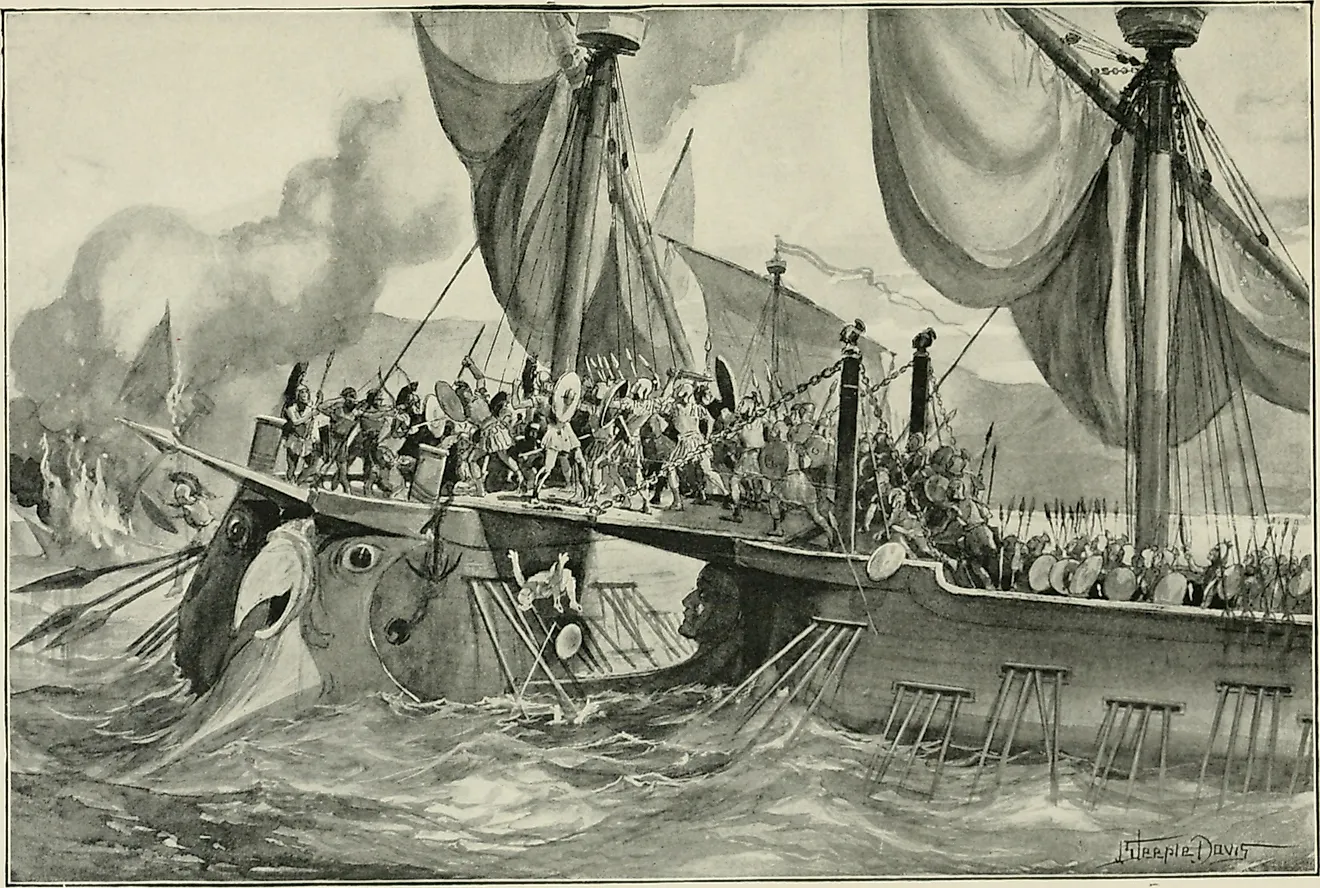
The political and military rupture between Antony and Octavian came to a head at the Battle of Actium on September 2, 31 BC, a naval engagement off the western coast of Greece in which Octavian's fleet under Marcus Vipsanius Agrippa decisively defeated the combined forces of Antony and Cleopatra. Both Antony and Cleopatra committed suicide in Alexandria the following year. The historical significance of Antony's defeat is that it ended the Roman civil wars, left Octavian as sole ruler of the Roman world, and made possible the founding of the Roman Empire. Antony's career, with its mix of military skill, political miscalculation, and personal entanglement with Cleopatra, has been retold in literature and drama for two thousand years, most notably in Shakespeare's Antony and Cleopatra.
Virgil (70 BC - 19 BC)

Publius Vergilius Maro (70-19 BC), known in English as Virgil, was the most influential Latin poet of the Augustan age and arguably of Western literature. He produced three major works: the Eclogues (a set of pastoral poems published around 38 BC), the Georgics (a didactic poem on agriculture completed around 29 BC), and his epic the Aeneid, on which he worked from about 29 BC until his death in 19 BC. The Aeneid tells the story of the Trojan prince Aeneas, who escapes the destruction of Troy, travels through the Mediterranean (with an extended stay in Carthage in modern Tunisia), and ultimately settles in Italy, where his descendants will found Rome.
The political function of the Aeneid was to provide a foundational national epic for Augustan Rome, linking the new imperial regime back to the heroic age and to divine ancestry through Aeneas and Venus. Beyond its immediate political purpose, the poem became the central work of the Latin literary curriculum for the next two millennia. Dante chose Virgil as the narrator's guide through Hell and Purgatory in the Divine Comedy, making him the central poetic figure of medieval Christian literature. Latin schools in Europe and the Americas studied Virgil continuously from antiquity into the twentieth century, and his influence on poets in every European vernacular language is difficult to overstate.
Octavia the Younger (69 BC - 11 BC)

Octavia the Younger (69-11 BC), elder sister of the future emperor Augustus and great-niece of Julius Caesar, occupied a position of unusual political importance for a Roman woman. Her second marriage, to Mark Antony in October 40 BC, was arranged by the Treaty of Brundisium and was specifically intended to seal the political reconciliation between her brother Octavian and Antony after the latest round of civil war. The marriage produced two daughters, Antonia Major and Antonia Minor. When Antony abandoned her for Cleopatra and was subsequently defeated and killed in 30 BC, Octavia took in Antony's surviving children by Cleopatra and his earlier wife Fulvia and raised them in her own household alongside her own children.
The reason Octavia matters in Roman history extends beyond her personal conduct: her descendants supplied four of the next five Roman emperors. Through her daughter Antonia Minor, she was the maternal grandmother of the Emperor Claudius, paternal grandmother of Germanicus, and great-grandmother of the emperors Caligula and Nero (Nero descended from her on both his father's and his mother's side). Augustus relied on her counsel during his rise to power and afterward, and after her death in 11 BC he had the Senate declare her divine and built the Porticus Octaviae in her memory. Among the women of the late Republic and early Empire, only Augustus's wife Livia rivaled her political importance.
Augustus (63 BC - 14 AD)

Gaius Octavius (63 BC - 14 AD), known after 27 BC as Augustus, was the grand-nephew and adopted son of Julius Caesar and the first Roman emperor. After defeating Mark Antony at Actium in 31 BC and annexing Egypt the following year, he spent the remaining four decades of his life reorganizing the Roman state. The constitutional settlement of 27 BC, in which he formally restored the Republic while retaining all real power as princeps (first citizen), established the basic political structure (the Principate) under which the Empire would be governed for the next three centuries. He reorganized the army into a standing professional force, established treasury arrangements for veterans' pensions, created the Praetorian Guard, founded the urban cohorts and the vigiles (the first organized firefighting and night-watch force in any major city), and reformed taxation, provincial administration, and the road network.
Augustus's reign inaugurated the Pax Romana, a period of roughly two centuries during which the Mediterranean world experienced unprecedented stability, economic integration, and demographic growth. The eighth month of the Roman calendar was renamed Augustus (August) in his honor by senatorial decree in 8 BC, alongside a correction of leap-year intercalation that finalized the operation of the Julian calendar his great-uncle had introduced four decades earlier. The model of monarchy that Augustus invented (an absolute ruler operating under republican forms) became a template for European political thought from the Holy Roman Empire through the Napoleonic period.
Livy (59 BC - 17 AD)

Titus Livius Patavinus (59 BC - 17 AD), known in English as Livy, was the principal historian of the Augustan age. His monumental work, Ab Urbe Condita Libri (Books from the Founding of the City), originally comprised 142 books covering Roman history from the legendary arrival of Aeneas in Italy through the death of Augustus's stepson Drusus in 9 BC. Only 35 of the 142 books survive in full, with the remainder known only from later summaries and fragments, but those that survive provide the most detailed surviving narrative of the Roman Republic from its early years through the wars against Carthage.
Livy is important not because he was an eyewitness to political events (he was a literary figure and a friend of Augustus, not a senator or general) but because for two thousand years his account has shaped how the Roman Republic has been understood. His narrative of figures such as Cincinnatus, the Horatii, Lucretia, and Hannibal became the canonical version of those stories, retold in textbooks, paintings, and political speeches throughout Europe. When the framers of the American constitution invoked Cincinnatus as a model of republican virtue, or when revolutionary France named institutions after Brutus, they were drawing on Livy's narrative. His history is also a major source for the conviction that Roman political success depended on civic virtue, a theme that runs through Western republican thought beginning with Machiavelli and continuing into the modern day.
Trajan (53 AD - 117 AD)

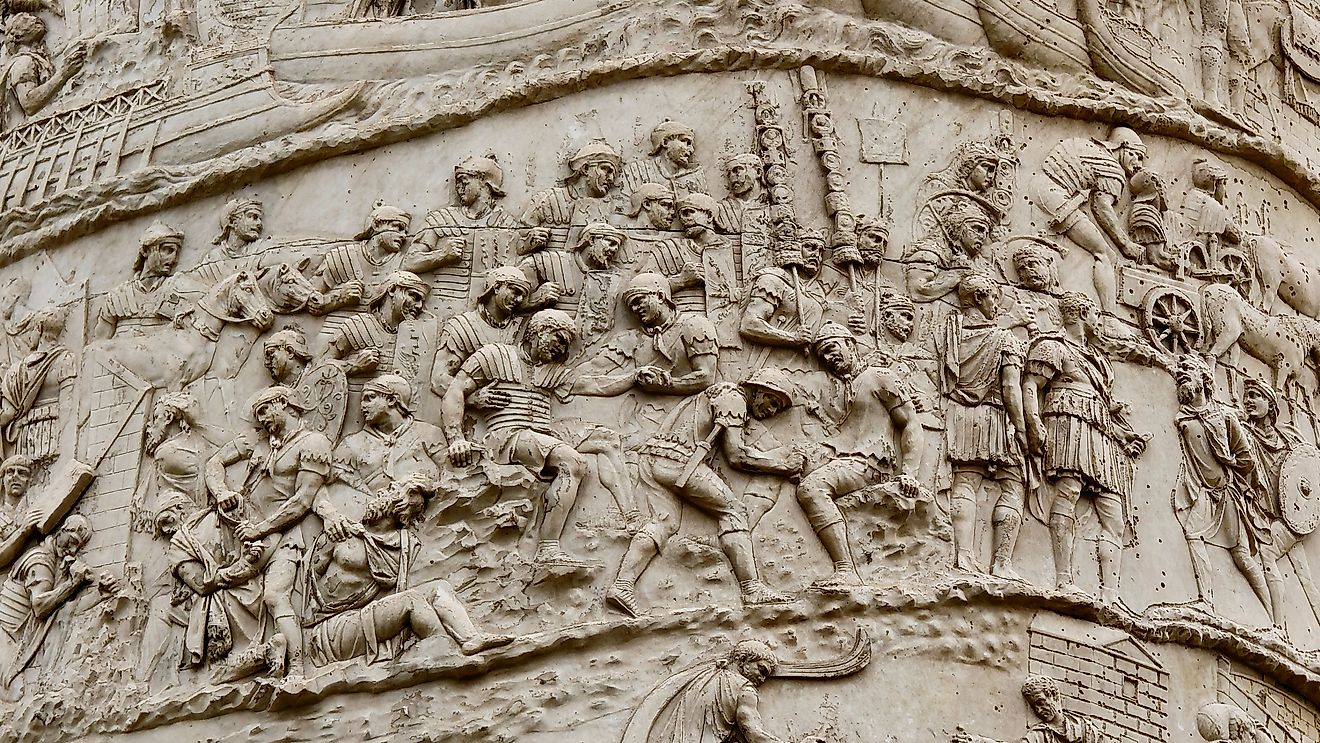
Marcus Ulpius Traianus (53-117 AD), known as Trajan, ruled as emperor from 98 to 117 AD and was the first Roman emperor born outside Italy (in Italica, in modern southern Spain). His reign saw the Roman Empire reach its greatest territorial extent. The two Dacian Wars (101-102 and 105-106 AD) added the rich gold-mining province of Dacia (covering most of modern Romania and parts of Hungary and Ukraine) to the Empire and are commemorated in the spiral relief on Trajan's Column, which still stands in Rome. His campaigns in the east between 114 and 117 AD took Roman armies through Armenia and Mesopotamia to the Persian Gulf, the furthest east Roman forces ever reached.
Trajan's lasting importance is not only territorial. He was the second of the so-called Five Good Emperors and was remembered by later Romans as the model of a successful princeps, to the extent that the Senate would later greet new emperors with the formula felicior Augusto, melior Traiano ("more fortunate than Augustus, better than Trajan"). His public works programs in Rome (Trajan's Forum, Trajan's Market, the Baths of Trajan) and across the provinces (roads, harbors, the bridge over the Danube designed by Apollodorus of Damascus) set a benchmark for imperial infrastructure investment. The territorial high-water mark of his reign also marks the point after which subsequent emperors generally consolidated rather than expanded, an inflection point that historians still use to date the transition between the expansionary phase of empire and the later defensive phase.
Hadrian (76 AD - 138 AD)

Publius Aelius Hadrianus (76-138 AD), known as Hadrian, succeeded Trajan in 117 AD and ruled until 138. His central decision as emperor was strategic: rather than continue Trajan's expansion, he withdrew from much of Mesopotamia and concentrated imperial resources on consolidating and fortifying the existing frontiers. The most famous result is Hadrian's Wall in northern Britain, a stone and turf fortification 73 statute miles (about 117 kilometers) long, running coast to coast across northern England, with Wallsend on the River Tyne at the eastern terminus and Bowness-on-Solway at the western. Construction began in 122 AD after Hadrian's personal visit to Britain and took roughly six years. He oversaw similar frontier fortifications along the Rhine and Danube, where the German limes was strengthened with continuous palisades and watchtowers.
Hadrian also rebuilt the Pantheon in Rome between roughly 118 and 128 AD, replacing the earlier temple of Marcus Agrippa that had burned down. The reconstructed building, with its 43.3-meter unreinforced concrete dome and central oculus, is the largest unreinforced concrete dome in the world and one of the best-preserved structures of antiquity. It is the architectural model from which Renaissance domes (Florence's Santa Maria del Fiore, St. Peter's Basilica) and the U.S. Capitol Building descend. Hadrian also constructed his own villa at Tivoli, his circular mausoleum on the Tiber (now the Castel Sant'Angelo), and Aelia Capitolina on the site of Jerusalem after suppressing the Bar Kokhba revolt (132-135 AD). He spent more than half his reign traveling the provinces in person, an administrative pattern with no real precedent in earlier emperors.
Marcus Aurelius (121 AD - 180 AD)

Marcus Aurelius Antoninus (121-180 AD) ruled from 161 to 180 AD, initially as co-emperor with his adoptive brother Lucius Verus until the latter's death in 169, and afterward alone. He was the last of the Five Good Emperors and the only one whose private philosophical writings survive. The Roman-Parthian War of 161-166 AD, fought during the early years of his reign, was nominally under the command of Lucius Verus but was actually directed by the generals Statius Priscus and Avidius Cassius, who recovered Armenia and sacked the Parthian capital Ctesiphon before the campaign was cut short by the outbreak of the Antonine Plague among the legions. From 166 AD onward, Marcus Aurelius spent most of his reign on the Danube frontier fighting the Marcomannic Wars against Germanic and Sarmatian tribes; he died on campaign at Vindobona (modern Vienna) in 180 AD with the war still in progress.
What makes Marcus Aurelius distinctive in Roman history is the survival of his Meditations, a series of personal philosophical notes written in Greek during his Danube campaigns. The work is the most extensive surviving statement of Roman Stoic philosophy and has remained continuously in print since its first publication in 1559. It is the rare case of a ruling head of state's private intellectual notebook surviving, and it has been read as a manual on duty, mortality, and self-discipline by an unusual range of readers, including Frederick the Great as well as modern executives and military officers. His death in 180 AD also marks a conventional turning point in Roman history: his son Commodus, who succeeded him, was the first emperor to inherit the throne by birth in over a century, and the end of the Antonine succession is often taken as the end of Rome's most stable imperial period.
The Common Thread
What links these ten figures, across the eight centuries between the legendary founding of Rome and the death of Marcus Aurelius, is that the institutions and cultural forms they created or shaped continued to function long after each of them was gone. The Julian calendar tracks our years today. The Aeneid was a Latin classroom text from antiquity until the twentieth century. The Pantheon still stands. The Stoic philosophy of Marcus Aurelius still sells in airport bookstores. The political vocabulary of monarchy in Europe carried Caesar's name for almost two thousand years. The reason these particular Romans warrant attention is not that they were the most famous, but that the work each of them did established something that outlasted Rome itself.