Rome’s Bloodiest Power Struggles
Rome was notorious for its power struggles, which ranged from behind-the-scenes scheming to full-on political purges and civil wars. Understanding these events is crucial to comprehending how the Roman political system functioned. The civil war between Caesar and Pompey helped clear the path to the Roman Empire, and the Crisis of the Third Century, more than two centuries later, laid bare deep flaws in Roman governance and administration. Such power struggles are indelible parts of Roman history.
Sulla's Civil War And Proscriptions (88 to 81 BCE)

At the beginning of the 80s BCE, the Roman Republic was divided between powerful generals. Two such generals were Lucius Cornelius Sulla and Gaius Marius. Tensions between the men came to a boiling point during the Mithridatic War. The Senate initially gave Sulla command of the campaign to defeat King Mithridates VI. However, the tribune Publius Sulpicius Rufus pushed through legislation transferring the command from Sulla to Marius. Rather than accepting this decision, Sulla marched on Rome in 88 BCE. Using one's own army to settle a domestic political dispute was unprecedented, and it established a dangerous norm for decades to come.
After resecuring control of the campaign, Sulla traveled east to fight Mithridates. While he was gone, Marius, who had fled from Italy, returned to Rome in 87 BCE and defeated Sulla's allies. He then purged Sulla's supporters and confiscated their property. Marius died soon afterward, but his allies remained in power. This led to another round of civil wars from 83 to 82 BCE when Sulla returned from the east. Sulla ultimately won and became dictator of Rome.
His victory was followed by yet another purge, this time via proscription lists. These were official, state-sponsored assassination lists. If your name appeared on one, you could legally be killed and have your property confiscated. While Sulla's battlefield enemies were the main targets, people were also assassinated due to their wealth or simply because they were associated with someone on the list. Hundreds were likely killed, on top of the already substantial death toll from the civil wars and previous purges in the preceding decade.
Caesar, Pompey, and the Second Triumvirate's Proscriptions (49 to 42 BCE)

The Roman Republic remained divided among powerful generals as the century went on. By the late 50s BCE, Julius Caesar and Pompey the Great were its two pre-eminent figures. Caesar's campaign to capture Gaul had garnered him immense wealth and personal popularity. As his command in Gaul neared its end, Pompey increasingly aligned himself with Caesar's senatorial opponents, who demanded that Caesar relinquish his command before returning to political life in Rome. Caesar refused and effectively declared war on the Senate when he crossed the Rubicon River, then the boundary between Cisalpine Gaul and Italy, with his army in 49 BCE.
The subsequent civil war lasted about four years. Pompey was quickly defeated in Greece and assassinated in Egypt in 48 BCE. Caesar then spent the next three years defeating Pompey's remaining forces. After emerging victorious, he declared himself dictator for life in 44 BCE. This wouldn't be for very long, since he was assassinated later that year by a group of senators concerned about his tyrannical rule. Caesar's allies, led by an alliance of Mark Antony, Octavian, and Lepidus called the Second Triumvirate, responded by launching arguably the most brutal proscription campaign in Roman history. The main targets were senators and wealthy Romans associated with the assassins. The famous orator and virulent critic, Cicero, was likely the most prominent victim. Ultimately, the nearly decade-long period of bloodshed came to an (temporary) end in 42 BCE, when the assassins were defeated at the Battle of Philippi.
The Year Of The Four Emperors (69 AD)

In 68 AD, disgraced emperor Nero committed suicide. With no clear succession process, the Roman Empire descended into chaos as four emperors rose and fell in a single year. Galba was the first to succeed Nero. Initially, he seemed like a fairly standard emperor. However, Galba quickly alienated important supporters through unpopular political decisions, including his refusal to pay expected military donatives and his decision to adopt Piso Licinianus rather than Marcus Salvius Otho as his heir. Otho, Galba's former ally, ultimately convinced the Praetorian Guard to kill him in January 69 AD. This made Otho the next emperor.
The new emperor immediately faced a threat to the north as legions stationed along the Rhine River proclaimed Aulus Vitellius emperor. Otho's forces were defeated by Vitellius' in April 69 AD, leading to Otho committing suicide. Vitellius was never accepted by the legions in the eastern empire, who instead proclaimed their own commander, Vespasian, as emperor. Despite holding onto power for eight months, Vitellius was ultimately defeated and killed in December of 69 AD. Vespasian would rule Rome for the next decade and brought with him some much-needed stability.
The Crisis Of The Third Century (235 to 284 AD)

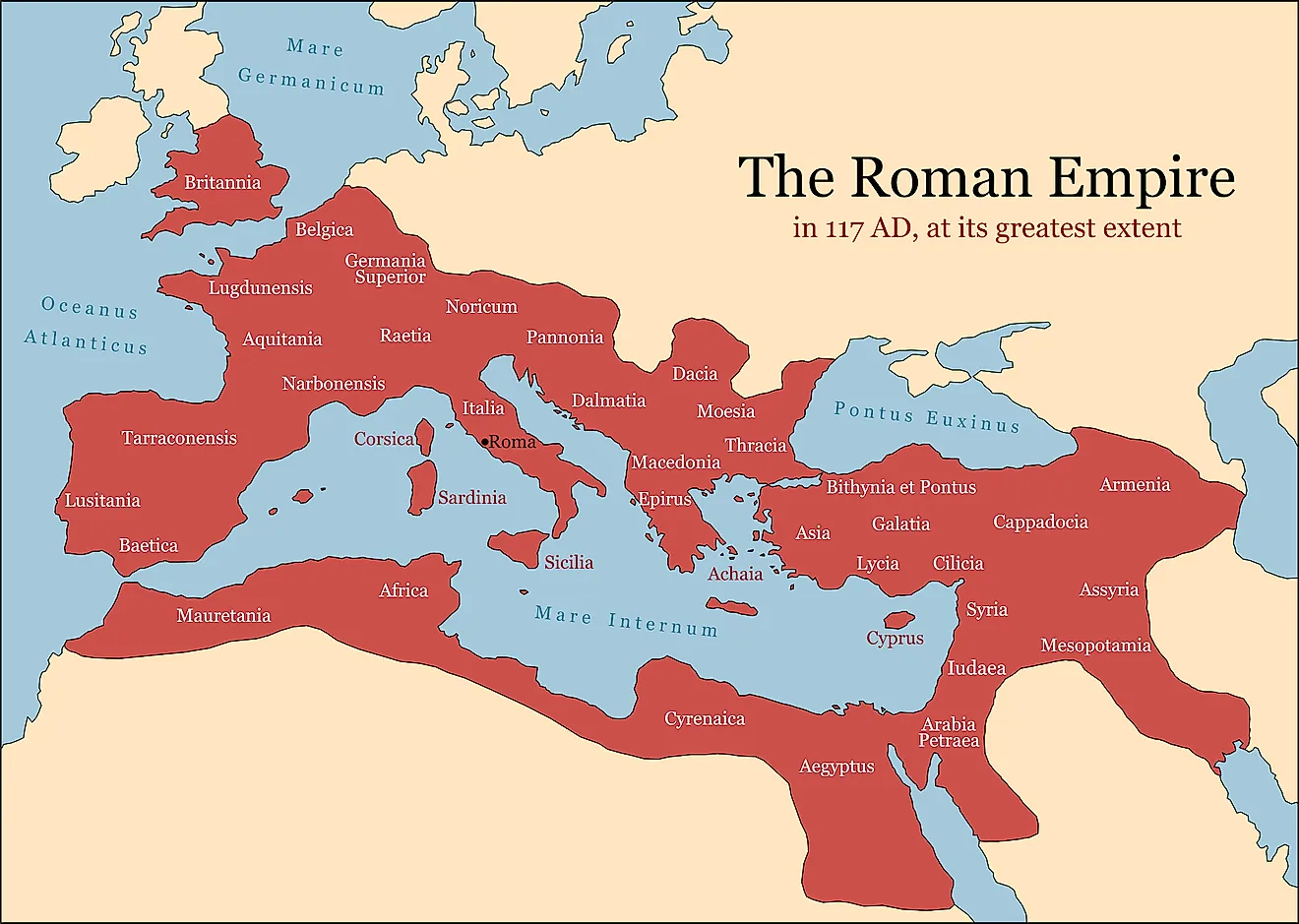
Rather than a traditional power struggle, the Crisis of the Third Century was a fifty-year period during which nearly every aspect of Roman civilization faced existential threats. It began in 235 AD with the assassination of Emperor Severus Alexander. Over the next half-century, over two dozen emperors rose and fell. Many of them were "barracks emperors," meaning that they were generals proclaimed emperor by their troops. External threats exacerbated this political crisis, as the Persia-based Sasanian Empire made incursions in the southeast and Germanic tribes invaded from the north. All these factors eventually proved to be too much, and the Roman Empire briefly split into three competing states: the Gallic Empire in the West, the Palmyrene Empire in the East, and the Roman Empire in the center. This division didn't last. Aurelian restored the empire's territorial unity by defeating the Palmyrene and Gallic breakaway states, while Diocletian later brought the wider crisis to an end and reorganized imperial government. Nevertheless, the Crisis of the Third Century was perhaps the most existential threat Roman civilization had faced up to that point.
Impact And Legacy
Rome's bloodiest power struggles left a lasting mark. When Sulla marched on Rome and drew up his proscription lists, he set the precedent of using armies to settle domestic political disputes. Caesar and Pompey took that precedent further, and a decade of civil war, assassinations, and purges followed. The Year of the Four Emperors grew out of Rome's informal system for imperial succession. During the Crisis of the Third Century, generals and invaders together exposed the fundamental weaknesses at the core of the Roman Empire.