The 10 Least Populated Countries In Asia
Asia is the world's largest continent in both area and population, but its 4.8 billion people are unevenly distributed. While India and China each hold over 1.4 billion residents, several Asian countries have populations smaller than a mid-size American city. The ten countries below are the least populated sovereign states in Asia among the 193 United Nations member states, ranked smallest to largest using the United Nations World Population Prospects 2024 revision (mid-2025 estimates). Small island nations like Brunei and the Maldives lead the list, while Lebanon now appears in the top 10 for the first time, having dropped below Turkmenistan due to sustained emigration during the country's ongoing economic crisis.
1. Brunei - 466,330

Brunei Darussalam, the smallest sovereign nation in Asia by population, occupies 5,765 square kilometres on the northern coast of the island of Borneo, almost entirely surrounded by the Malaysian state of Sarawak with the exception of a coastline along the South China Sea. The country is divided into two non-contiguous regions by a sliver of Sarawak territory at Limbang. Brunei has been ruled by the same dynasty for more than six centuries, currently under Sultan Hassanal Bolkiah, who has reigned since 1967 and is one of the longest-serving current monarchs in the world. The economy runs on oil and natural gas exports, which give Brunei one of the highest GDP-per-capita figures in Southeast Asia. About 76% of the population lives in urban areas, concentrated around the capital, Bandar Seri Begawan. Ethnic Malays make up about 66% of the population, and Standard Malay is the official language, with English and Chinese widely used in business. Islam is the state religion, and Brunei applies a dual legal system that includes Sharia courts alongside common law.
2. Maldives - 529,676

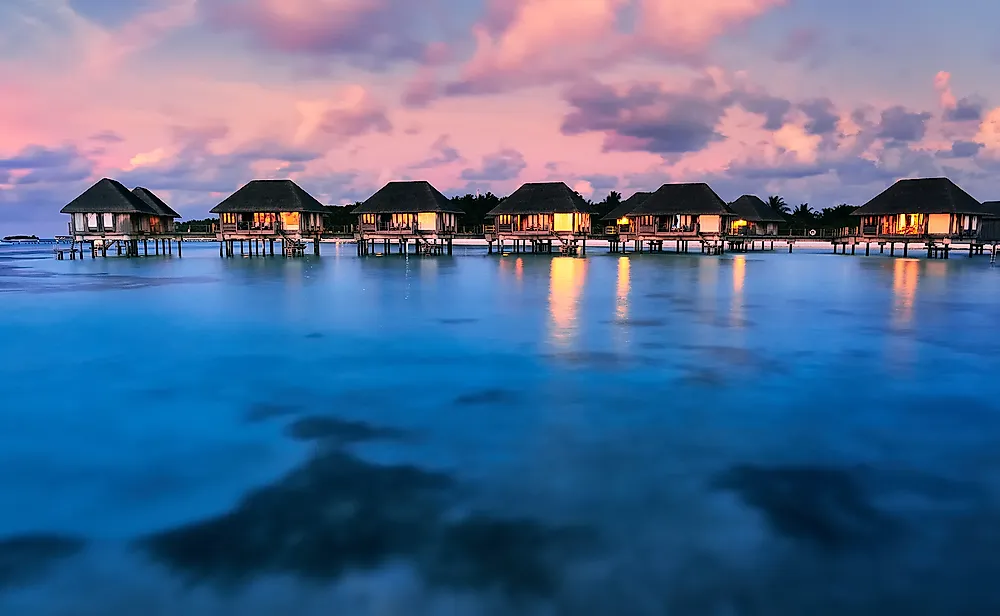
The Maldives is a chain of 26 natural atolls comprising approximately 1,192 individual coral islands spread across roughly 90,000 square kilometres of the Indian Ocean, southwest of Sri Lanka and India. Only about 200 of the islands are inhabited. The country covers 300 square kilometres of land area, making it the smallest Asian nation by territory, and it is also the world's lowest-lying country, with an average ground level of about 1.5 metres above sea level. This makes the Maldives one of the most climate-vulnerable nations on Earth, with the government actively pursuing land-reclamation and floating-island projects. The capital, Malé, on the island of the same name, is one of the most densely populated cities in the world. The population has grown by more than 35% since 2017, reflecting one of the higher birth rates in Asia. Dhivehi, an Indo-Aryan language, is the national language, and Sunni Islam is the state religion.
3. Bhutan - 787,425

Bhutan is a landlocked mountainous country in the Eastern Himalayas, with a 38,394-square-kilometre territory pinched between China to the north and India to the south, east, and west. Elevation ranges from about 200 metres in the southern foothills to over 7,500 metres at the peaks along the Chinese border. Bhutan is the only country in the world that measures progress using Gross National Happiness, a development index established in the 1970s under King Jigme Singye Wangchuck, alongside conventional GDP. The country is also constitutionally required to maintain at least 60% forest cover at all times and is currently the only country in the world certified as carbon-negative. The capital city Thimphu is one of the few in the world without traffic lights at major intersections, with white-gloved police directing vehicles. Dzongkha is the official language, and the Ngalop of western Bhutan and the Sharchop of the east are the two largest ethnic groups. Vajrayana (Tantric) Buddhism is the state religion and is practiced by around 75% of the population.
4. Timor-Leste - 1.40 million

Timor-Leste, also known as East Timor, occupies 14,874 square kilometres in the eastern half of the island of Timor, the small Oecusse exclave on the north coast of West Timor, and the offshore islands of Atauro and Jaco. The country was a Portuguese colony from the 16th century until 1975, was occupied by Indonesia from 1975 to 1999, and gained full independence on May 20, 2002, making it the youngest sovereign country in Asia. The economy relies heavily on offshore oil and natural gas from the Timor Sea, and the country uses the US dollar as its official currency. The capital and largest city is Dili. Tetum and Portuguese are the two official languages, with Indonesian and English designated as working languages. Roman Catholicism, a legacy of Portuguese rule, is followed by approximately 97% of the population, making Timor-Leste the most heavily Catholic country in Asia.
5. Bahrain - 1,643,331

Bahrain is the third-smallest country in Asia by area at 780 square kilometres, an archipelago of 33 islands in the Arabian Gulf connected to Saudi Arabia by the 25-kilometre King Fahd Causeway, completed in 1986. The country is the most densely populated sovereign state in the Middle East and one of the most densely populated in the world. Approximately 55% of residents are foreign nationals, with significant communities from India, Pakistan, Bangladesh, and the Philippines, drawn primarily by the banking, refining, and aluminum-smelting industries that supplement the country's depleting oil reserves. Bahrain was the first Gulf state to discover oil (in 1932) and has been positioning itself as a regional financial hub. Manama and Al Muharraq host the bulk of the population. Bahrain has hosted a Formula One Grand Prix since 2004 at the Bahrain International Circuit in Sakhir. Arabic is the official language, with English widely used in business. Islam is the official religion, with both Sunni and Shia communities present.
6. Qatar - 2,716,391

Qatar is a peninsular country in Western Asia, sharing its only land border with Saudi Arabia and with the rest of its perimeter on the Arabian Gulf. The country's population fluctuates considerably with the migrant workforce: Qatari citizens make up only about 12% of residents, while ethnic Indians, Bangladeshis, Nepalis, and Filipinos collectively account for over 60%. Qatar holds the world's third-largest proven natural gas reserves, and the country's economy is anchored by Qatar Energy's liquefied natural gas exports through the North Field facility. Qatar hosted the 2022 FIFA World Cup, the first World Cup ever held in the Arab world and in a Muslim-majority country, and the first to be played in November and December rather than in summer due to the local heat. The capital Doha is home to Al Jazeera, the influential Arabic-language news network founded in 1996. Arabic is the official language, and Islam is the state religion.
7. Mongolia - 3,447,157

Spread across 1,564,116 square kilometres between Russia and China, Mongolia is the most sparsely populated sovereign country in the world, with a density of just over two people per square kilometre. The Gobi Desert occupies the south, the Altai and Khangai mountains rise in the west, and the vast steppes of the central and eastern regions historically supported the nomadic herding culture that produced Genghis Khan and the 13th-century Mongol Empire, the largest contiguous land empire in history. Around 40% of the national population now lives in Ulaanbaatar, the capital, and approximately one-third of Mongolians still maintain traditional nomadic or semi-nomadic livelihoods. Mongolia is one of only two doubly landlocked countries in the world (the other is Liechtenstein), and it borders only Russia and China. Mongolian is the official language, written in the Cyrillic script since 1946 (the traditional Mongol script is being phased back in for official use by 2025). Tibetan Buddhism is the largest religion.
8. Kuwait - 4,310,108

Kuwait is a small country at the northern end of the Arabian Gulf, sharing land borders with Iraq and Saudi Arabia. The Kuwaiti Public Authority for Civil Information reports total residents including non-registered workers at around 4.9 million, with foreign nationals accounting for roughly 70% of that figure. Kuwait holds approximately 7% of the world's proven oil reserves and is one of the founding members of OPEC. The country was invaded by Iraq in August 1990 and liberated by a US-led coalition in February 1991 in the Gulf War, an event that continues to shape Kuwaiti foreign policy and the country's defense relationships. The capital Kuwait City is home to the landmark Kuwait Towers, completed in 1979 and recognised as a national symbol. Kuwait has one of the highest per capita incomes in the world, and the Kuwait Investment Authority is one of the oldest sovereign wealth funds, established in 1953. Islam is the dominant religion, and Modern Standard Arabic is the official language, with Kuwaiti Arabic spoken in daily life.
9. Oman - 4,644,384
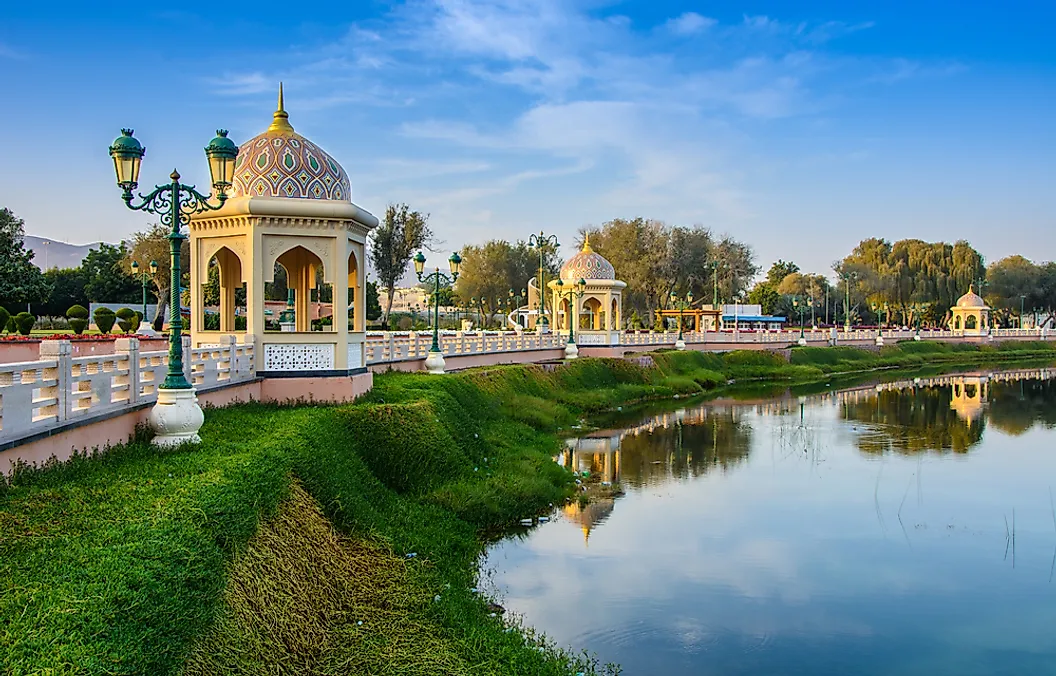
Oman occupies the southeastern corner of the Arabian Peninsula, with coastlines on the Arabian Sea, the Gulf of Oman, and the Strait of Hormuz, and land borders with Saudi Arabia, the UAE, and Yemen. The country also includes the Musandam exclave, separated from the rest of Oman by the UAE and overlooking the strategic Strait of Hormuz through which roughly 20% of global oil shipments pass. About 78% of the population lives in urban areas, with nearly half concentrated in and around the capital city of Muscat. Sultan Haitham bin Tariq, who succeeded Sultan Qaboos in 2020 after the latter's nearly 50-year reign, is implementing Oman Vision 2040, an economic-diversification strategy aimed at reducing the country's dependence on oil. About 45% of Oman's population are expatriates, primarily from South Asia and Southeast Asia. Ibadi Islam, a branch distinct from both Sunni and Shia, is the dominant tradition, and Islam is the official religion. Arabic is the official language.
10. Lebanon - 5,353,930

Lebanon appears in the top 10 least populated Asian countries for the first time, having seen its population decline due to sustained emigration during the country's ongoing economic crisis, which began in 2019 and is among the most severe peacetime economic collapses recorded by the World Bank. The country occupies 10,452 square kilometres on the eastern Mediterranean coast, bordered by Syria and Israel. Lebanon was the centre of Phoenician civilization roughly three thousand years ago and was a French Mandate following the dissolution of the Ottoman Empire, gaining independence in 1943. The country's 1975-1990 civil war and the 2006 war with Israel left lasting demographic and political impacts. The capital Beirut was once known as "the Paris of the Middle East" and remains the regional banking and cultural centre, though heavily marked by the August 4, 2020 port explosion. Lebanon is unique in the Arab world for its religious diversity, with the constitution requiring a Maronite Christian president, a Sunni Muslim prime minister, and a Shia Muslim speaker of parliament. Arabic is the official language, with French and English widely spoken.
The Demographics Behind The Ranking
The current ranking reflects three demographic dynamics shaping small Asian states. The Gulf countries (Bahrain, Qatar, Kuwait, Oman) have seen the most rapid percentage growth in Asia since 2000, driven primarily by migrant labour rather than natural increase, and Qatar's population has grown by more than 400% since 2000 alone. The small island and mountain states (Brunei, Maldives, Bhutan, Timor-Leste) reflect natural population limits tied to land area and resource constraints, with the Maldives' growth rate slowing as the country urbanises around Malé. Lebanon and Turkmenistan represent the demographic complications that can push a country in or out of these rankings unexpectedly: Lebanon has lost an estimated 200,000 to 400,000 residents through emigration since 2019, dropping it into the top 10, while Turkmenistan's population has grown past the 6.5-million threshold to exit it. The expanded table below extends the ranking to the 25 least populated Asian sovereign states. The next tier (Singapore, Turkmenistan, Kyrgyzstan, and Laos, between roughly six and eight million) sits just outside the top 10. The Central Asian republics (Turkmenistan, Kyrgyzstan, Tajikistan) cluster in the 6 to 10 million range, the smaller Levantine and Gulf states (Israel, UAE, Jordan) sit between 10 and 12 million, and the larger South and Southeast Asian states (Cambodia, Sri Lanka, Nepal, Malaysia) and conflict-affected Western Asian states (Syria, Yemen) make up the upper end of the 25-country list.
| Rank | Country | Population (mid-2025, UN WPP 2024 revision) | Region |
|---|---|---|---|
| 1 | Brunei | 466,330 | Southeast Asia |
| 2 | Maldives | 529,676 | South Asia |
| 3 | Bhutan | 787,425 | South Asia |
| 4 | Timor-Leste | 1,400,000 | Southeast Asia |
| 5 | Bahrain | 1,643,331 | Western Asia |
| 6 | Qatar | 2,716,391 | Western Asia |
| 7 | Mongolia | 3,447,157 | East Asia |
| 8 | Kuwait | 4,310,108 | Western Asia |
| 9 | Oman | 4,644,384 | Western Asia |
| 10 | Lebanon | 5,353,930 | Western Asia |
| 11 | Singapore | 6,014,723 | Southeast Asia |
| 12 | Turkmenistan | 6,516,100 | Central Asia |
| 13 | Kyrgyzstan | 6,735,348 | Central Asia |
| 14 | Laos | 7,633,779 | Southeast Asia |
| 15 | Israel | 10,003,232 | Western Asia |
| 16 | Tajikistan | 10,143,543 | Central Asia |
| 17 | United Arab Emirates | 10,678,556 | Western Asia |
| 18 | Jordan | 11,337,053 | Western Asia |
| 19 | Cambodia | 16,944,826 | Southeast Asia |
| 20 | Sri Lanka | 21,893,579 | South Asia |
| 21 | Syria | 23,227,014 | Western Asia |
| 22 | North Korea | 26,160,822 | East Asia |
| 23 | Nepal | 30,896,590 | South Asia |
| 24 | Malaysia | 34,308,525 | Southeast Asia |
| 25 | Yemen | 34,449,825 | Western Asia |