Jainism
Jainism, traditionally called Jain Dharma, is one of India's oldest religions, alongside Hinduism and Buddhism. Its name comes from the Sanskrit verb root ji, meaning "to conquer." A Jina is a "conqueror," someone who has overcome the passions and attachments that bind the soul to the cycle of rebirth, and the religion's followers are called Jains. Modern estimates put the worldwide Jain population at roughly four to five million people. The vast majority live in India, with significant communities in the United States, the United Kingdom, Kenya, Canada, Australia, and a handful of European countries.
Origin Of Jainism

Jains hold that their religion is an eternal dharma, passed down through a series of 24 Tirthankaras, or "ford-makers," who appear in each cosmic cycle to guide souls across the ocean of rebirth. Every living soul (jiva) is regarded as divine and capable of attaining moksha, or liberation, by following the Tirthankaras' teachings. Lord Rishabhanatha is counted as the first Tirthankara of the current cycle. Mahavira, the 24th and final Tirthankara of this cycle, is generally regarded as the spiritual successor of Parshvanatha, the 23rd. Historians place the historical emergence of organized Jainism around the same period as Buddhism, in the 6th to 5th century BCE.

Two major denominations emerged within Jainism: Digambara ("sky-clad") and Svetambara ("white-clad"). The split centers on monastic discipline. Svetambara ascetics wear plain white robes, while Digambara male ascetics renounce clothing entirely. Both traditions support a fourfold community of monks, nuns, laymen (sravakas), and laywomen (sravikas). Within the Svetambara tradition, three main subgroups developed: Murtipujaka (also called Mandirvasi, the temple-based idol-worshipping mainstream), Sthanakavasi (a non-idol-worshipping reform movement), and Terapanthi (a smaller reform sect that broke from the Sthanakavasi in the 18th century).
Principal Beliefs Of Jainism
Jainism is a transtheistic religion. It does not deny the existence of gods, but it does not regard any god as a creator, and gods themselves are seen as bound by karma and rebirth. Liberation comes through individual effort, not divine grace.
The framework rests on three core principles: ahimsa (non-violence), anekantavada (the many-sidedness of truth and reality), and aparigraha (non-attachment to possessions). Of these, ahimsa is foundational. Major Jain texts including the Tattvarthasutra hold that ahimsa applies to thought, speech, and action toward all living beings. The principle appears in Hindu and Buddhist texts as well, but Jainism takes it the furthest, with monastic practices that include filtering water, sweeping the path before walking, and wearing mouth coverings to avoid harming microorganisms.

Jains take five main vows, called the mahavratas for monks and nuns and the anuvratas (the same vows in milder form) for lay practitioners. The five are: ahimsa (non-violence), satya (truthfulness), asteya (not stealing), brahmacharya (chastity or celibacy), and aparigraha (non-possessiveness). Seven supplementary vows, divided into four sikshavratas and three gunavratas, expand on these for committed lay practitioners. Liberation from the cycle of samsara is said to be reached through the Three Jewels (Triratna): samyak darshana (right faith), samyak jnana (right knowledge), and samyak charitra (right conduct).
Brief History

Vardhamana Mahavira was born in the early 6th century BCE in Kundagrama, a settlement near the ancient city of Vaishali in what is now the Indian state of Bihar. His father was Siddhartha, a Kshatriya ruler of the Naya (or Jnatrika) clan, and his mother was Queen Trishala. Both parents were lay followers of Parshvanatha, the 23rd Tirthankara. According to Jain tradition, Siddhartha and Trishala died by performing sallekhana (also called santhara), the Jain practice of voluntary fasting at the end of life, when Vardhamana was about 28.
At about age 30, Vardhamana left home to live as an ascetic. After roughly twelve and a half years of severe austerities and meditation, he attained kevala jnana, or omniscience, under a sal tree on the bank of the Rijupalika river near the village of Jrimbhikagrama. From that point he was known as Mahavira ("Great Hero"). He spent the next thirty years preaching across the Ganges plain, and his teachings were later compiled by his chief disciples into the Jain Agamas. Tradition records that by the time of his death at Pawapuri at age 72, his community included some 14,000 monks, 36,000 nuns, 159,000 laymen, and 318,000 laywomen.
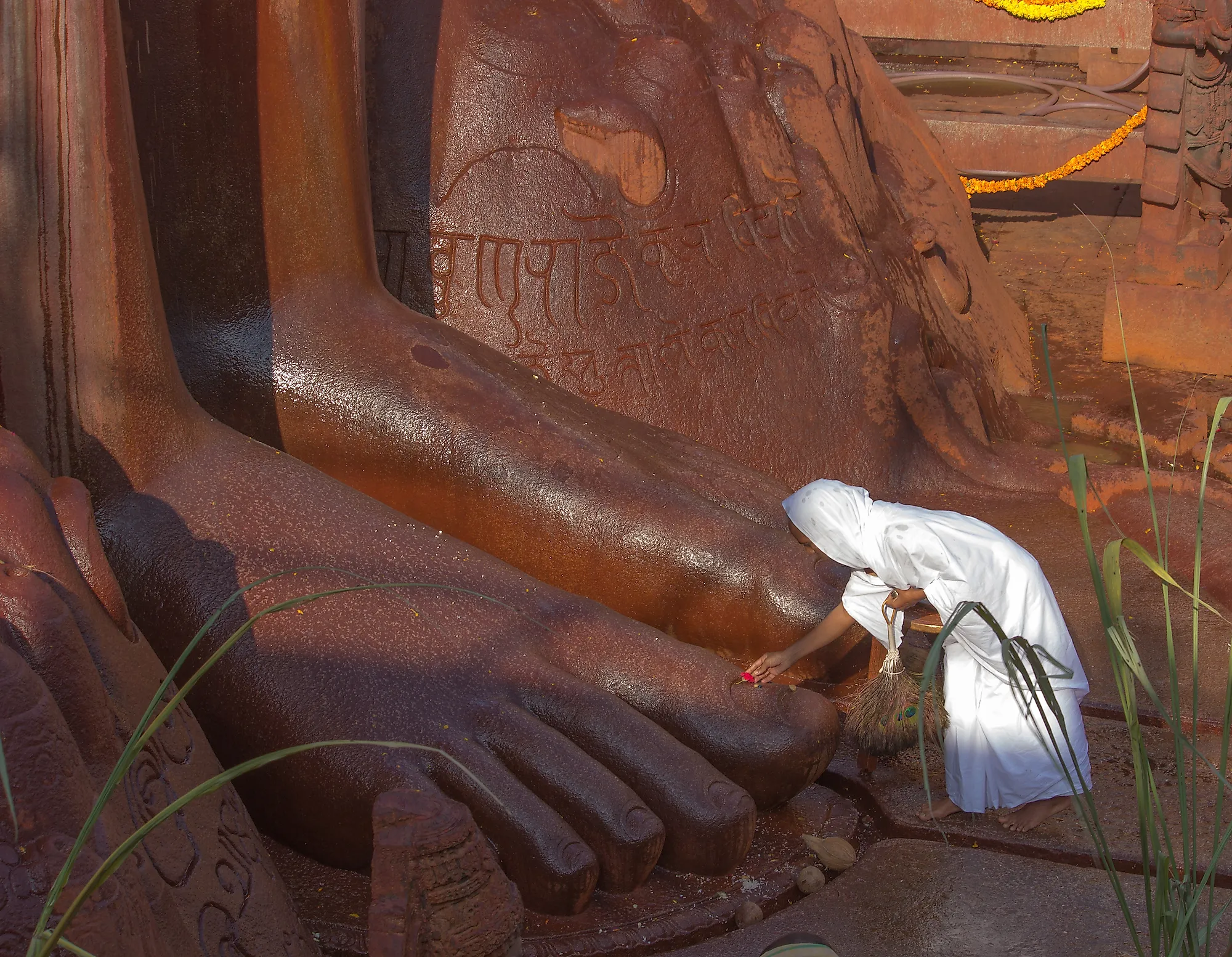
Several rulers of the Magadha kingdom's Haryanka dynasty, including King Bimbisara (also called Srenika) and his son Ajatashatru, are remembered in Jain tradition as patrons of Mahavira and his community. A long-running Jain tradition also holds that Chandragupta Maurya, the founder of the Mauryan Empire, abdicated late in life to become a disciple of the Jain teacher Acharya Bhadrabahu and ended his life through sallekhana at Shravanabelagola in present-day Karnataka, where the site is still a major Jain pilgrimage destination.
Jainism's relationship with later Muslim rule was uneven rather than uniformly hostile. Some periods of the Delhi Sultanate saw the destruction of Jain temples, as did individual military campaigns. Under the Mughals, by contrast, the picture was largely the opposite. Akbar, in particular, hosted Jain teachers like Hiravijaya at his court, issued farmans protecting Jain pilgrimage sites such as Palitana, banned animal slaughter during the Jain festival of Paryushana, and exempted Jain pilgrims from the jizya tax. Jainism continued to flourish in Gujarat, Rajasthan, and Karnataka throughout this period.
Jainism Today

India remains the global center of Jainism. The 2011 Census of India, the most recent comprehensive count, recorded 4,451,753 Jains in the country, about 0.37 percent of India's population. Roughly three-quarters live in just four states: Maharashtra, Rajasthan, Gujarat, and Madhya Pradesh.
The largest Jain diaspora is in the United States, where estimates range from about 80,000 to 200,000, depending on the source and definition. Most US Jains arrived after the 1965 Immigration Act, with the first formal Jain center established in New York in the 1970s. Kenya hosts a long-established East African Jain community founded by Gujarati merchants in the late 19th and early 20th centuries. The United Kingdom received a large secondary wave of Jain migration after Idi Amin expelled South Asians from Uganda in 1972. Smaller communities exist in Canada, Australia, Belgium (where Jains have played a notable role in the Antwerp diamond trade), and several other European countries.