Sikhism
Sikhism (Punjabi: Sikhī) is a monotheistic religion founded by Guru Nanak Dev Ji (1469-1539) in the greater Punjab region of the Indian subcontinent. Sikhs follow the teachings of Guru Nanak and his nine successors, collectively known as the Ten Gurus. The eternal Guru of the Sikh community today is the sacred scripture, the Sri Guru Granth Sahib. Sikhism counts an estimated 27 to 30 million followers worldwide. It is one of the largest world religions and the youngest of the major religious traditions that includes Hinduism, Buddhism, Jainism, Judaism, Christianity, and Islam.
The Founding by Guru Nanak Dev Ji

Guru Nanak Dev Ji was born in 1469 at Rai Bhoi Di Talwandi, the town now known as Nankana Sahib in present-day Punjab province of Pakistan. From his early years he taught that there is one God, accessible to all people directly, and that distinctions of caste, gender, religion, or social rank carry no spiritual weight before the Divine. Around the age of 30, Guru Nanak underwent a profound spiritual experience and began the teaching mission that would establish Sikhism as a distinct revelation.
Over roughly the next two decades, Guru Nanak undertook four major journeys (known as the Udasis), which by Sikh tradition took him across the Indian subcontinent, into Tibet and Sri Lanka, and west to Mecca, Medina, and Baghdad. During these journeys he engaged with religious teachers, ascetics, scholars, and ordinary people of every faith. Around 1521 to 1522 he settled at Kartarpur on the banks of the Ravi River, where he established the first Sikh community and lived until his death in 1539. The Sikh tradition does not view itself as a branch or reform of another religion. It is a distinct path revealed through Guru Nanak, with its own scripture, ethics, and identity.
Core Teachings and Beliefs

The word Sikh in Punjabi means “disciple” or “learner.” Sikhs are those who follow the teachings of the Ten Gurus and the Sri Guru Granth Sahib. The core theological commitment is to the One God, referred to by many names that emphasize different aspects of the Divine: Ik Onkar (“One Creator / There is One”), Akal (“the timeless”), Nirankar (“the formless”), and Waheguru (“Wondrous Lord”). God in Sikh theology is beyond gender, beyond form, beyond birth and death, present everywhere, and accessible to anyone through devotion regardless of background.
The everyday practice of Sikhism is anchored in the Three Pillars taught by Guru Nanak:
- Naam Japna: remembering and meditating on God’s name and presence.
- Kirat Karni: earning a living through honest, ethical work.
- Vand Chhakna: sharing one’s earnings and time with others, especially those in need.
Sikhism teaches the radical equality of all human beings. The caste system is explicitly rejected, as is gender inequality, religious supremacism, and discrimination based on race or social standing. Empty ritualism, idol worship, superstition, asceticism, and pilgrimage as ends in themselves are also rejected. What matters is sincere devotion expressed through daily life. Sewa (selfless service) is a central practice, performed in the Gurdwara, in the community, and toward strangers.
The Sri Guru Granth Sahib

The Sri Guru Granth Sahib is the eternal Guru of the Sikhs and the central sacred scripture of the religion. The first compilation, called the Adi Granth, was completed in 1604 by Guru Arjan Dev Ji, the Fifth Guru, who installed it ceremonially at Sri Harmandir Sahib in Amritsar on September 1, 1604. The scripture was later expanded by the Tenth Guru, Guru Gobind Singh Ji, who added the compositions of his father, Guru Tegh Bahadur Ji.
The Sri Guru Granth Sahib is written in Gurmukhi script and consists of 1,430 angs (the Sikh term for the scripture’s pages, meaning “limbs”) containing about 5,894 shabads (hymns). It is organized according to 31 musical ragas (melodic frameworks) and is intended to be sung. The scripture includes hymns not only from the Sikh Gurus but also from fifteen Bhagats (saints) of other religious traditions, including the Sufi mystic Sheikh Farid and the Hindu saints Kabir, Namdev, Ravidas, Trilochan, and Dhanna. This inclusion reflects Sikhism’s recognition of truth wherever it appears.
Before his death in 1708 at Nanded, Guru Gobind Singh Ji, the Tenth and final human Guru, declared the Sri Guru Granth Sahib to be the eternal Guru of the Sikhs. From that day, Sikhs have not had a living human Guru. Spiritual guidance comes through the scripture itself.
The Gurdwara and the Sikh Community

A Gurdwara (literally “door to the Guru”) is the Sikh place of worship. Sikhism does not have a priesthood: any baptized Sikh in good standing can read from the Sri Guru Granth Sahib and lead services. The official caretaker and reader at a Gurdwara is the Granthi, but the Granthi is not a priest in the doctrinal sense. People of all faiths and backgrounds are welcome in any Gurdwara.
Every Gurdwara operates a langar, a free community kitchen open to all visitors regardless of religion, caste, gender, or economic status. Diners sit together in rows (pangat) on the floor to eat, a deliberate practice that affirms the equality of all people. The institution of the langar was established by Guru Nanak Dev Ji and developed by his successors as a living embodiment of the Three Pillars: meditation, honest work, and sharing.
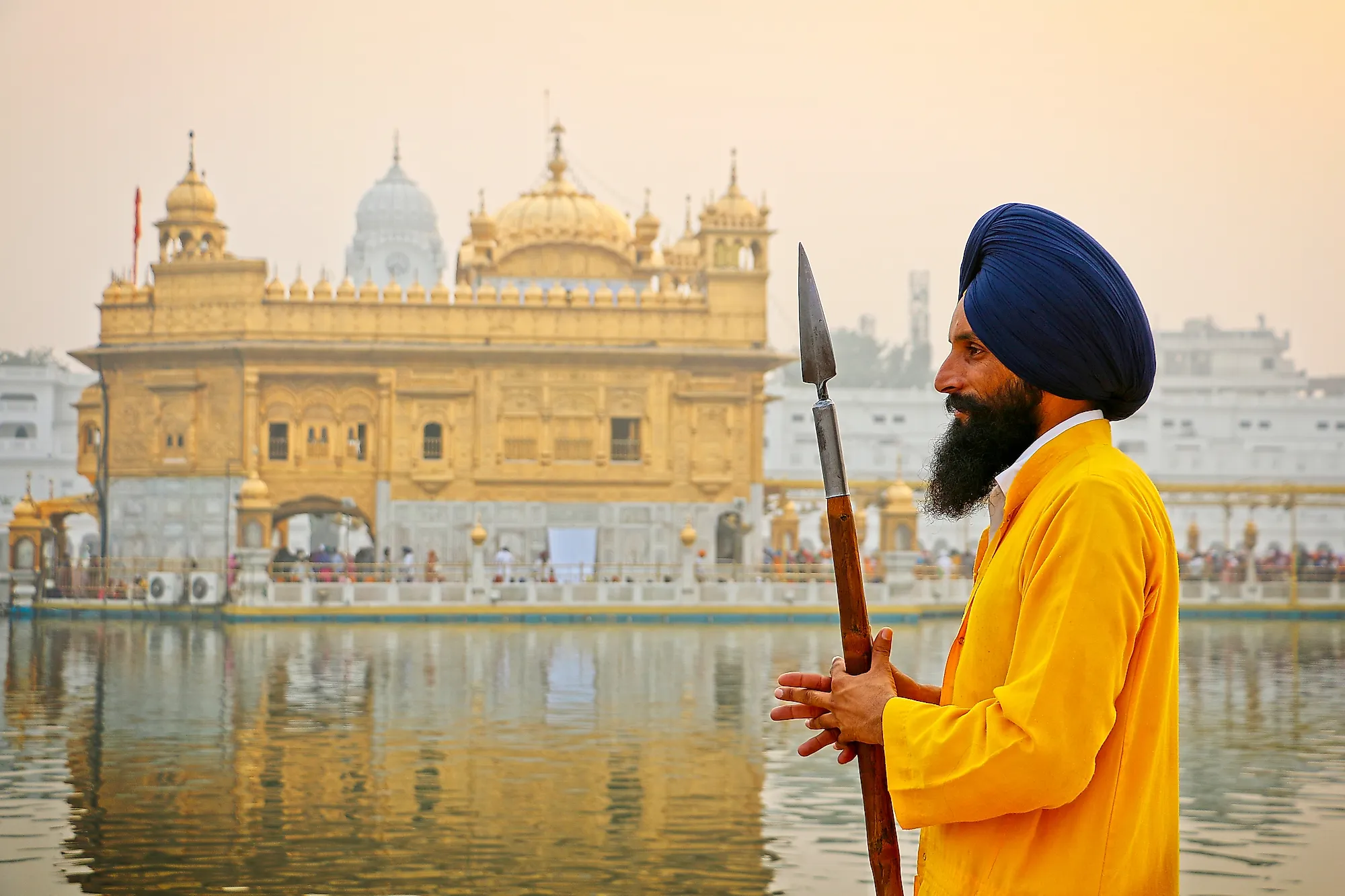
The holiest Sikh shrine is Sri Harmandir Sahib, popularly known as the Golden Temple, in the city of Amritsar in the Indian state of Punjab. The city itself was founded by the Fourth Guru, Guru Ram Das Ji, around 1577. The foundation stone of Sri Harmandir Sahib is traditionally said to have been laid in 1589 by Sai Mian Mir, a respected Sufi Muslim saint of Lahore and a close friend of Guru Arjan Dev Ji. The gilding of the temple’s exterior in gold leaf was commissioned by Maharaja Ranjit Singh in the early 19th century, the origin of the “Golden Temple” name. The site receives more than 100,000 visitors daily and is served by what is widely regarded as the largest community kitchen in the world.
The Khalsa and the Five Ks

On Vaisakhi day, April 14, 1699, at Anandpur Sahib, the Tenth Guru, Guru Gobind Singh Ji, established the Khalsa (“the pure”), the formal community of initiated Sikhs committed to upholding the highest Sikh ideals of devotion, ethical conduct, courage, equality, and service. Initiation into the Khalsa is through a ceremony called Amrit Sanchar. Initiated Sikh men take the name Singh (“lion”) and women take the name Kaur (“princess”), names that emphasize spiritual dignity and equality and dissolve the inherited caste markers that surname traditions had carried.
Khalsa Sikhs wear the Five Ks, five articles of faith intended as a continuous physical and spiritual reminder of their commitment:
- Kesh: uncut hair, kept covered with a turban (the dastaar).
- Kangha: a small wooden comb worn in the hair, symbolizing cleanliness and order.
- Kara: a steel bracelet worn on the wrist, a reminder of ethical conduct.
- Kirpan: a small ceremonial sword, representing the obligation to defend the weak and uphold justice.
- Kachera: a specific style of cotton undergarment, representing self-discipline and modesty.
The Khalsa observes a code of conduct known as the Rehat Maryada, the standard Sikh code adopted in 1945 by the Shiromani Gurdwara Parbandhak Committee, which governs daily practice, life rituals, and observances.
Historical Development

The succession of the Ten Gurus spans from 1469 (the birth of Guru Nanak Dev Ji) to 1708 (the death of Guru Gobind Singh Ji). During this period the Sikh community grew from a small congregation around Guru Nanak into an established religious community with its own scripture, sacred sites, and institutions, and into significant political conflict with the Mughal Empire.
Two of the Gurus were martyred under Mughal rule. Guru Arjan Dev Ji, the Fifth Guru, was executed in 1606 under Emperor Jahangir, after which the Sikhs took up arms in self-defense under his son and successor, Guru Hargobind Ji. Guru Tegh Bahadur Ji, the Ninth Guru, was executed in Delhi in 1675 under Emperor Aurangzeb after publicly defending the right of Kashmiri Pandits (Hindus) to practice their religion freely. His martyrdom for the religious liberty of another faith community is remembered as one of the defining acts of Sikh history.
After Guru Gobind Singh Ji’s death in 1708 at Nanded, Sikh political and military power grew through the 18th century. The Sikh confederacy of twelve military bands (misls) consolidated under Maharaja Ranjit Singh, who founded the Sikh Empire in 1799 with the capture of Lahore and was formally enthroned in 1801. At its peak, the Sikh Empire covered most of present-day Punjab, Kashmir, Khyber Pakhtunkhwa, and parts of Afghanistan, and it was the last independent power to fall to the British in India. Following defeat in the Second Anglo-Sikh War, the Punjab was annexed by the British East India Company in 1849.
Sikhism Today

The global Sikh population is estimated at 27 to 30 million. India remains the spiritual and demographic center, with around 22 to 25 million Sikhs living there, the heaviest concentration in the state of Punjab and significant communities in Haryana, Delhi, Rajasthan, Uttarakhand, Uttar Pradesh, Himachal Pradesh, Chandigarh, and Jammu and Kashmir.
The Sikh diaspora has grown substantially in recent decades. According to the 2021 census of Canada, approximately 771,790 Sikhs live in Canada, making it the largest Sikh community outside India and one of the most politically and culturally established Sikh communities anywhere. The 2021 census of England and Wales recorded approximately 524,140 Sikhs in the United Kingdom. The 2021 Australian census recorded approximately 210,397 Sikhs, making Sikhism one of the fastest-growing religions in Australia. The United States is home to an estimated 500,000 to 700,000 Sikhs, with the largest concentrations in California (especially the Yuba City area and the Central Valley), the New York and New Jersey metropolitan area, and the Pacific Northwest. Sikhism also has long-established communities in Malaysia, Singapore, Thailand, the Philippines, Italy, and East Africa, and a growing presence in the Middle East driven by professional and labor migration.
Sikh communities around the world remain anchored in the institutions established by the Ten Gurus: the Gurdwara as a place of worship and community, the langar as a daily expression of equality and service, the Sri Guru Granth Sahib as the eternal Guru, and the Three Pillars of meditation, honest work, and sharing as the framework for daily life.
Major Sikh Populations Worldwide
| Country | Estimated Sikh Population | Approximate Share of Global Sikh Population |
|---|---|---|
| India | 22 to 25 million | ~85% |
| Canada | 771,790 (2021 census) | ~2.7% |
| United States | 500,000 to 700,000 (estimate) | ~2.0% |
| United Kingdom | 524,140 (2021 England and Wales census) | ~1.9% |
| Australia | 210,397 (2021 census) | ~0.8% |
| Italy | ~70,000 to 150,000 | ~0.3% to 0.5% |
| Malaysia | ~100,000 | ~0.4% |
| Thailand | ~70,000 | ~0.2% |
| Philippines | ~50,000 | ~0.2% |
| East Africa (Kenya, Uganda, Tanzania) | ~30,000 to 50,000 | ~0.1% to 0.2% |